By Flin Jaggy, physiotherapist at Kineo Wipkingen
Steady on your feet: why balance can be trained
A wet pavement, a kerb in the dark, a rug that curls up: most falls happen in completely everyday situations. Perhaps you have tripped and only just caught yourself, or you notice that you reach for the handrail more often on the stairs. Some people deliberately leave the house less after a fall, for fear it will happen again.
The good news: balance is not fixed. You can train it at any age. Targeted balance and strength training is one of the best-researched measures for preventing falls in older people.
How your balance works
For you to stand and walk safely, several systems work together:
- Eyes: they provide information about your surroundings and the position of your body in space.
- Balance organ in the inner ear: it registers rotations and accelerations of your head.
- Deep sensation (proprioception): receptors in your feet, joints and muscles report how you are standing and what the ground feels like.
- Brain and muscles: your brain processes all the information, and your muscles carry out the corrections quickly and strongly enough.
If one of these systems weakens, the others can compensate for a lot, as long as they are trained. This is exactly where training comes in.
What increases your risk of falling
- Declining strength in your legs and hips, especially the ability to react quickly
- Previous falls and fear of falling
- Dizziness, vision problems or reduced sensation in your feet, for example with polyneuropathy
- Certain medications or taking many different medications
- Trip hazards at home, poor lighting and unsuitable footwear
- Little movement in everyday life

Warning signs: when to see a doctor
- A fall with no obvious reason, for example with brief loss of consciousness or your vision going black
- Newly occurring rotational vertigo or dizziness with hearing loss
- Sudden unsteadiness when walking, paralysis, a drooping corner of the mouth or speech problems: this can be a stroke. Call the emergency number 144 immediately.
- Rapidly increasing numbness or weakness in your legs
- Pain after a fall, especially in the hip or wrist
What you can do yourself
- Practise daily: short balance exercises are easy to build into everyday life, for example while brushing your teeth or at the kitchen counter.
- Train your strength: strengthen your legs and hips two to three times a week. Balance without strength stays wobbly.
- Check your home: remove loose rugs, secure cables, have good light on the stairs and on the way to the toilet at night.
- Good shoes: sturdy shoes with non-slip soles instead of open slippers.
- Eyes and medication: have your eyesight checked regularly and talk to your doctor about medications that make you dizzy or tired.
Five balance exercises for home
Always practise at a stable spot, for example at the kitchen counter, so you can hold on if needed.
- Tandem stance: place one foot directly in front of the other, heel to toe. 3 x 30 seconds, then switch feet.
- Single-leg stance: stand on one leg with your hand just above the counter. 3 x 20 to 30 seconds per side. Progression: turn your head or briefly close your eyes.
- Sit to stand: stand up from a chair without using your arms and sit down slowly. 3 x 10 repetitions.
- Toe and heel stand: alternate between standing on your tiptoes and on your heels. 2 x 10 repetitions.
- Walking on a line: walk forwards heel to toe for 10 steps, turn round and come back. 3 rounds.
The exercises should be challenging. Once you can do them safely, it is time for the next level. Balance training works best when you do it regularly over several months.
How we work at Kineo
We find out where your unsteadiness comes from and build a training plan that challenges you specifically without putting you at risk.
1. Our check before we start
- Timed Up and Go test: stand up, walk three metres, turn round, walk back and sit down
- 30-second sit-to-stand test: a simple measure of leg strength
- Balance tests: feet together, tandem stance and single-leg stance with eyes open and closed
- Walking with an extra task: walking while counting or talking shows how much attention your gait needs
- Sensation in your feet and dizziness screening to identify other causes
2. How we build your training
- Weeks 1 to 4: basics. Static balance exercises, sit to stand, leg strengthening, 2–3 sets each. Plus a short home programme for every day.
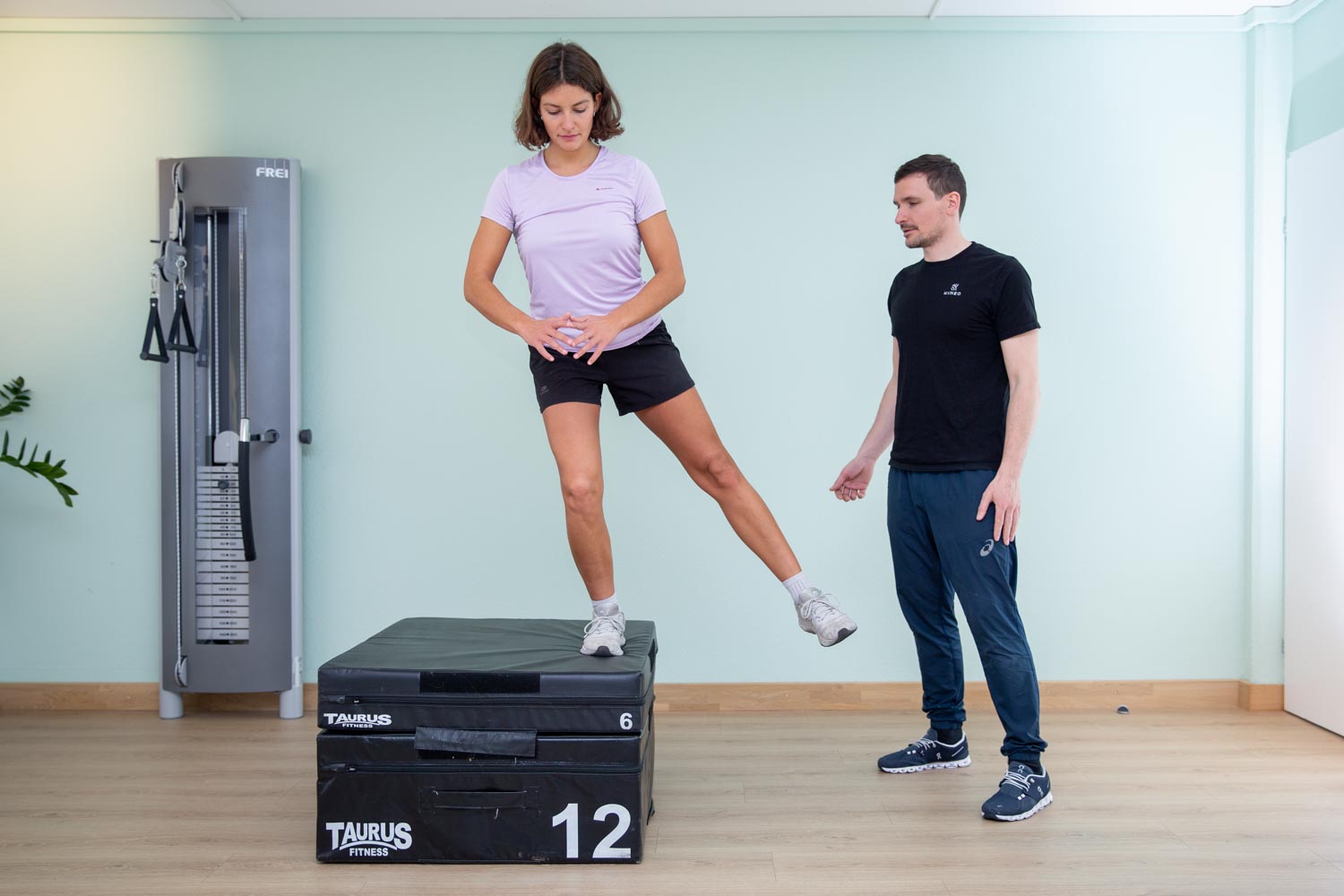
- Weeks 4 to 8: dynamics. Weight shifts, steps in all directions, training on uneven surfaces and on the Sensopro.
- From week 8: everyday life and reactions. Walking with extra tasks, changes of direction, stairs and practising getting up from the floor.
3. Kineo services we use
- Sensopro training for reactive balance training on a moving surface in a safe environment
- Medical training therapy to build strength in your legs, hips and trunk
- Physiotherapy for dizziness when dizziness contributes to your unsteadiness
- General physiotherapy for assessment and support, for example after a fall
- Digital home programme for your daily balance training at home
From our practice
After a fall, many people move more cautiously and less. That is understandable, but it makes the legs weaker and balance less secure. In training, we often see how quickly confidence returns when people discover in a safe environment that they can do more than they thought. This confidence is at least as important as the exercises themselves.
Balance training in Wipkingen
At Kineo Wipkingen, Röschibachstrasse 79 on Röschibachplatz, the Sensopro coordination trainer stands on our training floor. There are also strength machines, a rack and a bike ergometer for building strength. This way you train balance and strength in the same place, with supervision. Find out more about the location on the Kineo Wipkingen page.
Frequently asked questions
Am I too old to improve my balance?
No. Balance and strength can be improved into old age. What matters is that the exercises match your level and that you do them regularly.
How often should I practise?
Balance exercises ideally every day for a few minutes, strength training two to three times a week. The effect usually shows after a few weeks.
How long does an appointment last?
An appointment lasts 30 minutes. In your first session we clarify the cause and start straight away with treatment and exercises.
Does health insurance cover physiotherapy?
Yes. With a doctor's prescription, your basic health insurance covers the cost. Kineo is recognised by all Swiss health insurers.
You might also like
- Dizziness and balance disorders
- Osteoporosis and strength training
- Sensopro: targeted coordination training
Book an appointment
Want to feel steadier on your feet again? Book your appointment at Kineo Wipkingen and we will start your balance training.