By Flin Jaggy, physiotherapist at Kineo Wipkingen
Getting moving again, but how?
After weeks or months of illness, a lot feels different. The stairs to the second floor leave you breathless, your legs are weak, and after a short walk you’re exhausted. At the same time, you want to get back to your everyday life, to work, perhaps to sport.
Whether after a serious infection, a hospital stay, an operation or cancer treatment: getting back into exercise works best when it is planned and gradual. In this article, we show you what to look out for.
What long illness does to the body
If you’ve been ill for a long time and couldn’t be very active, you lose strength and endurance. Clinically, this is called deconditioning. The leg muscles, which we need for getting up, walking and climbing stairs, decline particularly quickly. The heart and circulation also adapt to the lower load. That’s why your pulse rises sharply even with small efforts.
On top of that, there is often uncertainty and anxiety: what can I trust myself to do? Is it normal that I get tired so quickly? These questions are justified. And they are a good reason not to plan your return alone.
Before you start: medical clearance
Talk to your doctor before getting back into exercise, especially after heart or lung disease, after cancer treatment, after a thrombosis or if you are taking medication that affects your pulse or blood pressure. Clarify whether there are any restrictions, for example on lifting or intensity.
Caution with exhaustion after exertion: if your symptoms get significantly worse with a delay after exertion, for example the next day or the day after, this may indicate so-called exercise intolerance, as seen in long COVID or ME/CFS, for example. In that case, gradually increasing according to a plan is not the right approach. Medical assessment and a very cautious approach with pacing are needed here.
Warning signs: stop immediately
Stop training and seek medical help if any of these signs occur:
- Pain, pressure or tightness in the chest
- Marked shortness of breath that doesn’t ease quickly at rest
- Dizziness, light-headedness or a racing or irregular pulse
- A swollen, warm or painful calf on one side
- Fever or a clear feeling of being unwell
What you can do yourself
These basic rules help with almost any return to exercise:
- Start small: for example, walk for 5–10 minutes once or twice a day. Better too little than too much.
- Use the talk test: you should still be able to speak in full sentences while moving.
- Rate your effort: on a scale of 0 to 10, start in the 3–4 range, i.e. “light to somewhat hard”. This scale is called the Borg scale and is also used in therapy.
- Watch the next day: if you feel similar the next day to before, you can increase slowly. If you are clearly more exhausted, stay at that level or take a step back.
- Duration first, then intensity: first longer walks, then hills or a faster pace.
- Don’t forget strength: sit-to-stand from a chair, calf raises at the kitchen counter and wall push-ups, 2 x 8–10 each, on two to three days a week.
How we support your return at Kineo
We start where you are today and plan the way back into your everyday life together.
1. Assessment: what we examine in your first session
- History and medical guidelines: illness, treatment, medication, restrictions
- Pulse, blood pressure and oxygen saturation at rest and under light load, where useful
- 30-second sit-to-stand test: how many times can you stand up from a chair in 30 seconds without using your arms?
- 6-minute walk test or a shorter walk test as an endurance value
- Balance, for example standing on one leg and standing with your eyes closed
- Perceived exertion and recovery after exercise, including the next day
2. Treatment in phases
- Weeks 1–2: lay the foundation. Short sessions of walking or the bike ergometer at 3–4 out of 10, simple bodyweight strength exercises, breathing exercises if needed.
- Weeks 3–6: build up. Extend endurance to 20–30 minutes, strength training on machines with 2–3 x 10–12 repetitions, two to three times a week.
- Weeks 6–12: everyday life and goals. Stairs, carrying, bending and, if desired, first sport-specific elements. Progression always depends on the reaction the next day.
- Ongoing: repeating the initial tests so you can see how far you’ve come.
3. Kineo services we use
- Medical training therapy: strength and endurance training on machines with precise dosing
- General physiotherapy for assessment, breathing exercises and support through all phases
- Senso Pro training for balance and coordination when your legs are still unsteady
- Physiotherapy for dizziness when dizziness makes the return harder
- Digital home programme for the days between appointments
An example for the first weeks
This is what a weekly plan could look like at the start. It is an example and must be adapted to your situation:
- Monday: walk for 10 minutes, then sit-to-stand from a chair and wall push-ups, 2 x 8 each
- Tuesday: walk for 10 minutes
- Wednesday: rest or gentle mobilisation
- Thursday: walk for 12 minutes, strength exercises as on Monday
- Friday: walk for 10 minutes
- Weekend: a relaxed walk, strength exercises as you feel
After one to two weeks without a negative reaction, extend your walking time by a few minutes or add a third strength exercise.

From our practice
A typical pattern: after a long illness, things suddenly get better, and then everything is made up for at once. A few days later comes the crash. Those who instead increase patiently in small steps usually come back faster and more sustainably, even if it feels too slow at first.
Getting back into exercise at Kineo Wipkingen
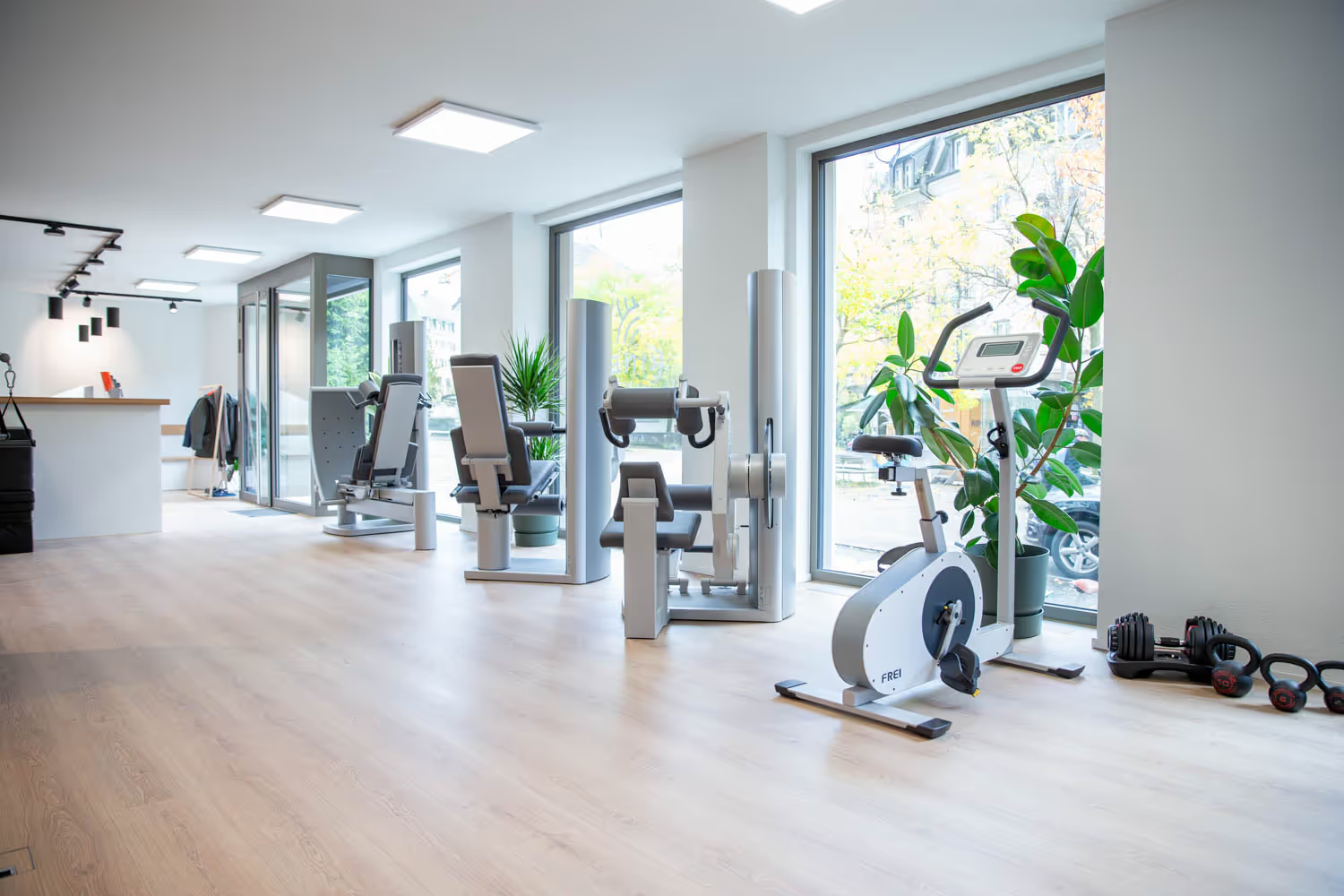
At Kineo Wipkingen at Röschibachstrasse 79 on Röschibachplatz, we combine physiotherapy and training in the same space. With a bike ergometer, strength equipment and the Sensopro coordination trainer, we can dose endurance, strength and balance very precisely. Find out more about the location on the Kineo Wipkingen page.
Frequently asked questions
How soon can I do sport again?
That depends on the illness, its duration and your starting level. Rebuilding often takes about as long as the period in which you were inactive, sometimes longer.
Is muscle soreness a bad sign?
Mild muscle soreness is normal. Severe exhaustion that lasts for days, on the other hand, is a sign that the load was too high.
Does health insurance cover physiotherapy?
Yes. With a doctor's prescription, your basic health insurance covers the cost. Kineo is recognised by all Swiss health insurers.
How long does an appointment last?
An appointment lasts 30 minutes. In the first session, we clarify the cause of your complaints and start straight away with treatment and first exercises.
You might also like
- Strength for everyday life from 60
- Fibromyalgia: exercise as therapy
- Physiotherapy with a prescription: how it works
Book an appointment
Want to get moving again after a long illness? Book an appointment at Kineo Wipkingen and we’ll plan your return step by step.