
By Eva Danko, physiotherapist at Kineo Wipkingen
Osteoporosis: why strength training matters most now
A diagnosis of osteoporosis unsettles many people. Can I still lift weights? Is bending over dangerous? Do I have to be careful now so that nothing breaks? This uncertainty often leads people to move less. The opposite is what matters.
Bones are living tissue. They adapt to the load they experience. Targeted, supervised strength training is therefore one of the most important building blocks in osteoporosis, alongside medical treatment and a good supply of calcium, vitamin D and protein.
What osteoporosis is
In osteoporosis, bone mass is reduced and the inner structure of the bone is weakened. This raises the risk of fractures, especially in the vertebrae, hip, wrist and upper arm. Bone density is usually measured with a DXA scan. Diagnosis and drug treatment belong in medical hands.
Osteoporosis causes no symptoms for a long time. It is often discovered only after a fracture. Risk factors include the time after the menopause, older age, a family history, lack of exercise, being underweight, smoking and certain medications such as long-term cortisone therapy.
Why strength training helps your bones
- Mechanical stimulus: When muscles pull on the bone and the bone carries weight, bone formation is stimulated. What matters are loads that go clearly beyond everyday life.
- Muscle strength: Strong muscles protect your body in everyday movements and help you break a fall.
- Balance: Most fractures in osteoporosis result from falls. If you stand and walk with confidence, you fall less often.
- Posture: Strong back extensor muscles support an upright posture of the thoracic spine.
Walking and swimming are good for your heart and wellbeing. For your bones, however, they are usually not enough, because the stimulus is too low. You need progressive strength training, in which the load increases step by step.
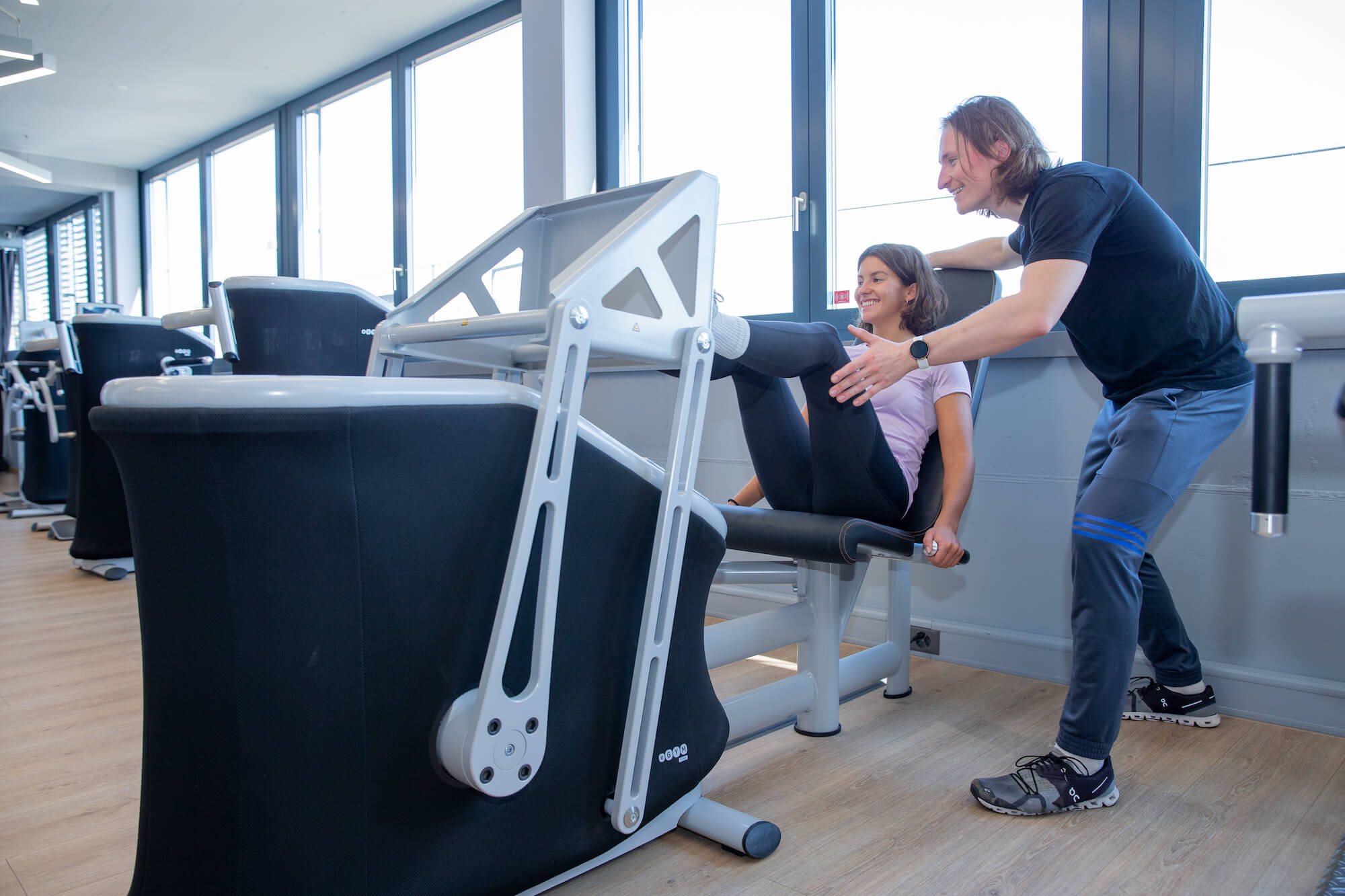
What to bear in mind when training
- Keep your back long: It is better to avoid repeatedly rounding your back under load, as in sit-ups or touching your toes with straight legs. Bend from the hips instead.
- No fast twisting under load: Do rotation movements with weight in a controlled way, or leave them out.
- Increase slowly: Start with a load you can manage cleanly and increase it over weeks.
- Regularity: Two to three strength sessions a week, plus daily balance training.
- After a vertebral fracture: Training is adapted individually. Be sure to get guidance for this.
You should get checked by a doctor for sudden, severe back pain without a clear accident, especially if you have osteoporosis. A noticeable loss of height or an increasing rounding of the back should also be looked at by a doctor, because they can point to vertebral fractures.
How we support your training with osteoporosis at Kineo
We start by taking stock of your strength, your balance and your history, and build a training programme from that which is safe and still provides enough stimulus.
1. Our check before you start
- History: Earlier fractures, bone density results, pain and the guidance from your doctor
- 30-second chair stand test: How many times you can stand up from a chair in 30 seconds without using your arms
- Timed Up and Go test: Stand up, walk three metres, turn around, walk back and sit down. A measure of mobility and fall risk.
- Balance: Single-leg stand and tandem stand, that is, one foot directly in front of the other
- Posture and mobility: Thoracic spine, hips and shoulders
2. How we build your training
- Weeks 1 to 4: learning technique. Hip hinges, squats, rows and support exercises with little weight. The focus is on clean movement and a long back.
- Weeks 4 to 12: increasing the load. Two to three times a week, 2–3 sets of 8 to 12 repetitions each. The last repetitions should feel demanding.
- From month 3: keep challenging yourself. Heavier loads with fewer repetitions and, if your doctor has no objection, light impact loading such as heel drops.
- Alongside: Balance training and strengthening of the back extensors as a fixed part of every session.
3. Kineo services we use
- Medical training therapy at the core: supervised, progressive strength training on machines and with free weights
- Sensopro training for balance and reaction on an unstable surface in a safe environment
- General physiotherapy for back pain or after a fracture
- Digital home programme for the exercises you do regularly at home
Five basic exercises for osteoporosis
- Standing up from a chair: Stand up without using your arms and sit down slowly. 3 x 10 repetitions. Later with a weight held at your chest.
- Hip hinge with a kettlebell: Lift the weight from the floor or from a raised surface, back long, movement from the hips. 3 x 8 to 10 repetitions.
- Row: On the cable machine or with a band, shoulder blades back and down. 3 x 10 to 12 repetitions.
- Back extension lying on your front: Lift your chest and arms a few centimetres off the floor, looking at the floor. 2 x 8 to 10 repetitions.
- Heel drops: Stand on your toes and let your heels drop firmly to the floor. 2 x 10. Only after checking with your doctor or physiotherapist, and not with recent fractures.

From our practice
Many people with osteoporosis come expecting that they may only train very gently. When, under guidance, they discover that they can lift more than they thought, their sense of their body often changes too. If you trust your body again, you move more safely, and with osteoporosis that is an important protection.
Strength training in Wipkingen
At Kineo Wipkingen at Röschibachstrasse 79 on Röschibachplatz, you train on a training floor with strength machines, a rack and a bike ergometer. For balance, the Sensopro coordination trainer is ready to use. This way you combine strength and balance training with physiotherapy support. You can find out more about the location on the Kineo Wipkingen page.
Frequently asked questions
Isn't heavy lifting dangerous with osteoporosis?
With good technique, slow progression and guidance, strength training is generally safe even with osteoporosis. What matters is the right execution and a load that suits you.
Does training replace medication?
No. Training complements medical therapy. Whether medication makes sense, and which, is something to discuss with your doctor.
How long does an appointment last?
An appointment lasts 30 minutes. In your first session we establish the cause and start straight away with treatment and exercises.
Does health insurance cover physiotherapy?
Yes. With a doctor's prescription, your basic health insurance covers the cost. Kineo is recognised by all Swiss health insurers.
You might also like
Book an appointment
Do you want to train safely and strongly despite osteoporosis? Book your appointment at Kineo Wipkingen and we will get started together.