By Pablo Moreno Aguilar, physiotherapist at Kineo Wipkingen
Training on a moving surface
You stand on stable ground, do a squat and everything feels secure. Then you slightly roll your ankle while jogging on a forest path, or your knee wobbles when you push off after an injury. In everyday life and in sport, the ground is rarely perfectly still. That is exactly why you need good coordination: the ability to react in a split second to disturbances.
The Sensopro is a coordination trainer with which exactly this ability can be trained in a targeted way. At Kineo Wipkingen, we use it in rehab, prevention and training.
What the Sensopro is
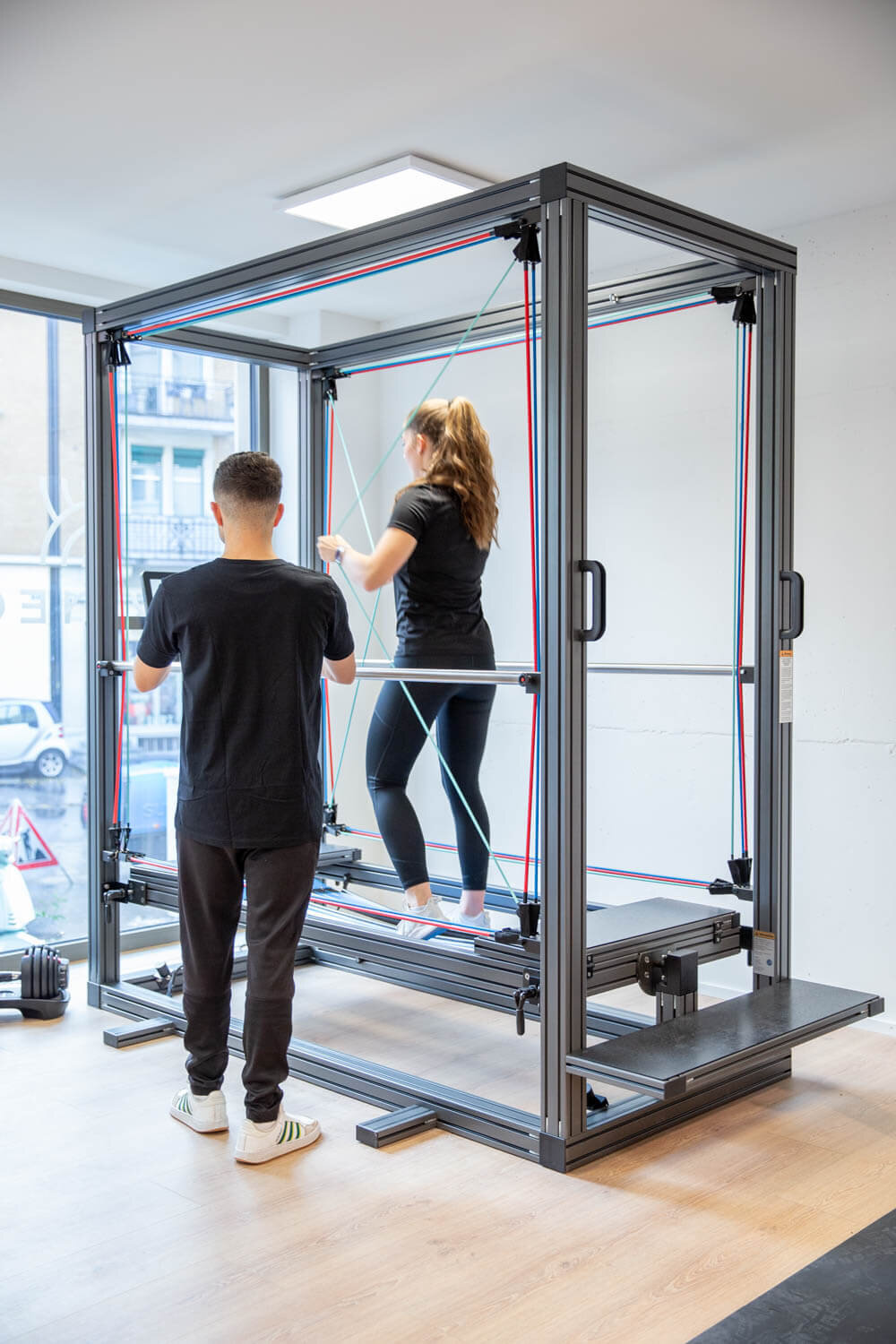
On the Sensopro, you stand on footplates suspended from a rope system. The surface under your feet moves with every small shift of weight. Your body has to compensate constantly so that you stay stable. A frame around you gives you support when you need it.
The difference from a wobble board or cushion: the ropes react quickly and in several directions, and on the device you can not only stand but also perform dynamic movements such as squats, weight shifts or quick changes. This brings the training closer to the demands of everyday life and sport.
What coordination training achieves
- Deep sensitivity (proprioception): Receptors in your feet, ankles and knees constantly report how you are standing. Training helps you make better use of this feedback.
- Reactivity: Your muscles learn to respond faster and more precisely to disturbances.
- Joint stability: Ankle, knee and hip are stabilised actively, instead of only passively by ligaments.
- Interplay: Trunk, hips and legs work together as a chain.
An important note: coordination training does not replace strength training. The two complement each other. Only when the muscles have enough strength can they also carry out the corrections effectively.
Who Sensopro training suits
- After an ankle injury: Balance training is considered an important building block in preventing repeated ankle sprains.
- After knee injuries and knee operations, for example after a cruciate ligament tear or meniscus procedure, once wound healing is complete and the leg can bear enough load
- Athletes in running, ball and mountain sports who have to master quick changes of direction and uneven terrain
- Older people who want to improve their balance and prevent falls
- People who feel unsteady when walking, for example with reduced sensation in the feet
The training is not suitable for fresh injuries that are not yet allowed to bear weight, and for unexplained dizziness. After operations too, we decide on the start together with the instructions from your treating doctor.
How we work at Kineo
At our practice, Sensopro training is part of an overall plan. We first check where you stand, and we continuously adapt exercises and difficulty.
1. Our check before starting
- Single-leg stance: With eyes open and closed, compared side to side
- Y-Balance Test: You stand on one leg and reach as far as possible with the other foot in three directions. Differences between left and right become visible.
- Single-leg squat: Checking leg alignment, pelvis and trunk
- Strength compared side to side: calf, thigh and hip
- History and goals: injury, operation, sport or everyday situation in which you want to feel more confident
2. How we build up your training
- Level 1: Calm stance. Standing on both legs, shifting weight, small squats. Intervals of 30 to 45 seconds, 3 to 4 rounds with a rest.
- Level 2: Dynamics. Deeper squats, split stance, quick switches between the legs. Intervals of 45 to 60 seconds.
- Level 3: Making it harder. Additional tasks such as catching a ball, turning the head or briefly closing the eyes, depending on goal and safety.
- Transfer: We transfer the stability you have gained to jumps, landings, changes of direction or walking in everyday life.
3. Kineo services we use
- Sensopro training as the core of coordination training on the rope system
- Medical training therapy for the strength building that complements coordination
- Sports physiotherapy for the return to sport after an injury
- Sport-specific training with jumps, landings and changes of direction
- General physiotherapy for assessment and treatment of the underlying problems
An example session
This is what a Sensopro sequence could look like after a healed ankle injury. It is part of a training session, not the whole session:
- Warm-up: 2 x 45 seconds of calm stance with a slight weight shift from left to right
- Squats: 3 x 45 seconds of controlled mini squats, knees over the middle of the foot
- Split stance: 3 x 30 seconds per side, weight more on the affected leg
- Quick switches: 3 x 20 seconds of brisk shifting between the legs
- Rest: 30 to 60 seconds between rounds
The exercises should be challenging but controllable. If the wobbling is so strong that you lose your posture, we choose an easier variation.

From our practice
Many patients are surprised how tiring even a few seconds on the Sensopro can be, even though the exercises look simple from the outside. Especially after ankle or knee injuries, the device often clearly shows that the affected leg is still less steady than the healthy one. This feedback is motivating, and the progress is usually easy to feel over time.
Sensopro in Wipkingen
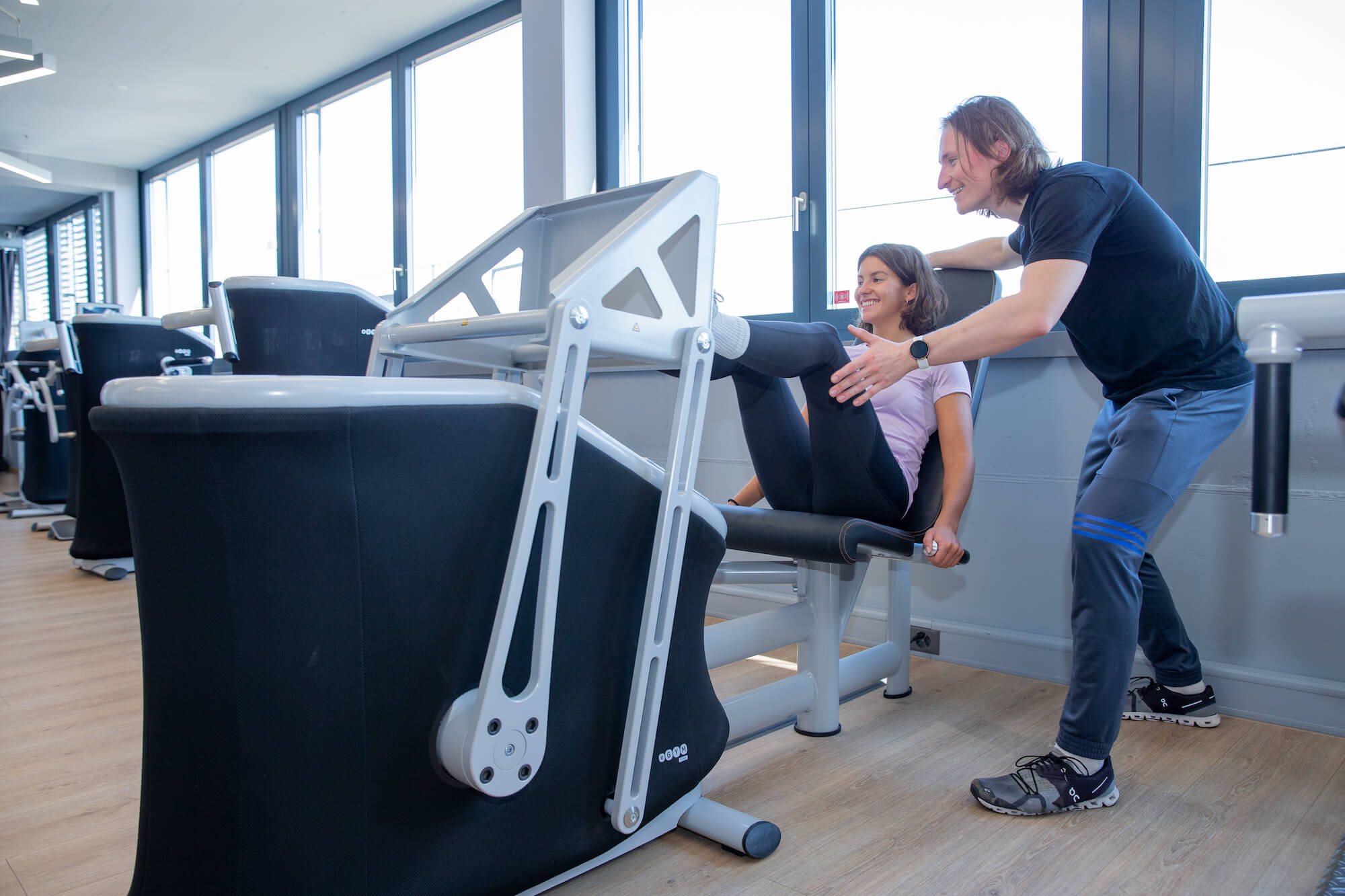
At Kineo Wipkingen at Röschibachstrasse 79 on Röschibachplatz, the Sensopro coordination trainer stands on our training floor, right next to strength machines, a rack and a bike ergometer. That way, coordination and strength training can be combined in one session. You can find more about the location on the Kineo Wipkingen page.
Frequently asked questions
Do I need any prior experience for Sensopro training?
No. The difficulty can be adjusted a great deal. You start at a level where you feel safe, and we progress step by step.
Can I fall on the Sensopro?
The frame around the footplates gives you support at all times, and we accompany you during training. Especially at the beginning, you hold on if you need to.
How long does an appointment take?
An appointment lasts 30 minutes. In your first session, we clarify the cause and start straight away with treatment and exercises.
Does health insurance cover physiotherapy?
Yes. With a doctor's prescription, your basic health insurance covers the cost. Kineo is recognised by all Swiss health insurers.
You might also like
- Ankle injury or instability
- Training balance and preventing falls
- Return to sport: when am I ready again?
Book an appointment
Do you want to improve your coordination in a targeted way? Book your appointment at Kineo Wipkingen and try Sensopro training.