By Pablo Moreno Aguilar, physiotherapist at Kineo Wipkingen
Scoliosis: what does it mean for you as an adult?
Perhaps you have known since school that your spine has a curve. Perhaps a doctor only recently told you after an X-ray. And now you have questions: Will it get worse? Can I keep doing sport, lifting heavy, jogging? And does my back pain come from the scoliosis?
The good news first: many adults with scoliosis live without major limitations and are active in sport. What matters is knowing your type of scoliosis and keeping your back strong and mobile.
What is scoliosis?
In scoliosis, the spine curves sideways when seen from behind and is at the same time twisted on itself. The curve is measured on the X-ray using the Cobb angle. From about 10 degrees, it is called scoliosis. Because of the twist, the ribs sit further back on one side. When you bend forward, this shows as a so-called rib hump.
In adults, there are mainly two types:
- Idiopathic scoliosis: It developed in childhood or adolescence without a clear cause and persists into adulthood. The main curve is often in the thoracic spine.
- Degenerative scoliosis: It only develops later in adult life through wear and tear of the discs and facet joints, mostly in the lumbar spine. It often occurs together with a narrowing of the spinal canal.
Typical symptoms
- Often none at all. Many cases of scoliosis are an incidental finding.
- Back pain and rapid fatigue when standing or sitting for a long time
- Uneven shoulders, pelvis or waist triangles, clothes sitting asymmetrically
- Muscular tension on one side of the back
- With degenerative scoliosis: pain or weakness in the legs when walking that improves when sitting or bending forward
Important: Not every back pain in scoliosis comes from the curve. Back pain is also very common in people without scoliosis, and the size of the curve says little about how much pain someone has.

Can the scoliosis still increase?
Small curves usually stay stable in adulthood. Larger curves can slowly increase even after growth has finished, and so can degenerative scoliosis. That is why follow-up checks by a doctor with an X-ray make sense for larger curves. Physiotherapy cannot "straighten" a fully developed scoliosis in adults. But it can help to reduce pain, improve strength and mobility and make you more resilient in everyday life.
Warning signs: when you should see a doctor
See a doctor if the curve visibly increases, you are getting shorter, new pain appears at night, your legs become weaker or numb, you have to stop earlier and earlier when walking, or you have problems with your bladder or bowel. Shortness of breath with very pronounced curves in the thoracic spine should also be assessed by a doctor.
Myths about scoliosis
- "With scoliosis I'm not allowed to lift heavy." In most cases, strength training is not only allowed but worthwhile. Clean technique and gradual progression are what matter.
- "I always have to train symmetrically." Sometimes deliberately one-sided training is helpful, because one side is weaker or less mobile.
- "Scoliosis comes from poor posture." Idiopathic scoliosis does not develop from sitting incorrectly. You have done nothing wrong.
- "Massage straightens the spine." Massage can release tension and feel good, but it does not change the curve.
How we treat scoliosis at Kineo
We do not treat the X-ray, we treat you, with your symptoms and goals. Whether it is pain in everyday life, fitness or sport, we shape the programme accordingly.
1. Assessment: what we examine in your first session
- Adams forward bend test: While you bend forward, we assess the rib hump and lumbar prominence, comparing both sides
- Posture and shape: shoulder and pelvis height, waist triangles, location of the main curve, X-ray findings if available
- Mobility: side bending and rotation of the spine as well as hip mobility, compared side to side
- Muscular endurance: back extensors in the Biering-Sørensen test, side plank left and right
- Neurology: strength, sensation and reflexes of the legs, walking distance if a narrow spinal canal is suspected
- Breathing: how well your rib cage moves on both sides
2. Treatment in phases
- Phase 1, weeks 1–3: Pain and awareness. Soft tissue techniques, mobilisation, breathing exercises and exercises with which you consciously perceive your posture and can straighten up actively.
- Phase 2, weeks 3–8: Strength and control. Targeted strengthening of the trunk, glutes and shoulder blades, partly with one-sided emphasis. 2–3 sets of 8–12 repetitions, two to three times per week.
- Phase 3, from week 8: Resilience for everyday life and sport. Squats, deadlifts, rowing, carrying and balance with increasing load.
- Long term: A training programme that you continue independently two to three times per week.
3. Kineo services we use
- General physiotherapy: assessment, education and individual exercises
- Manual therapy for stiff sections of the thoracic and lumbar spine and ribs
- Medical training therapy to keep your trunk and back strong in the long term
- Sensopro training for balance and trunk control
- Digital home programme for your exercises at home
Scoliosis-specific exercises
There are special scoliosis concepts such as the Schroth method. They work with three-dimensional self-correction, targeted breathing into the sunken areas of the rib cage and holding the corrected posture in everyday life. Some of these basic ideas can easily be built into general training:
- Straightening up with breathing: Lengthen up while sitting, as if a string were pulling you up by the head. Breathe calmly into the flatter side of your rib cage. 5 breaths, 3 rounds.
- Side plank with emphasis on the weaker side: 3 x 20–30 seconds, with one more set for the weaker side.
- One-arm row: With a cable pulley or band, trunk stays still and long. 3 x 10 per side.
Which side you should emphasise depends on your curve. We decide this together during the assessment.

From our practice
Many adults with scoliosis have been told for years that they need to be careful. As a result, they avoid strength training and sport and tend to get weaker. When they realise that their back tolerates targeted loading well, they regain confidence. Often the pain decreases even though the curve stays the same.
Treatment and training in Wipkingen
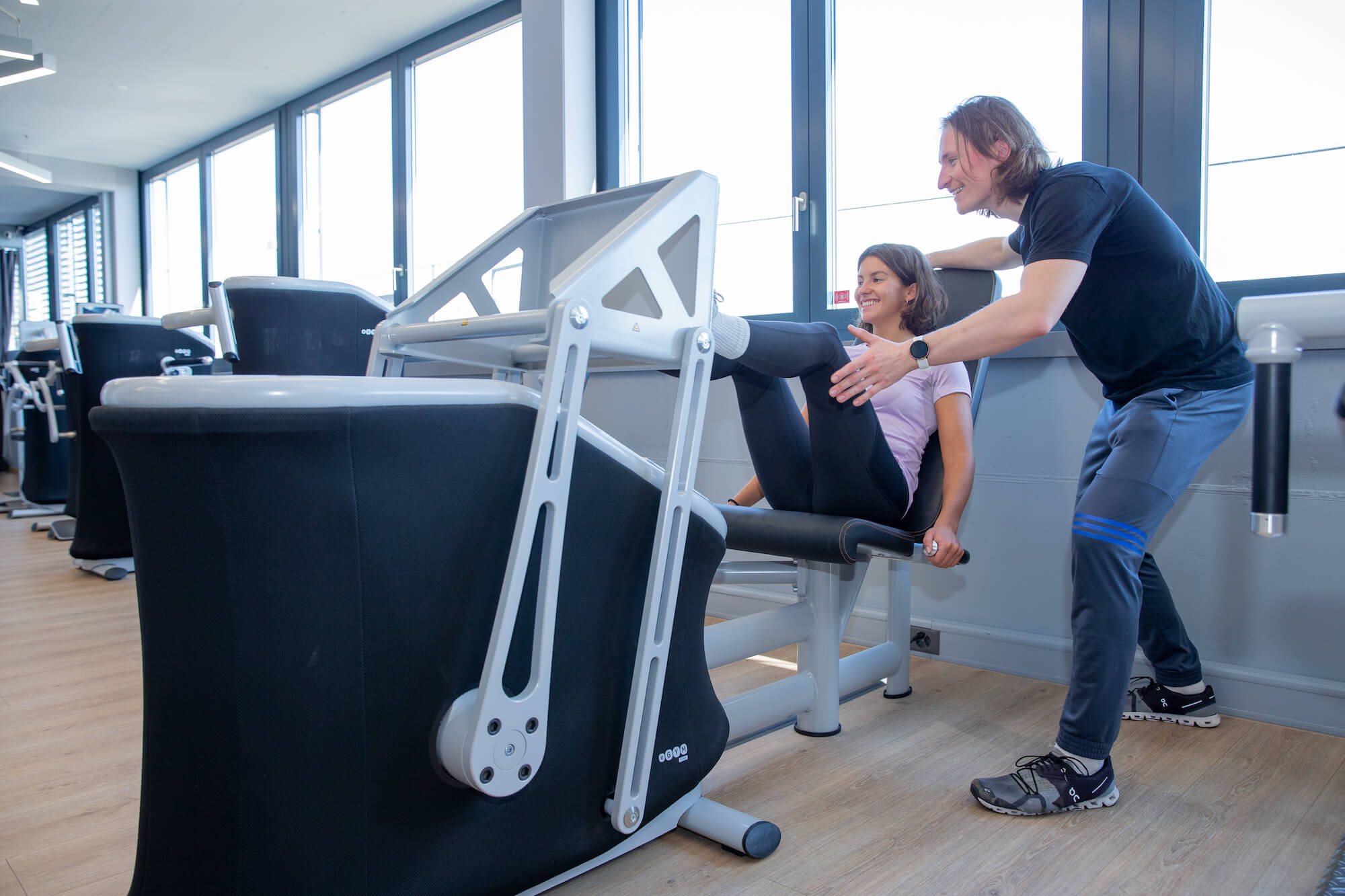
You will find Kineo Wipkingen at Röschibachstrasse 79 on Röschibachplatz. Back treatments are one of our focus areas here. On the training floor with strength machines and a rack, you build up strength under guidance, and on the Sensopro coordination trainer you train balance and trunk control. You can find all the information about the location at Kineo Wipkingen.
Frequently asked questions
Can physiotherapy correct my scoliosis?
In adults, the curve can hardly be changed. But physiotherapy can relieve pain and make your back stronger and more mobile.
Which sports are suitable with scoliosis?
Almost all of them. Swimming, strength training, running or climbing are usually quite possible with scoliosis. Choose what you enjoy and increase the load gradually.
How long does an appointment take?
An appointment lasts 30 minutes. In your first session, we clarify the cause of your symptoms and start straight away with treatment and exercises.
Does health insurance cover physiotherapy?
Yes. With a doctor's prescription, your basic health insurance covers the cost. Kineo is recognised by all Swiss health insurers.
You might also like
- Rounded back: train your posture instead of correcting it
- Spinal stenosis: narrowing of the spine
- Low back pain: pain in the lower back
Book an appointment
Do you want to stay strong and active with your scoliosis? Book your appointment at Kineo Wipkingen and we will put your programme together.