By Asier Gochicoa, physiotherapist at Kineo Wipkingen
"Stand up straight!" rarely helps
You catch sight of yourself in a photo or in the lift mirror and think: I have a rounded back. Your shoulders hang forward and your head pushes ahead. Perhaps you feel pressure between your shoulder blades or in your neck in the evening. So you try to straighten up consciously, and a few minutes later you are sitting in exactly the same way again.
That is normal. You can't permanently "switch on" posture. What you can change well is your body's ability to straighten up, and the capacity of your back and neck to cope with load. That is what this article is about: training your posture instead of constantly correcting it.
What is a rounded back?
The thoracic spine naturally curves backwards. Specialists call this kyphosis. With a rounded back, this curve is more pronounced, often together with shoulders pulled forward and a head that sits forward. It is important to distinguish between two types:
- Postural rounded back: You can straighten it actively, for example when you stretch out lying down. This is the most common form and is very trainable.
- Structurally fixed rounded back: It remains even when you straighten up actively, for example after Scheuermann's disease in adolescence or through changes in the vertebral bodies in older age.
Myth: there is one right posture
For a long time the belief was that sitting hunched leads to back pain. It is not that simple. Research shows only a weak link between the shape of the spine and pain. Many people with a clearly rounded back have no symptoms, while others with "perfect" posture do. Variety matters far more than one right position. The best posture is the next one.
Training is still worthwhile: if you can straighten up, and you have a mobile thoracic spine and strong shoulder blade muscles, you cope better with long days at the screen and have more room to move in overhead movements, for example when swimming, climbing or strength training.
Typical symptoms
- Pressure or burning between the shoulder blades after sitting for a long time
- Tense neck, sometimes with headaches
- Restricted movement when lifting your arms overhead
- Stiffness of the thoracic spine when turning, for example when checking over your shoulder in the car or on the bike
Warning signs: when to see a doctor
See a doctor if your rounded back visibly increases within a short time or you are getting shorter, or if severe back pain suddenly appears after a minor strain or a fall, especially in older age or with known osteoporosis. Also get these checked: pain at night, fever, unintended weight loss or long morning stiffness that eases with movement.
How we treat a rounded back at Kineo
We look at where your body needs more room to move and where strength is missing. From this we build a programme that fits your everyday life.
1. Assessment: what we examine in your first session
- Occiput-to-wall distance: You stand with your heels and buttocks against the wall. How far is the back of your head from the wall, and can you rest it against the wall without arching your lower back?
- Straightening test lying on your front: Can the rounded back be straightened actively, or is it fixed?
- Rotation of the thoracic spine: rotation test sitting and on all fours, comparing both sides
- Shoulder mobility: How far can you lift your arms overhead without compensating by arching your lower back?
- Strength and endurance: shoulder blade muscles, back extensors and deep neck flexors in the cranio-cervical flexion test
- Everyday life: screen time, workstation, sport and breaks
2. How we build your training
- Phase 1, weeks 1–3: increase mobility. Mobilisation of the thoracic spine and ribs, soft tissue treatment of the chest and neck muscles, daily mobility exercises lasting a few minutes.
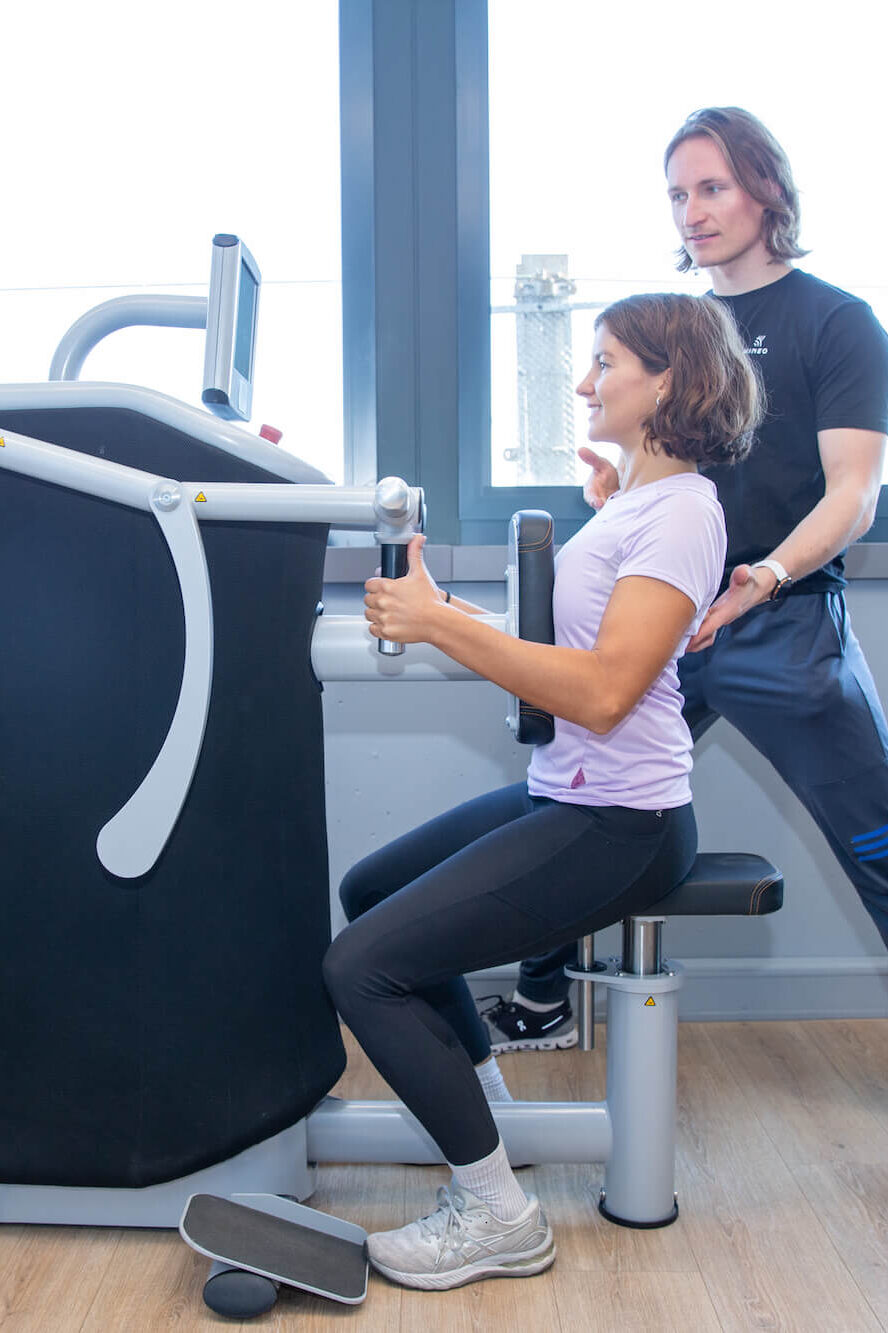
- Phase 2, weeks 3–8: build strength. Rows, face pulls and exercises lying on your front for the shoulder blade muscles, 3 x 10–15 repetitions, two to three times a week.
- Phase 3, from week 8: build resilience. Heavier pulling exercises, deadlifts, overhead presses and carries, so that the new strength carries over into everyday life and sport.
- Sticking with it: Posture is the result of habits. A short programme that you do two to three times a week over the long term works better than one intense month.
3. Kineo services we use
- Manual therapy for a stiff thoracic spine and the rib joints
- Mobilising massage for tense chest, neck and shoulder blade muscles
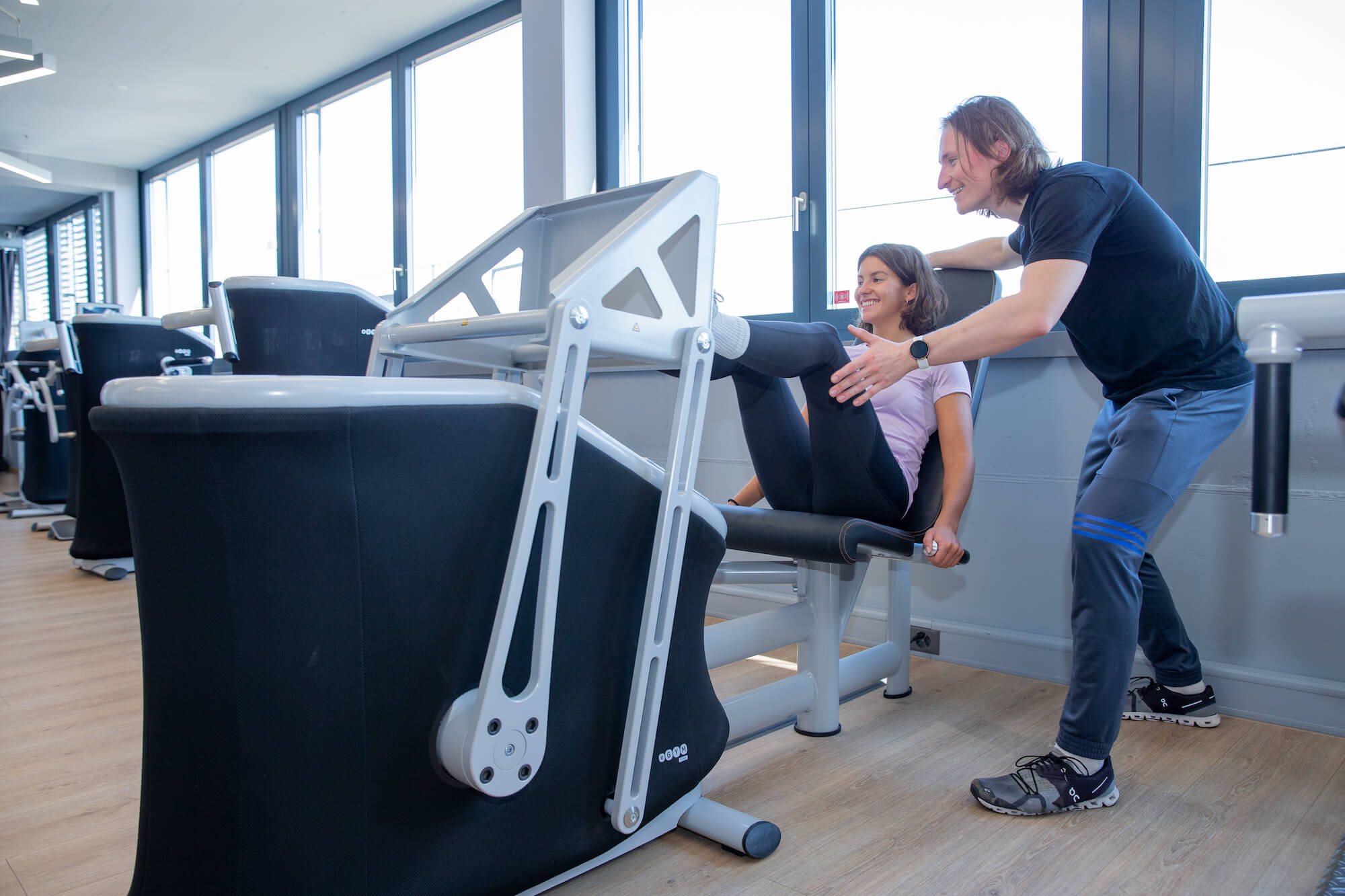
- Medical training therapy: strength for the upper back, the real foundation
- Digital home programme with short exercises for the office and home
Five exercises for an upright upper body
- Extension over the roller: Lie on your back with a foam roller placed across your thoracic spine and your hands supporting your head. Gently extend backwards over the roller, then move the roller along a little. 2 x 8–10.
- Open book: Lie on your side with your knees bent and your arms stretched out in front of you. Open the top arm backwards like a page of a book and follow it with your eyes. 2 x 8 per side.
- Y raise lying on your front: Arms forward in a Y shape, thumbs pointing up. Lift your arms slightly off the floor and draw your shoulder blades back and down. 3 x 10–12.
- Rows: With a band or cable machine, pull your elbows back close to your body and hold briefly. 3 x 12–15. On strength machines you can also go heavier, 3 x 8–10.
- Chin tucks: Sitting or against the wall, gently push your chin back as if you were making a double chin. Hold for 5 seconds, 10 repetitions.
Does a posture corrector help?
Posture braces, posture shirts or apps with a vibration alert can remind you of your posture. But they don't make you stronger and are often put away again after a short time. As a reminder at the start they are fine, but they don't replace training. An ergonomic workstation helps too, but it is only one part: if you stand up briefly every hour, you relieve your back more than with the perfect chair.

From our practice
Many people with a rounded back have already tried to sit up straight consciously all day. That is tiring and rarely lasts. When we mobilise the thoracic spine and strengthen the upper back instead, many people tell us they feel more upright without thinking about it, and the pressure between their shoulder blades eases.
Training in Wipkingen
At Kineo Wipkingen at Röschibachstrasse 79 on Röschibachplatz, shoulder and back treatments are a focus. On the training area with strength machines and a rack, you train rows, deadlifts and overhead exercises under guidance. You can find out more about the location at Kineo Wipkingen.
Frequently asked questions
Can you train a rounded back straight again?
A postural rounded back can often be improved well, because mobility and strength are trainable. A structurally fixed rounded back hardly changes, but the symptoms can still be eased.
How quickly will I see a difference?
Many people notice after a few weeks that they can straighten up more easily. Visible changes usually take several months of regular training.
How long does an appointment last?
An appointment lasts 30 minutes. In the first session we clarify the cause and start straight away with treatment and exercises.
Does health insurance cover physiotherapy?
Yes. With a doctor's prescription, your basic health insurance covers the cost. Kineo is recognised by all Swiss health insurers.
You might also like
Book an appointment
Would you like to get through the day more upright and with less pressure in your neck? Book your appointment at Kineo Wipkingen.