By Clara Benning, physiotherapist at Kineo Escher Wyss
The ski season does not start on the slopes
For many people, the first day on skis is the highlight of the winter. After a few runs your thighs burn, your turns get sloppy in the afternoon, and that is exactly when many falls happen. If you go straight from the office to the slopes, you are asking your knees, hips and trunk to do something they are not prepared for.
Six weeks of targeted training is enough to start the season noticeably stronger, more stable and with better endurance. You do not need a gym, just two to three sessions a week and a bit of consistency.
What skiing demands of your body
- Eccentric strength: When you ski, your thigh muscles do a lot of braking work, that is, they work while lengthening. In everyday life they are hardly trained for this.
- Strength endurance: A long run in a deep position is like a long wall sit with bumps from below.
- Single-leg stability: In every turn, more weight is on the outside ski. Your knee and hip have to stay in control on one leg.
- Reaction and balance: Icy patches, moguls and slush call for quick corrections.
- Trunk: It keeps your upper body calm and transfers the force to your skis.
Typical injuries in skiing
In alpine skiing, the knee is the most frequently injured area. Injuries to the medial collateral ligament and the anterior cruciate ligament are typical. Cruciate ligament injuries often happen without any contact from outside: leaning back with your weight behind you, in a botched landing, or when the outside ski catches an edge and twists the knee. Also common is "skier's thumb", an injury to the collateral ligament at the base of the thumb when you fall with the pole in your hand.
Fatigue is an important factor. When your legs are tired, you end up leaning back more often and react more slowly. Better strength endurance therefore also means more reserve in the afternoon.
Your 6-week plan
Train two to three times a week with at least one rest day in between. Warm up for 5–10 minutes each time, for example on a bike or with easy skipping.
Weeks 1–2: basic strength
- Squat with body weight or a light weight, 3 x 12, lowering slowly (3 seconds)
- Reverse lunge, 3 x 8 per side
- Hip bridge, 3 x 12
- Wall sit, 3 x 30–45 seconds
- Side plank, 3 x 20–30 seconds per side
Weeks 3–4: single-leg and eccentric
- Bulgarian split squat, 3 x 8 per side, lowering for 3 seconds
- Single-leg Romanian deadlift, 3 x 8 per side
- Side lunges, 3 x 8 per side
- Wall sit, 3 x 60 seconds, or shorter on one leg
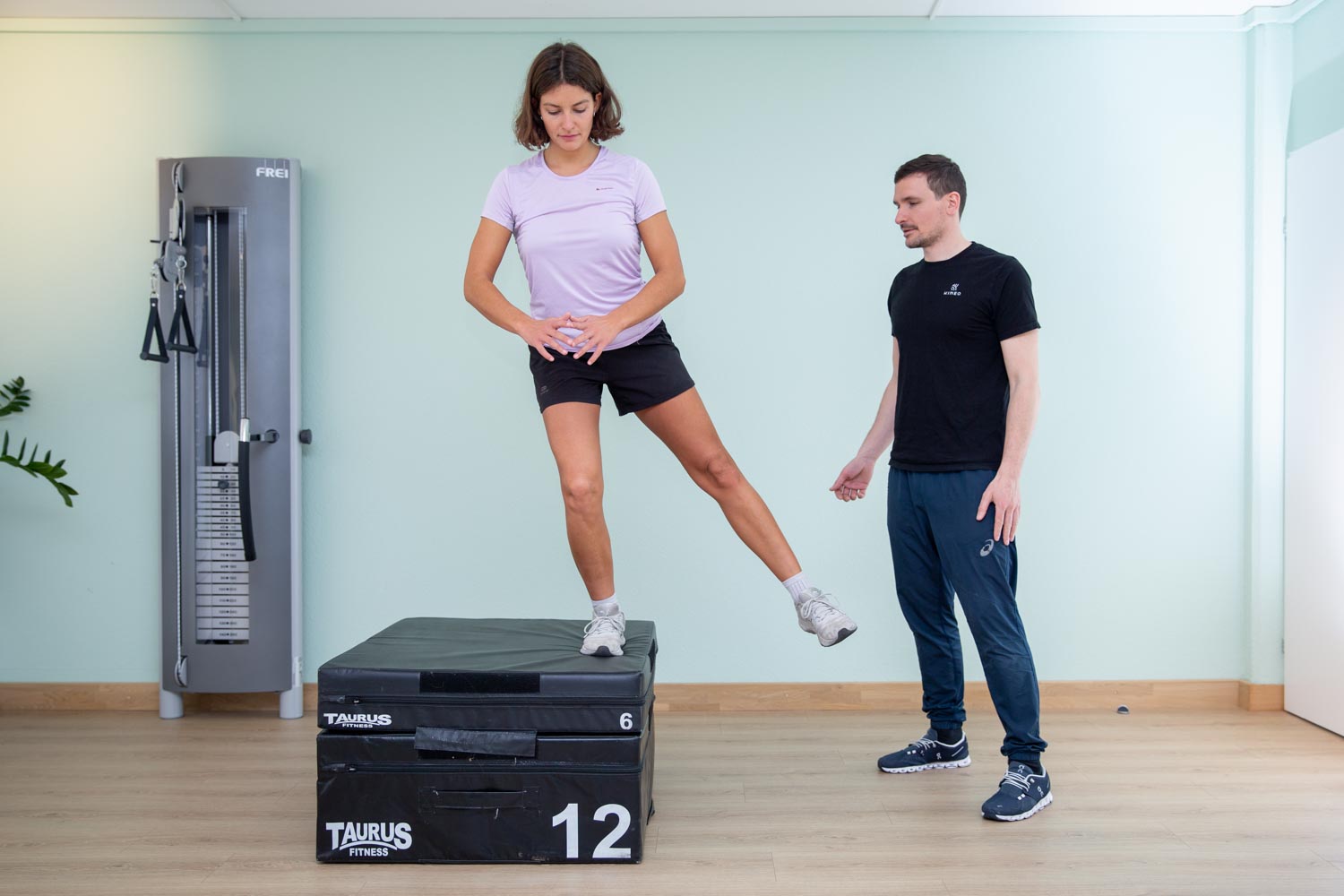
- Single-leg stand on a soft surface, eyes closed or with a ball, 3 x 30 seconds per side
Weeks 5–6: jumping, reaction and endurance
- Side-to-side jumps over a line, quick and quiet, 3 x 20 seconds
- Skater jumps from one leg to the other, holding for 2 seconds, 3 x 6 per side
- Squat jumps with a soft landing, 3 x 6
- Strength endurance circuit: 40 seconds of work, 20 seconds of rest, 3 rounds with squat, lunge, side plank and side-to-side jumps
One to two easy endurance sessions a week also help, for example cycling or running. Always practise landings with your knee over your foot, not tipped inwards.
What you can do yourself
- Have your bindings adjusted: At a specialist shop, according to weight, height, age and skiing ability. A suitable setting is important so that the binding releases at the right moment.
- Start slowly: On the first day, better to do a few runs fewer, with breaks.
- Listen to fatigue: The "last run" is often the one where it happens.
- Hold your pole correctly: If you fall, let go of the pole. This can protect your thumb.
- Wear a helmet and slow down when visibility is poor.
How we prepare you for the ski season at Kineo
Whether you feel unsure after an earlier knee injury or simply want to start well prepared, we check where you stand and adapt the plan to you.
1. Our check before you start
- Squat and single-leg squat: Does your knee stay over your foot or drop inwards?
- Y-Balance Test: Single-leg stability and reach, compared side to side
- Hop tests: Single-leg hop for distance and side hops, especially after knee injuries
- Thigh strength compared side to side, and hold time in the wall sit
- Hip and ankle mobility, which affect your position in the ski boot
2. How we build your training
- Weeks 1–2: Technique of the basic exercises, a clean squat and hip hinge, building strength endurance
- Weeks 3–4: Single-leg and eccentric exercises with increasing weight, 3 x 8–10
- Weeks 5–6: Jumps, landings and reaction, strength endurance circuit
- After a knee injury: Additional hop tests as a basis for deciding whether you are ready for the slopes
3. Kineo services we use
- Sports physiotherapy: check, assessment of earlier injuries and clearance
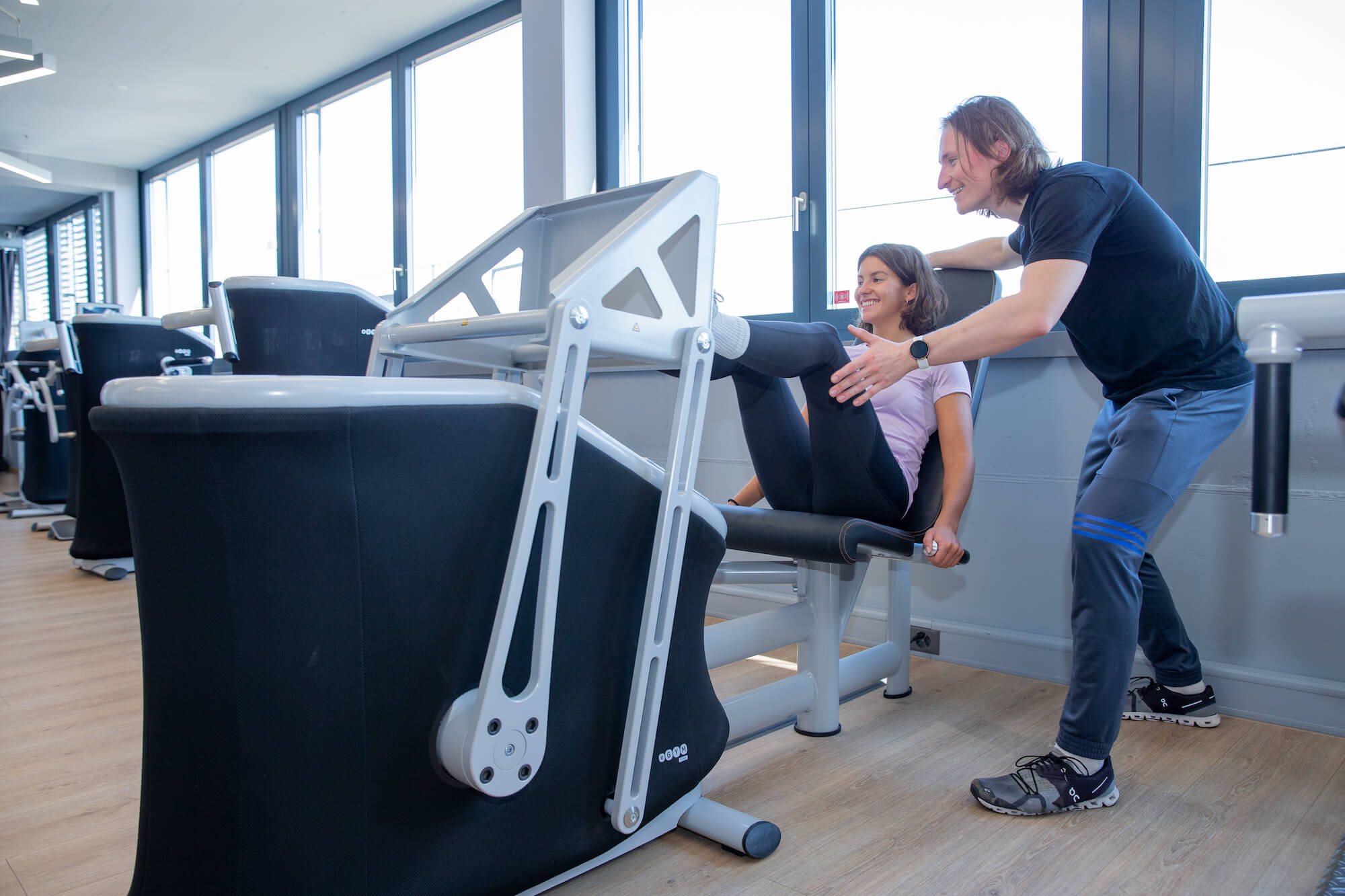
- Medical training therapy for building strength in your legs, hips and trunk
- Sport-specific training with single-leg landings, reaction and changes of direction
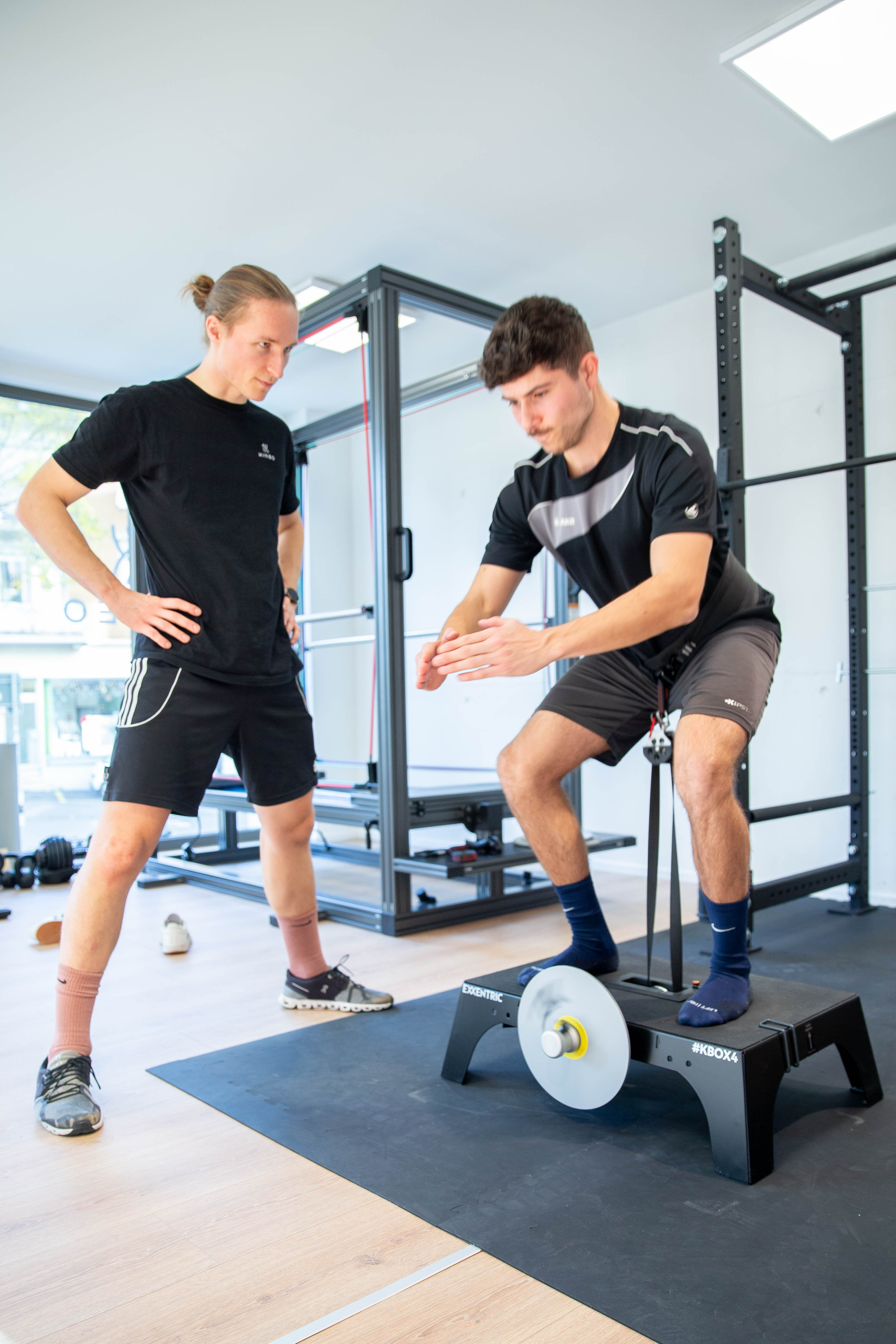
- Explosive strength training for quick corrections and controlled jumps
Back on skis after a knee injury
After a cruciate ligament rupture or a medial collateral ligament injury, the ski season is often a big goal. What matters is not just the time since the injury, but whether strength, stability and jumping ability are right again. We use tests such as the single-leg hop for distance and strength values compared side to side as a guide. Whether a knee brace makes sense on the slopes is best discussed with your doctor. For the first days on skis after an injury, we recommend easy, well-groomed slopes and shorter days.
From our practice
Before the season, many skiers mainly train endurance, for example by running or cycling. That is good, but it is not quite enough. What is most often missing is the braking strength of the thighs and control on one leg. If you train these two things in a targeted way for a few weeks, you often notice on the very first day on skis that your legs last longer.
Season preparation at Kineo Escher Wyss
At Kineo Escher Wyss at Hardturmstrasse 18, right on Escher-Wyss-Platz, you train on the supervised training floor with guidance. If you want to keep working on your strength and fitness after the six weeks, you will find Kineo HYROX in the same building, with group and personal training. You can find out more about the location on the Kineo Escher Wyss page.
Frequently asked questions
Are six weeks really enough?
Six weeks is enough to noticeably improve strength, strength endurance and stability. If you start earlier or keep training through the winter, you benefit even more.
Can I keep training during the season?
Yes, and it makes sense. One to two short strength sessions a week maintain your level.
When should I see a doctor after a skiing accident?
If you hear a "pop" in the knee, it swells quickly, it gives way, it hurts a lot when you put weight on it, or your thumb is unstable and painful. These should be checked by a doctor.
How long does an appointment last?
An appointment lasts 30 minutes. In your first session we establish where you stand and start straight away with the first exercises.
You might also like
- Injury prevention and rehabilitation in winter sports
- Cruciate ligament rupture in competitive athletes
- Injury prevention in floorball
Book an appointment
Do you want to start the ski season strong and stable? Book your appointment at Kineo Escher Wyss.