Injury prevention in winter sports: the basics
Every year, winter sports inspire millions of people. Whether it is:
- skiing,
- snowboarding,
- cross-country skiing,
- freeriding,
- ski touring,
- ice climbing
- or ice skating,
the combination of movement, nature, speed and adrenaline makes winter sports unique.
At the same time, winter sports place high demands on your body:
- quick changes of direction,
- high forces,
- unpredictable terrain,
- cold,
- fatigue
- and high speeds
put enormous strain on muscles, joints and the nervous system.
Many injuries are caused not only by falls, but also by:
- poor preparation,
- restricted mobility,
- lack of stability,
- muscular imbalances
- or overdoing it at the start of the season.
With a targeted prevention programme, you can clearly reduce your risk of injury and at the same time feel safer, more stable and more capable on the slope or in the trail.
At KINEO, we support winter sports athletes with:
- sport-specific physiotherapy,
- functional training,
- movement analysis
- and individual prevention plans.
COMMON INJURIES IN WINTER SPORTS
The combination of speed, dynamic movements and changing conditions leads to typical injury patterns.

KNEE INJURIES
Particularly common are:
- cruciate ligament injuries,
- meniscus damage,
- medial collateral ligament injuries
- and sprains.
Typical causes:
- twisting,
- loss of control,
- hard landings
- or falls.
Knee injuries are very common, especially in skiing.
SHOULDER INJURIES
Falls onto the shoulder can lead to:
- dislocations,
- bruises,
- rotator cuff injuries
- or instability.
Particularly affected:
- snowboarders,
- freeriders
- and ice skaters.
WRIST INJURIES
In snowboarding especially, many people instinctively try to break their fall with their hands.
This often results in:
- sprains,
- fractures
- or overuse injuries.
BACK AND NECK PROBLEMS
Long days on the slope, hard surfaces or poor technique can lead to:
- muscle tension,
- overuse,
- blockages
- or bruises.
HEAD INJURIES
Concussions and severe head injuries are among the most serious risks in winter sports.
A helmet can clearly reduce the risk of injury and should be a given.
WHY PREVENTION MATTERS SO MUCH
Many injuries happen:
- at the start of the season,
- when you are tired,
- after longer breaks
- or when you are poorly prepared physically.
Targeted training improves:
- stability,
- reaction speed,
- strength,
- movement quality
- and resilience.
This lowers the risk of:
- falls,
- faulty movements
- and overuse.
WHAT CAN YOU DO YOURSELF?
STRENGTH TRAINING FOR MORE STABILITY

JUMP SQUATS
This exercise improves:
- explosive strength,
- landing control
- and leg axis stability.
Particularly important for:
- skiing,
- snowboarding
- and jumping movements.
Recommendation:
- 3 sets of 10 jumps.
BULGARIAN SPLIT SQUATS
This exercise strengthens:
- the gluteal muscles,
- thighs,
- stability
- and control of the leg axis.
Recommendation:
- 3 sets of 12 repetitions per leg.
TRAINING CORE STABILITY
A stable core improves:
- balance,
- force transfer,
- control
- and safety.
PLANK WITH ARM RAISE
This exercise improves:
- core stability,
- shoulder control
- and coordinative resilience.
Recommendation:
- 3 sets of 10 repetitions per side.
WEIGHTED RUSSIAN TWISTS
This exercise strengthens:
- the oblique abdominal muscles,
- rotational strength
- and stability.
Recommendation:
- 3 sets of 15 repetitions per side.
MOBILITY AND FLEXIBILITY
Good flexibility helps you to:
- perform movements cleanly,
- distribute forces better
- and prevent injuries.
DYNAMIC MOBILISATION BEFORE SPORT
Particularly useful:
- hip openers,
- leg swings,
- mobilisation exercises
- and dynamic lunges.
STRETCHING AFTER TRAINING
Helpful for:
- recovery,
- flexibility
- and muscle relaxation.
Particularly important:
- quadriceps,
- hip flexors,
- calves
- and back.
COORDINATION AND BALANCE
Good body control reduces the risk of:
- ankle sprains,
- falls
- and faulty movements.
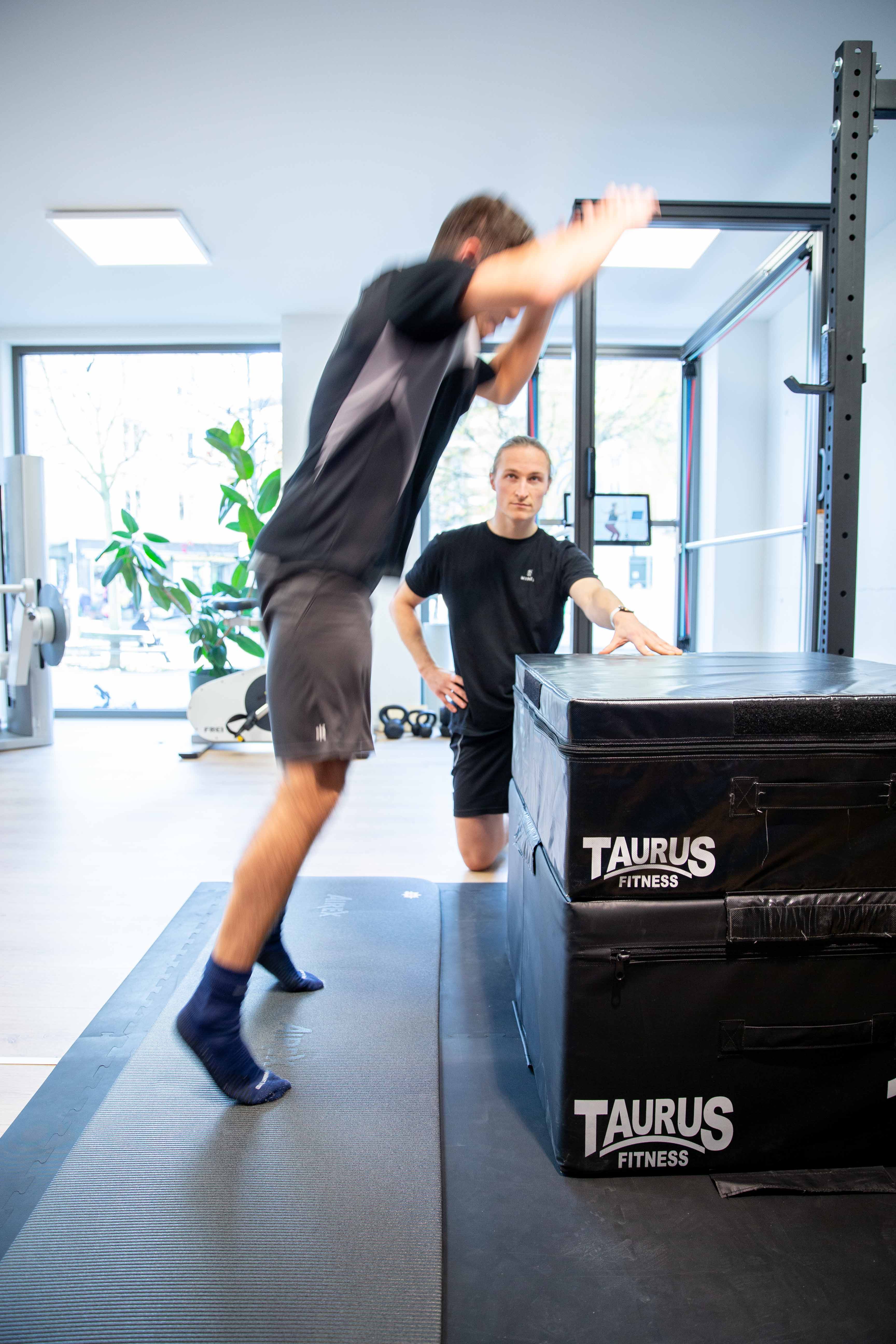
SINGLE-LEG STANCE ON AN UNSTABLE SURFACE
This exercise improves:
- balance,
- proprioception
- and ankle stability.
Recommendation:
- 3 rounds of 30 seconds per leg.
SLALOM DRILLS
They improve:
- reaction speed,
- changes of direction,
- coordination
- and agility.
ENDURANCE TRAINING
Winter sports often put intense strain on the cardiovascular system.
Helpful options are:
- interval training,
- cycling,
- rowing
- or running.
Good basic endurance reduces fatigue, and with it the risk of injury.
SAFETY MEASURES IN WINTER SPORTS
THE RIGHT EQUIPMENT
Important:
- helmet,
- back protector,
- well-fitting boots
- and correctly adjusted bindings.
PAY ATTENTION TO WEATHER AND SLOPE CONDITIONS
Poor visibility, ice or exhaustion clearly increase the risk of injury.
TECHNIQUE TRAINING
Clean technique improves:
- control,
- efficiency
- and safety.
Regular technique sessions or courses make sense, even for advanced athletes.
REHABILITATION AFTER AN INJURY
After an injury, your return should be:
- gradual,
- controlled
- and tailored to you.
Important:
- no pain,
- sufficient stability,
- good control
- and progressive load increases.
HOW KINEO PHYSIOTHERAPY CAN SUPPORT YOU
At KINEO, we offer specialised programmes for winter sports athletes, both for prevention and for rehabilitation.
INDIVIDUAL MOVEMENT ANALYSIS
We analyse:
- movement patterns,
- stability,
- strength,
- mobility
- and coordination.
This lets us identify:
- weak points,
- imbalances
- and risk factors.
SPORT-SPECIFIC TRAINING
We develop:
- individual prevention programmes,
- strength and stability training,
- balance exercises
- and sport-specific loading programmes.

MANUAL THERAPY AND REHABILITATION
After injuries, we support you with:
- manual therapy,
- mobilisation,
- functional training,
- stabilisation exercises
- and return-to-sport plans.
RETURN-TO-SPORT SUPPORT
Our goal:
- a safe,
- controlled
- and lasting return to winter sports.
We guide you step by step:
- from building up your load
- to your full return to the slopes.
OUR GOAL: AVOID INJURIES AND IMPROVE PERFORMANCE
Winter sports should be fun, not slowed down by injuries.
With:
- targeted preparation,
- functional training,
- good technique,
- sufficient recovery
- and professional support
you can:
- clearly reduce your risk of injury,
- feel safer on the move
- and improve your performance in the long term.
The KINEO team guides you through the winter sports season individually, evidence-based and specific to your sport.
FAQ: Injury prevention in winter sports
1. Which injuries are most common in winter sports?
Knee, shoulder, wrist, back and head injuries are particularly common.
2. Why do so many injuries happen at the start of the season?
After longer breaks, strength, stability, coordination and load tolerance are often lacking.
3. Which exercises are most important for prevention?
Strength training, balance training, core stability and coordination exercises are particularly effective.
4. Does physiotherapy help with prevention too?
Yes. Movement analyses and individual training programmes help to identify risk factors early and prevent injuries.
5. When should I return to winter sports after an injury?
Only when:
- mobility,
- stability,
- strength
- and load tolerance have been sufficiently restored and you are pain-free.