By Clara Benning, physiotherapist at Kineo Escher Wyss
Floorball: fast, agile and demanding on the knee and ankle
Floorball thrives on short sprints, abrupt stops and quick changes of direction in a low position. Add a hard hall floor, a fast ball and lots of sticks in a small space. That makes the sport attractive and, at the same time, prone to injury, above all for the ankles, knees and groin.
The good news: many of these injuries happen without contact with an opponent, when landing, braking or turning. These are exactly the situations you can train for. A targeted warm-up programme and a little strength work each week can lower the risk considerably.
Typical injuries in floorball
- Ankle sprain: The most common acute injury. The outer ligaments are usually affected, often after a landing or a change of direction on the grippy hall floor.
- Knee injuries: When braking and turning with the knee collapsing inwards, the anterior cruciate ligament can tear. Female players are affected more often than male players.
- Groin and adductors: The low, wide base position and many sideways steps put strain on the inner thighs.
- Lower back: The bent-forward posture with the stick, often over years and with a stick that is too short, can overload the back.
- Face and eyes: The ball and stick can hit the eye. Protective goggles offer effective protection.
Why it so often happens without contact
With cruciate ligament injuries and many ankle injuries, there is usually no opponent involved. Typically, it happens during a landing or a stop in which the knee tips inwards (knee valgus) and the upper body falls to the side or backwards. Fatigue plays a big role: towards the end of a match or training session, movement control gets worse.
Another risk factor is a previous injury. If you have sprained your ankle before, you are more likely to sprain it again without targeted training. This has less to do with the ligament itself than with reduced control and strength around the joint.
What you can do yourself
- Warm up in a structured way: Neuromuscular warm-up programmes, such as FIFA 11+ from football, are considered well supported by evidence in team sports. They combine running, strength, jumps and balance in around 15–20 minutes. They adapt well to floorball.
- Land and stop correctly: Knee over the foot, hips back, land quietly. It is best to practise this before you get tired.
- Check your stick length: A stick that is too short forces you into a more bent posture. As a rough rule of thumb, the stick should reach about your navel when you stand.
- Shoes: Indoor shoes with good lateral support and a sole that isn't worn down. Running shoes aren't made for changes of direction.
- Keep going after a sprain: Even if the pain is gone after a week, the ankle still needs weeks of targeted balance and strength training.
Prevention exercises for the season
You can build these exercises into your warm-up or strength training two to three times a week:
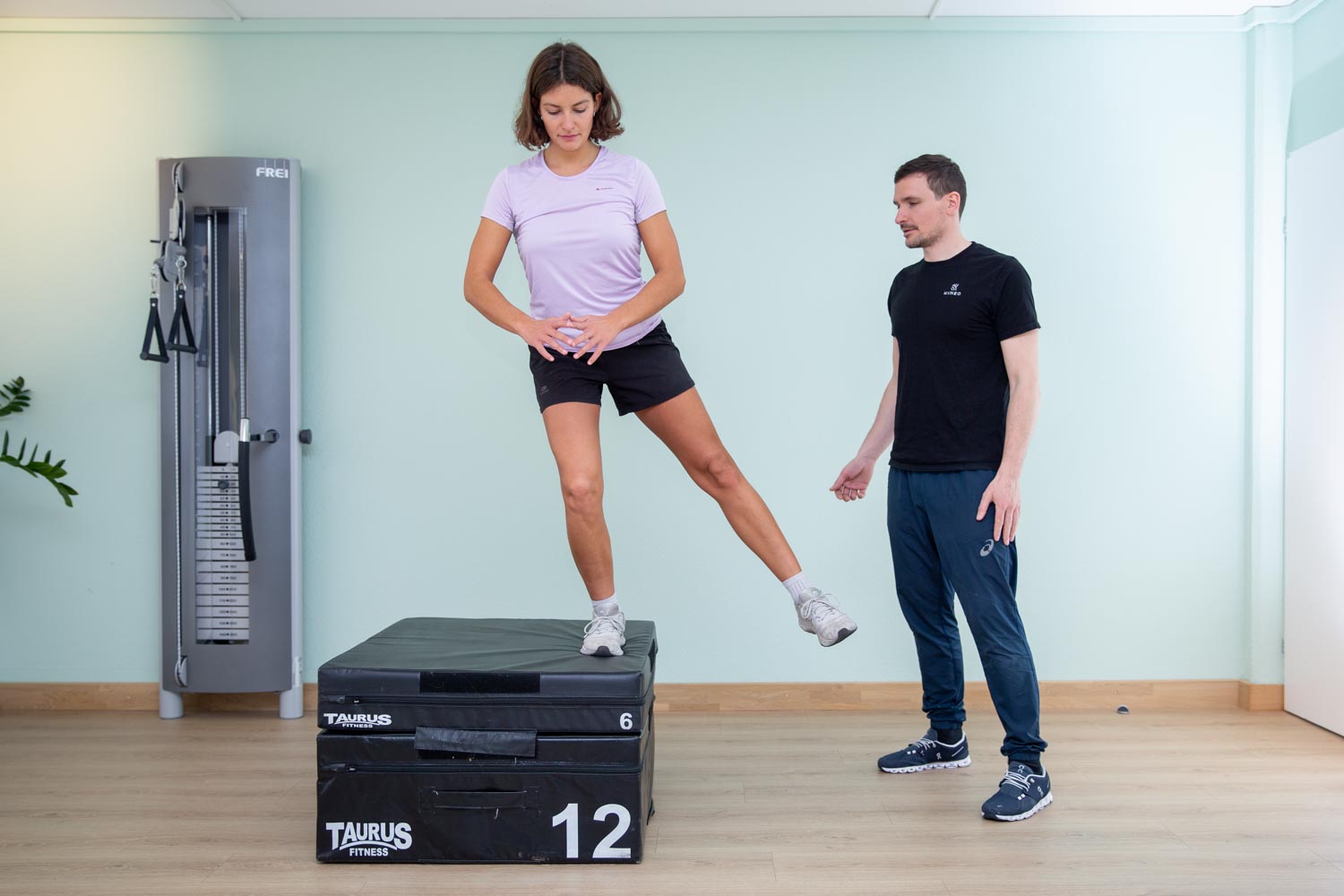
- Single-leg stand with disturbance: Stand on one leg with your knee slightly bent and pass a ball back and forth with teammates. 3 x 30 seconds per side.
- Nordic hamstring curl: Kneeling, with someone holding your heels, lower yourself slowly forwards. Start with 2 x 4–6 repetitions and build up over weeks.
- Copenhagen exercise: Side plank with the top knee on a bench, 3 x 15–20 seconds per side. Strengthens the adductors and protects the groin.
- Lateral jumps with a stop: Jump sideways from one leg to the other and hold the landing for two seconds. 3 x 6 per side.
- Bulgarian split squat: Rear foot on a bench, go down deep in a controlled way. 3 x 8 per side.
How we prepare floorball players at Kineo
Whether you want to get back after an injury or want to know your weak points before the season: we start with a clear assessment and build a programme on it that fits your training routine.
1. Assessment: what we examine in your first session
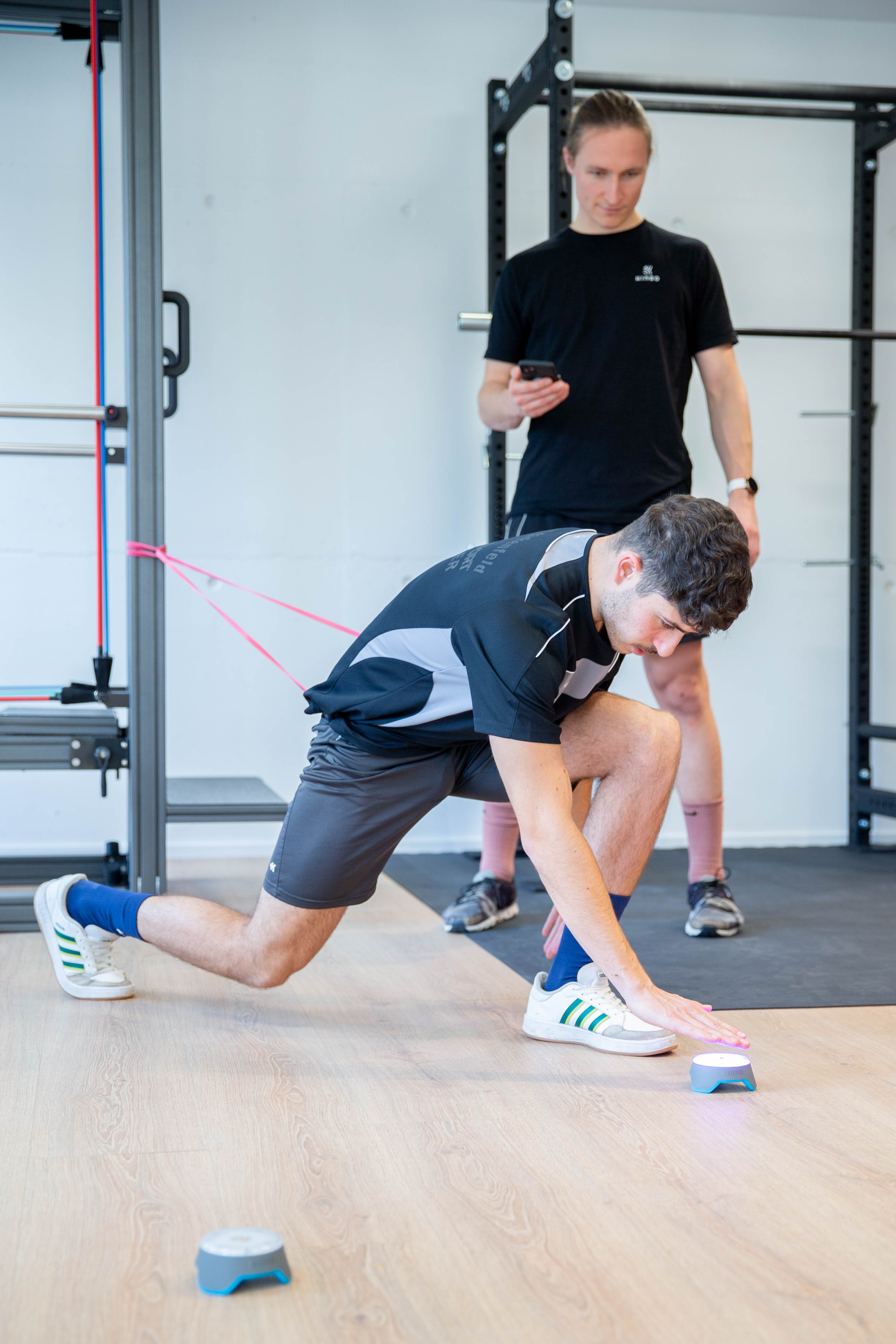
- Y-Balance Test: How far can you reach in three directions while standing on one leg? Large differences between sides point to an increased risk.
- Drop jump and landing analysis: We film landings and stops and look at whether the knee falls inwards.
- Hop tests: Single-leg long jump and triple hop, compared side to side, especially after knee or ankle injuries.
- Knee-to-wall test: It measures the mobility of the ankle. A stiff side changes landing mechanics.
- Squeeze test: Strength and pain of the adductors as an early warning sign for groin problems.
2. Treatment in phases
- Phase 1: Settle and build a base (weeks 1–2): For an acute injury, control swelling, move the joint with little pain, first isometric exercises.
- Phase 2: Strength and control (weeks 2–6): Squats, split squats, calf raises and balance, two to three times a week, 3 x 8–12 repetitions each.
- Phase 3: Jumps and changes of direction: Landing on two legs, then on one, followed by cutting drills at increasing speed.
- Phase 4: Back to team training: First without contact duels, then with. Clearance after hop tests with a small difference between sides and no reaction the next day.
3. Kineo services we use
- Sports physiotherapy: assessment, risk profile and support until you return to play
- Cold therapy with Game Ready: against swelling in the first days after an ankle or knee injury
- Medical training therapy to build strength in the legs, hips and trunk
- Sport-specific training with stops, turns and stick handling under time pressure
- Speed-strength training, so that acceleration and jumping become explosive and controlled again
Back and posture in floorball
The bent playing posture isn't a problem as long as the load comes from the hips and legs. Problems arise when you create the posture mainly from the lower back. Strong gluteal muscles, a resilient trunk and a mobile thoracic spine take pressure off the back. Helpful exercises are the side plank, the Pallof press against a sideways pull and the hip hinge with a stick along your back.
From our practice
After a sprain, many players only come once the ankle gives way for the second or third time. The pain was quickly gone after the first injury and training carried on as normal. The assessment then usually shows noticeably worse balance on the injured side. If you train in a targeted way early on, you can often avoid this cycle.
Sports physio and training at Kineo Escher Wyss
At Kineo Escher Wyss at Hardturmstrasse 18, right at Escher-Wyss-Platz, the supervised training area is part of the therapy. We practise jumps, stops and changes of direction on site rather than just on paper. Game Ready is available for fresh injuries. If you then want to keep working on strength and fitness, you will find Kineo HYROX in the same building, with group and personal training. You can find out more about the location on the Kineo Escher Wyss page.
Frequently asked questions
Should I tape my ankle after a sprain?
Tape or a brace can lower the risk of spraining your ankle again in the first months after an injury. However, they are no substitute for balance and strength training.
When should I see a doctor after a knee injury?
If you hear a "pop", if there is rapid, severe swelling, if your knee gives way, or if you can no longer put weight on it. In that case, a cruciate ligament or meniscus injury should be checked by a doctor.
How long does an appointment last?
An appointment lasts 30 minutes. In your first session, we clarify the cause and start straight away with treatment and exercises.
Does health insurance cover physiotherapy?
With a doctor's prescription, your basic health insurance covers the cost. Kineo is recognised by all Swiss health insurers.
You might also like
Book an appointment
Want to get through the floorball season without injury? Book your appointment at Kineo Escher Wyss.