By Lucrecia Guerra, physiotherapist at Kineo Escher Wyss
When your groin hurts during sport
Groin pain is one of the most stubborn problems in sport. Football, ice hockey, floorball, tennis and runners with many changes of pace are particularly affected. The pain often starts gradually and is ignored until sprints or shots are hardly possible any more.
Common causes
- Adductor-related groin pain: The most common form. The muscles on the inside of the thigh are overloaded where they attach to the pubic bone.
- Iliopsoas-related groin pain: The hip flexor is irritated, typical with a lot of sprinting and shooting.
- Inguinal canal-related pain, formerly called "sportsman's groin"
- Pubic-related pain from loading of the pubic symphysis
- Hip joint: Problems in the joint itself can also show up as groin pain
Often several structures play a part. A precise examination is therefore important.
Typical symptoms
- Pain in the groin or on the inside of the thigh
- Worse with sprints, shots, changes of direction or sitting up
- Stiffness in the morning or after training
How we treat groin pain
Groin pain is a collective term. For treatment, we assign your symptoms to one structure, following the internationally used Doha classification: adductors, hip flexors, inguinal canal, pubic bone or hip joint.
1. Assessment: what we examine in your first session
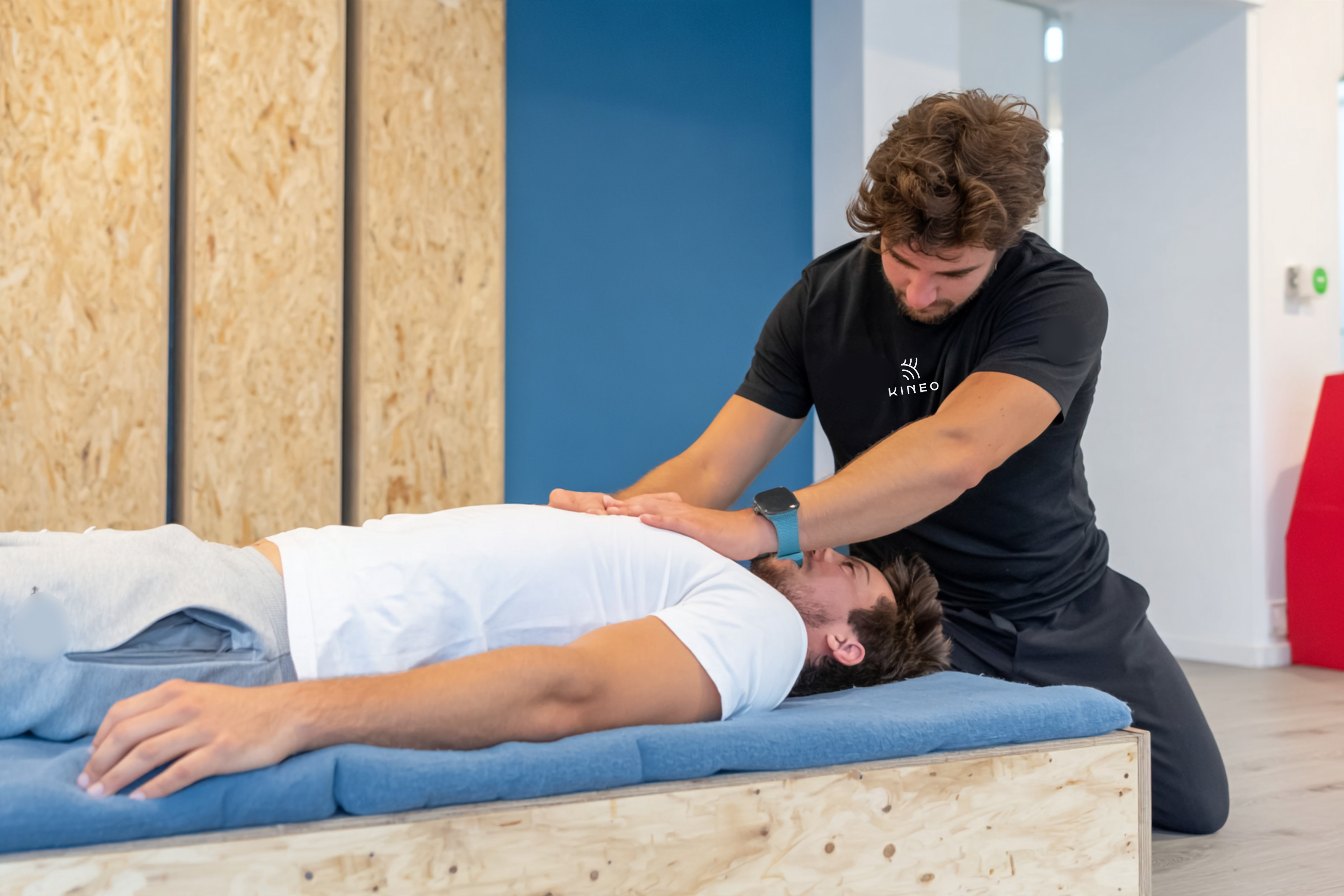
- Squeeze test: You squeeze your knees together against our fist. We check whether this hurts and how much force you produce. It is the most important value for tracking progress.
- Palpation: attachment of the adductors at the pubic bone, hip flexors, inguinal canal and pubic symphysis
- Hip flexors against resistance and stretch in the Thomas test
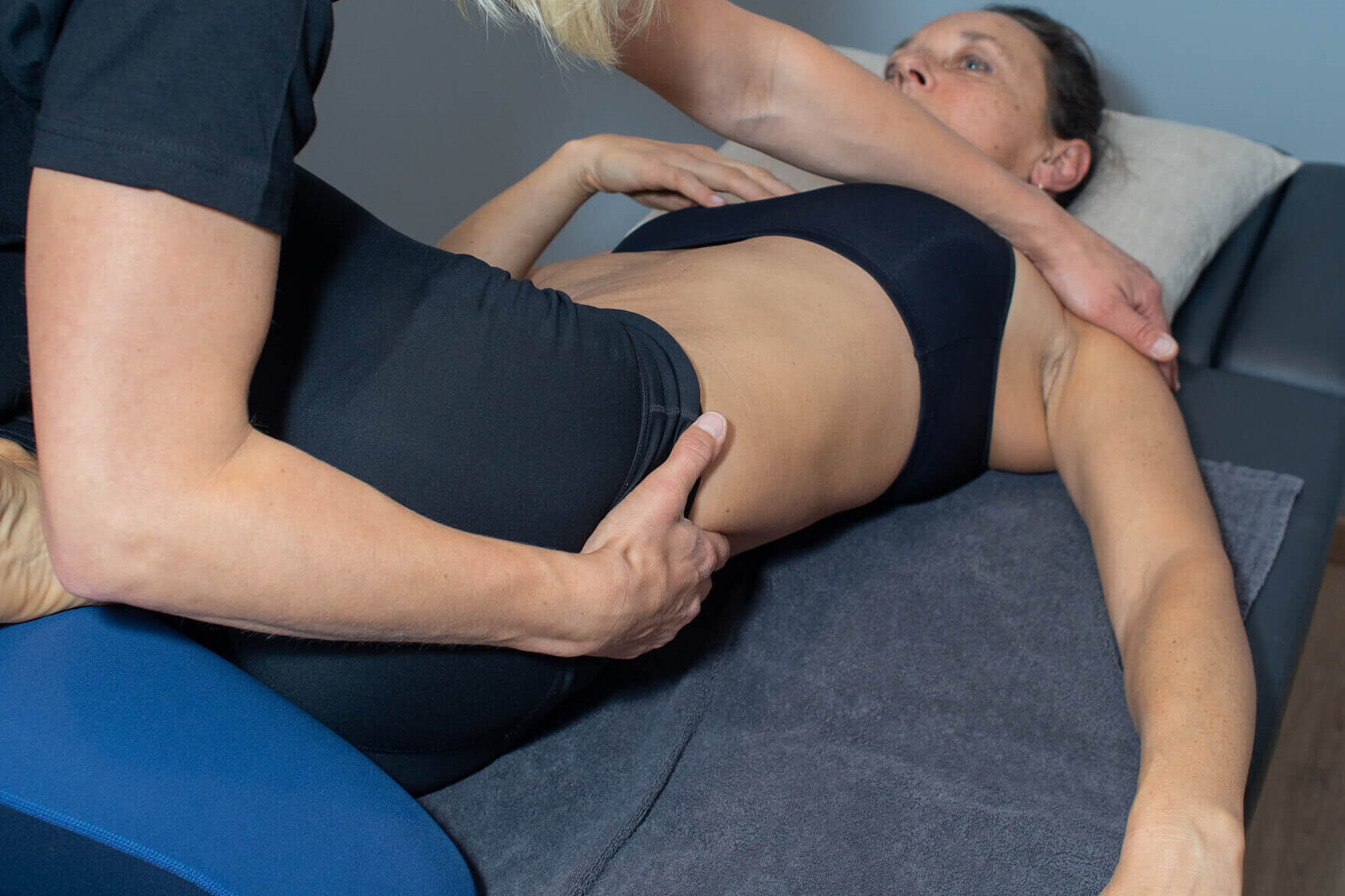
- Hip joint: flexion with internal rotation (FADIR test) and internal rotation compared on both sides. If the joint itself hurts, a medical assessment is sometimes needed.
- Inguinal canal: Pain when coughing or straining can point to an early inguinal hernia. We have that clarified by a doctor.
2. Treatment in phases
- Phase 1: manage the load. Reduce sprints, shots and fast changes of direction, but keep training. Isometric ball squeeze between the knees, 5 x 30 seconds.
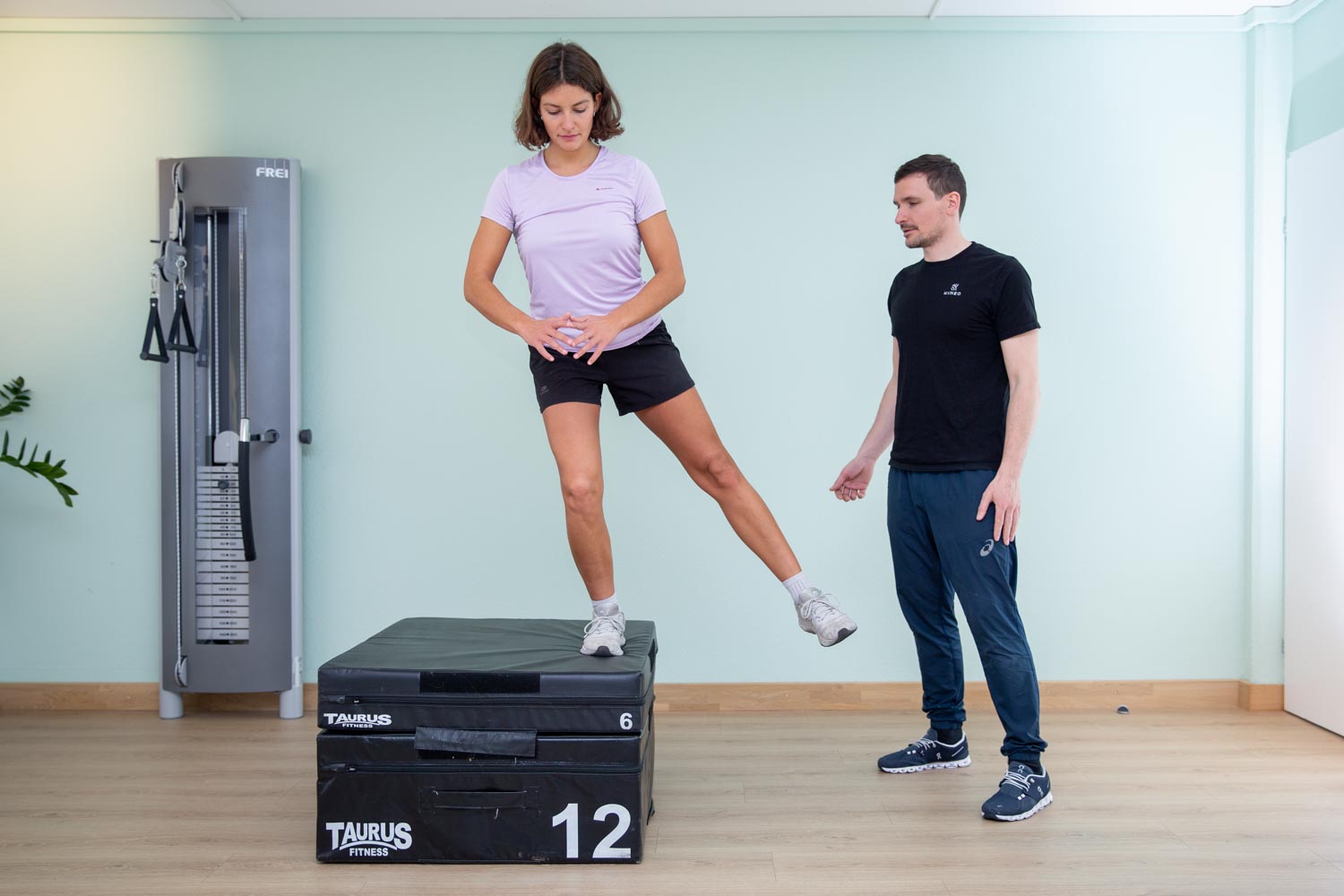
- Phase 2: build strength. Copenhagen exercises in stages, plus hip flexors, glutes and lateral trunk, two to three times a week.
- Phase 3: sport-specific. Running with changes of direction, sprint build-ups, then passing and shooting over increasing distances.
- Clearance: squeeze test pain-free and strong, sprint and shot without pain, no reaction the next day.
3. Kineo services we use
- Sports physiotherapy: identifying the cause, load plan and clearance
- Manual therapy for the hip joint, pelvis and lumbar spine
- Trigger point treatment and dry needling for the adductors and hip flexors
- Sport-specific training with sprints, changes of direction and shooting
- Speed-strength training for the return to full pace
Strength training of the adductors is also considered one of the most effective measures for preventing groin pain.
Copenhagen exercise in three levels
- Starter: Side plank on your forearm, the top knee rests on a bench, the bottom leg hangs free. Hold for 3 x 15 seconds.
- Progression: Same position, but place your foot on the bench instead of your knee. 3 x 20 seconds.
- Advanced: Foot on the bench, slowly raise and lower the bottom leg towards the bench. 3 x 6 to 10 repetitions.
Two to three times a week, mild discomfort during the exercise is fine.
Hip, trunk and groin are connected
The groin is a crossroads: the adductors, abdominal muscles and hip flexors meet here. If one of these areas is weak or stiff, the others have to do more. In athletic training, we therefore pay attention to three things:
- Hip mobility: Restricted internal rotation of the hip increases stress on the groin, especially when shooting and changing direction
- Trunk stability against rotation: Exercises such as the Pallof press, where you resist a sideways pull, relieve the groin during shooting and twisting movements
- Train braking: Many groin problems arise when stopping and moving sideways, not when accelerating. Lateral lunges and controlled stops therefore belong in the programme
In group and personal training at Kineo HYROX, such movements are a fixed part. If you keep training there after treatment, you continue to build the resilience of your groin.
From our practice
Many footballers play on for weeks with groin pain and stretch a lot because the muscles feel tight. Yet usually it is strength that is missing, not flexibility. As soon as the adductors are strengthened in a targeted way, symptoms often improve after just a few weeks.
Strength training right after treatment
At Kineo Escher Wyss at Hardturmstrasse 18, the supervised training area is part of the therapy. You do adductor, hip and sprint exercises on site under guidance, instead of just taking them home on a sheet of paper. With stubborn groin pain especially, this makes the difference.
Frequently asked questions
Is groin pain a hernia?
Usually not. In athletes, the adductors and hip flexors are much more often the cause. A visible or palpable bulge should still be checked by a doctor.
Do I have to take a break from football?
Rarely completely. Usually we temporarily reduce sprints and shots and build them back up in a targeted way.
What is a Copenhagen exercise?
A side plank in which the top leg rests on a bench. It strengthens the adductors very specifically and protects against groin pain.
Does health insurance cover physiotherapy?
Yes. With a doctor's prescription, your basic health insurance covers the cost. Kineo is recognised by all Swiss health insurers.
You might also like
Book an appointment
Is your groin holding you back in training? Book your appointment at Kineo Escher Wyss.