By Lucrecia Guerra, physiotherapist at Kineo Escher Wyss
When your back twinges after rowing
The rowing machine and SkiErg are popular because they challenge almost the whole body and are gentle on the joints. In HYROX, functional training and classic endurance training, they are firmly part of the mix. Even so, many people complain of lower back pain after intense sessions.
Usually the cause is not the machine, but technique, fatigue and how quickly the volume was increased. With a few clear technique points and targeted strength work, this can be solved well in many cases.
Why rowing loads the back
In rowing, a lot of force is transferred through the spine: the legs drive, the trunk transmits, the arms pull. The lower back is most at risk at the catch, that is, at the front of the slide, when the force is greatest. If the lumbar spine is strongly rounded here, the load on discs and ligaments increases.
On the SkiErg it is similar: the movement is a powerful hip hinge with an arm pull. If you "fold up" mainly from the stomach instead of from the hips, you load the back more and waste power.
The most common technique errors
- Rounded back at the catch: You reach too far forward, the pelvis tilts backwards and the lower back rounds.
- Wrong sequence: The correct order in the drive is legs, upper body, arms, and on the recovery arms, upper body, legs. If the upper body opens too early, your back pulls instead of your legs.
- Leaning back too far: At the finish, a slight layback is enough. Leaning back hard adds hardly any power and loads the lumbar spine.
- Damper set too high: The air damper at 10 feels like more training, but makes the stroke heavy and slow. A middle setting suits most people.
- SkiErg only from the arms or only from the stomach: The power should come from a hip hinge with slightly bent knees, with the arms guiding the handle past close to the body.
What you can do yourself
- Technique before intensity: Practise the sequence at an easy pace, for example 5 minutes with only legs and arms and no upper body, then the full movement.
- Increase volume slowly: If you suddenly do many metres or many intervals, you overload your back. Increase distance or number of intervals step by step over several weeks.
- Hip mobility: Short hamstrings and stiff hips pull the pelvis backwards at the catch. A hip hinge with a stick along your back helps you learn the feeling.
- Breaks and changes: In long sessions, stand up in between and move your back into extension.
- Filming: A short video from the side quickly shows whether your back rounds at the catch.
Exercises for a resilient back
- Hip hinge with a stick: Stick along your back in contact with the back of your head, thoracic spine and sacrum, push your hips back. 3 x 10 slowly.
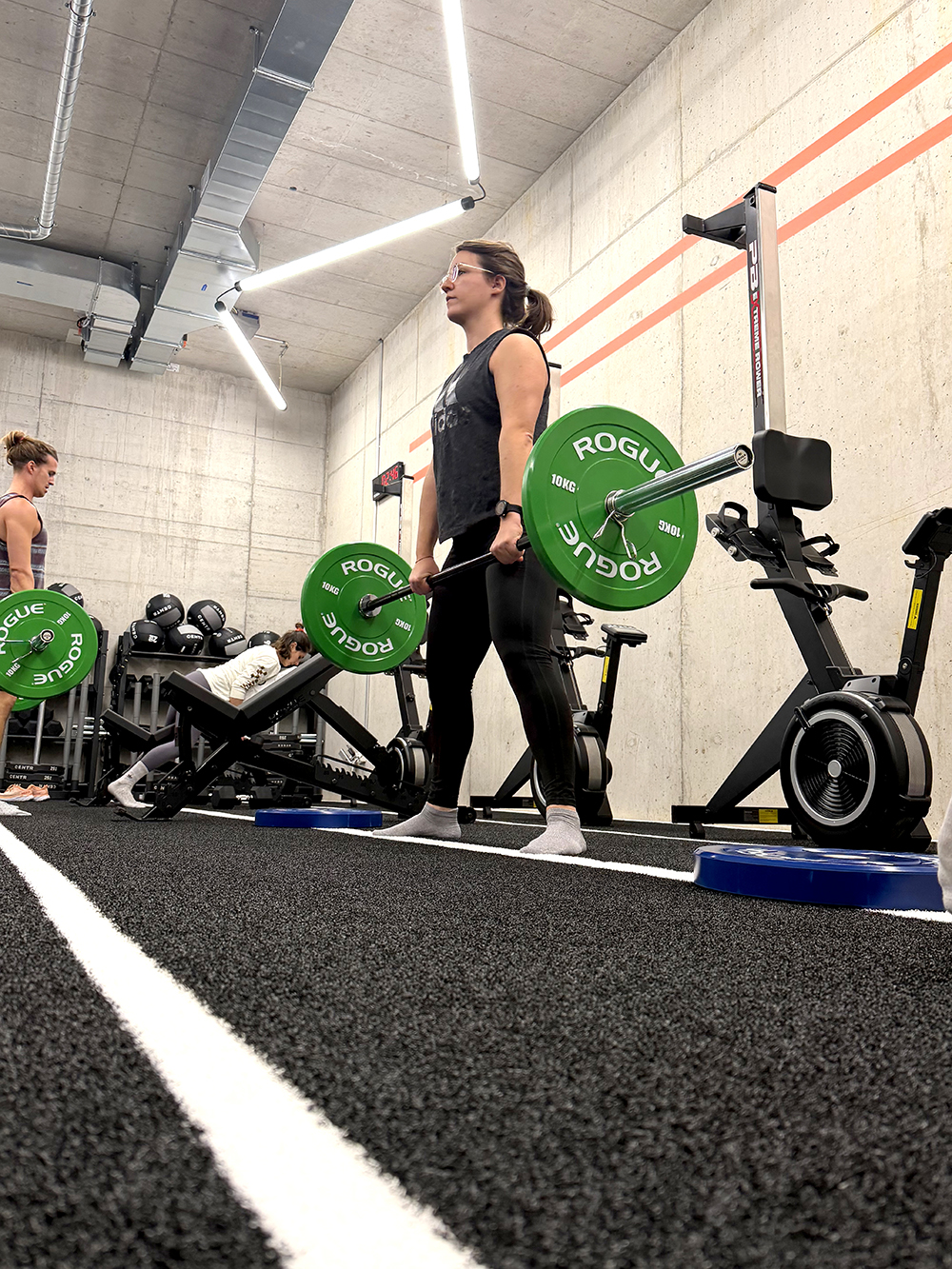
- Romanian deadlift: With dumbbells or a barbell, back neutral, weight close to your legs. 3 x 8–10, two to three times per week.
- Bird dog: On all fours, extend opposite arm and leg, pelvis still. 3 x 8 per side with a 3-second hold.
- Side plank: 3 x 20–40 seconds per side.
- Back extension on the bench: Controlled, without overextending. 3 x 10–12.
These exercises strengthen exactly the muscles that stabilise the back at the catch and through the drive.
How we treat back pain from rowing at Kineo
We do not only look at your back, but also at your movement on the machine. The aim is that you can keep training, with adapted loading.
1. Assessment: what we examine in your first session
- Movement tests of the lumbar spine: Which direction, bending or extension, triggers the pain?
- Brief neurological check: strength, reflexes and sensation in the legs as well as the straight leg raise test, to identify nerve irritation
- Hip mobility and hamstring length compared side to side
- Trunk endurance: hold times in the side plank and back extension (Biering-Sørensen test)
- Technique analysis: video of your movement on the rowing machine or SkiErg, if possible also when fatigued
2. Treatment in phases
- Phase 1: Adjust the load (weeks 1–2): Reduce intensity and damper, short sessions with clean technique. Pain-relieving treatment and movement in the pain-free direction.
- Phase 2: Strength and technique (weeks 2–6): Hip hinge, deadlifts, trunk exercises two to three times per week, 3 x 8–12 each. Technique drills on the machine.
- Phase 3: Intensity returns: Build intervals back in step by step, shorter first, then longer. Monitor pain during and on the day after training.
- Goal: Full sessions without back pain and without a reaction the next day.
3. Kineo services we use
- Sports physiotherapy: assessment, technique analysis and load plan
- Manual therapy for the lumbar spine, thoracic spine and pelvis when they are stiff
- Trigger point treatment and dry needling for tense back extensor and gluteal muscles
- Medical training therapy for targeted strength building of the trunk and hips
Warning signs: when to see a doctor
- Pain radiating into the leg with numbness or weakness
- Altered sensation in the buttock or genital area, or problems passing urine or stool: get checked by a doctor immediately
- Severe pain at night, fever or unexplained weight loss
- Localised pain at a rib that gets worse when rowing, breathing in deeply or coughing. With a lot of rowing training, this can point to a stress reaction of the rib.
From our practice
Often athletes come to us who have only recently added rowing to their training, for example in preparation for a competition. Their technique is fine at an easy pace, but breaks down in hard intervals. A few technique corrections, a lower damper setting and some strength work for the hip hinge are usually enough to get the back back on board.
Rowing and SkiErg in the building: Kineo Escher Wyss
Kineo Escher Wyss at Hardturmstrasse 18 is our sports physio location with a supervised training area. Kineo HYROX trains in the same building with rowing machines and SkiErgs. That way, your technique can be looked at right where you use it. You can find all the information on the Kineo Escher Wyss page.
Frequently asked questions
Is rowing bad for the back?
No. With good technique and adapted volume, rowing is good training, also for people with back problems. What matters is the position at the catch and the sequence of the movement.
Which damper setting is right?
For most athletes, a middle setting. A high setting feels heavier, but tempts you into a slow, pulling stroke from the back.
Can I keep rowing with back pain?
Often yes, with less intensity and shorter sessions. Mild discomfort that eases again the next day is usually fine. If the pain increases, take a break and have it checked.
Does health insurance cover physiotherapy?
Yes. With a doctor's prescription, your basic health insurance covers the cost. Kineo is recognised by all Swiss health insurers.
You might also like
Book an appointment
Is your back complaining on the rowing machine or SkiErg? Book your appointment at Kineo Escher Wyss.