By Martino Crivelli, physiotherapist and co-founder of Kineo, Kineo Escher Wyss
HYROX: running meets strength
In HYROX you run one kilometre eight times and complete eight workouts in between: SkiErg, sled push, sled pull, burpee broad jumps, rowing, farmers carry, sandbag lunges and wall balls. It is exactly this mix that makes the sport so popular and so demanding for the body. Your legs have to run while at the same time doing heavy strength work.
Typical complaints in HYROX
- Knee: Lunges, wall balls and burpee broad jumps put a lot of load on the kneecap. Pain at the front of the knee is typical.
- Lower back: Sled pull, farmers carry and rowing under fatigue quickly lead to a rounded posture.
- Shoulder: SkiErg and wall balls at high repetition numbers irritate the rotator cuff.
- Achilles tendon and calf: Running between the stations with tired legs.
- Calf and thigh strains from explosive jumps without enough warm-up.
How to prevent injuries
- Technique before tempo: Train wall balls, lunges and sled cleanly rather than fast
- Practise running under fatigue, but increase the volume step by step
- Build strength in the hip, trunk and shoulder blade in a targeted way
- Control your pace: If you know which heart rate zone you can run in, you stay more in control. A lactate test helps with this.
- Plan recovery: At least one to two easy days per week
If it already twinges
Minor symptoms are a signal, not a weakness. The earlier you react, the less training time you lose. We adapt your training rather than stopping it.
1. Assessment: what we examine in your first session
- Front of the knee (patellar tendon, kneecap): Pain with wall balls, lunges and burpee broad jumps? With the single-leg squat on a decline board, we test how resilient the tendon is.
- Lower back: Sled pull, rowing and farmers carry demand a stable hip hinge. We look at whether the movement comes from the hip or from the back.
- Shoulder: SkiErg and wall balls. We check the rotator cuff, shoulder blade control and overhead mobility.
- Calf and Achilles tendon: Eight kilometres of running plus jumps. Single-leg heel raises to fatigue show how much strength endurance is there.
- Training plan: How has your volume changed over the last four weeks? New stations, more running kilometres, one simulation a week?
2. Treatment in phases
- Phase 1: Restructure training. Adapt the painful station instead of cutting all training: for example less load on the sled, box step-ups instead of lunges or the bike instead of running.
- Phase 2: Make tendon and muscle resilient. Isometric and slow, heavy exercises, increased over several weeks.
- Phase 3: Back to simulation. First individual stations at race pace, then combinations with running, finally a full simulation.
3. Kineo services we use
- Sports physiotherapy in Escher Wyss, in the same building as the HYROX training
- Shockwave therapy for the patellar tendon, Achilles tendon or elbow
- Dry needling and medical massage for tight calves, hips and shoulders
- Kineo HYROX: training with coaches who know your limitations from physio
Station by station: what to watch for
- SkiErg: Take the power from the hip and trunk, not just from the arms. Protects the shoulders.
- Sled push and pull: Back straight, short powerful steps, work from the legs on the pull.
- Burpee broad jumps: Land softly, knees over the feet.
- Rowing: Legs first, then upper body, then arms.
- Farmers carry: Shoulders down, trunk firm, calm steps.
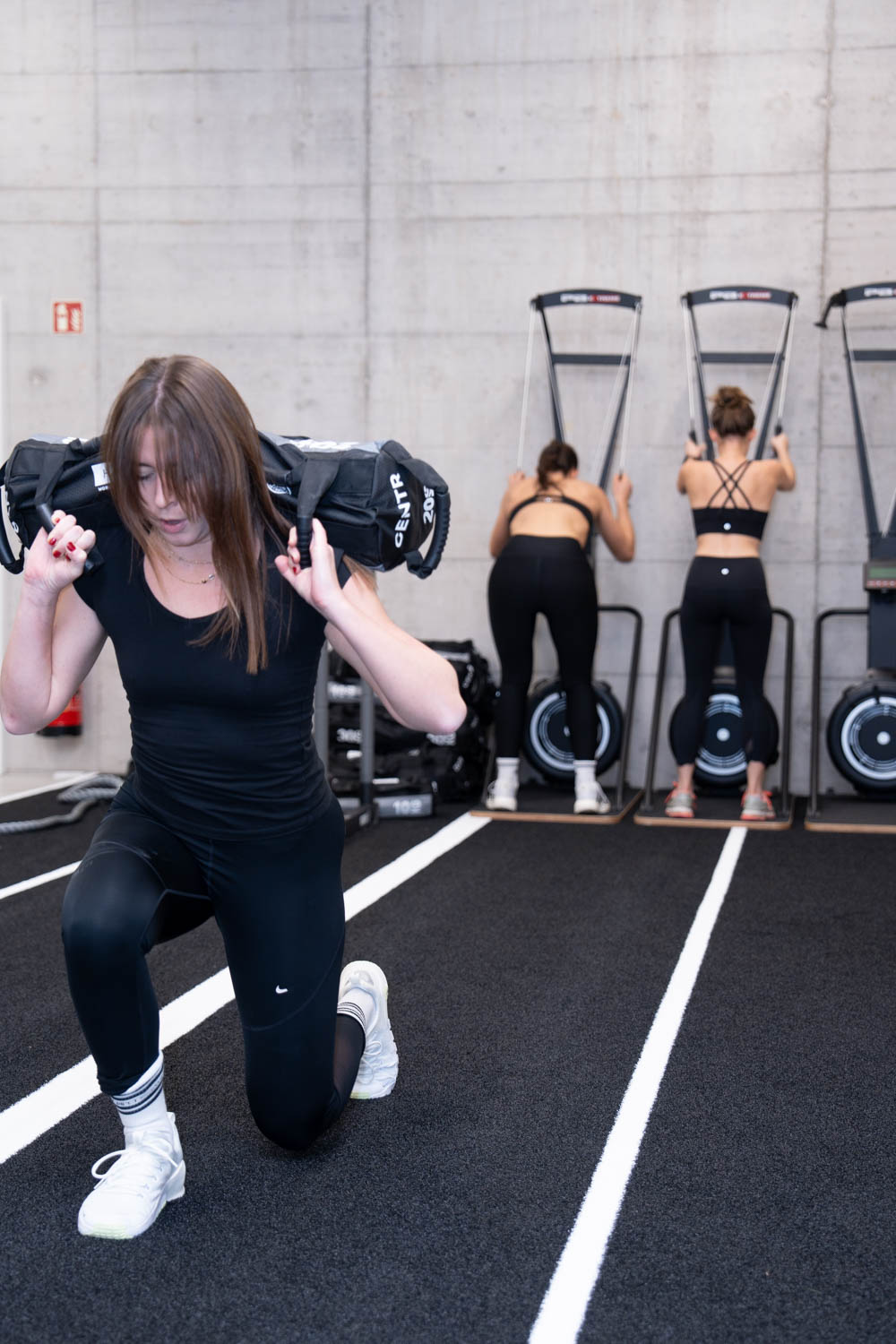
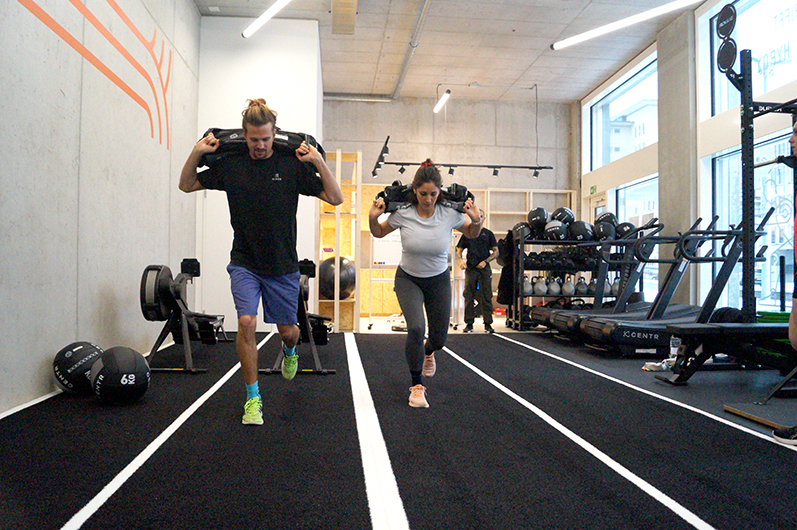
- Sandbag lunges: Don't let the knees fall inwards, keep the trunk upright.
- Wall balls: Deep squat with a stable back, throw the ball from the legs.
The real risk: running with tired legs
What is special about HYROX is not the individual station, but the switch between strength and running. After the sled push or lunges you run with fatigued thighs, the steps get shorter and heavier, the landing less controlled. Coaches call this compromised running.
- Practise it deliberately: Build short runs directly after a strength station into training, so that technique and feel get used to it
- Easy for the first 200 metres: After the station, take the pace down briefly until your running rhythm is back
- Strength endurance of the legs: If you can do many clean lunges and wall balls, you run more stably afterwards
Pacing: the most common mistake is starting too fast
Many people run the first kilometre far too fast and pay for it from the halfway point. It helps to base your running pace on your own threshold. A lactate step test shows which pace you can hold over a longer period without building up too much lactate. In HYROX training at Kineo we practise exactly this pacing, so that you don't complete the last stations completely exhausted and with sloppy technique.

From our practice
Typical are HYROX athletes who have the running sections under control but have never trained wall balls and lunges under fatigue. That is exactly where technique breaks down, and the knee or back speaks up. If you practise the stations deliberately in a tired state, you usually stay free of symptoms.
HYROX and sports physio in the same building
At Kineo Escher Wyss at Hardturmstrasse 18 (trams 8 and 17 to Escher-Wyss-Platz) you train HYROX downstairs, and physiotherapy is upstairs. If something twinges after a session, the way to treatment is short, and your training plan is adapted rather than stopped. You can find out more about the training at Kineo HYROX.
Frequently asked questions
Can I keep training HYROX with knee pain?
Often yes, with adapted stations. Lunges and wall balls can be replaced for a while as you build strength. But have the cause checked.
How many weeks of preparation do I need for my first HYROX?
If you run regularly and do strength training, you usually plan 8 to 12 weeks of targeted preparation.
What does a lactate test do for HYROX?
You know your pace for the running sections and avoid overpacing in the first kilometres.
How long does an appointment last?
A physiotherapy appointment at Kineo lasts 30 minutes. In the first session we clarify the cause and start straight away with treatment and first exercises.
You might also like
- Runner's knee: pain at the front of the knee
- Injury prevention in CrossFit
- Lactate test: benefits and procedure
Book an appointment
Is your knee, back or shoulder speaking up when you train? Book your appointment at Kineo Escher Wyss.