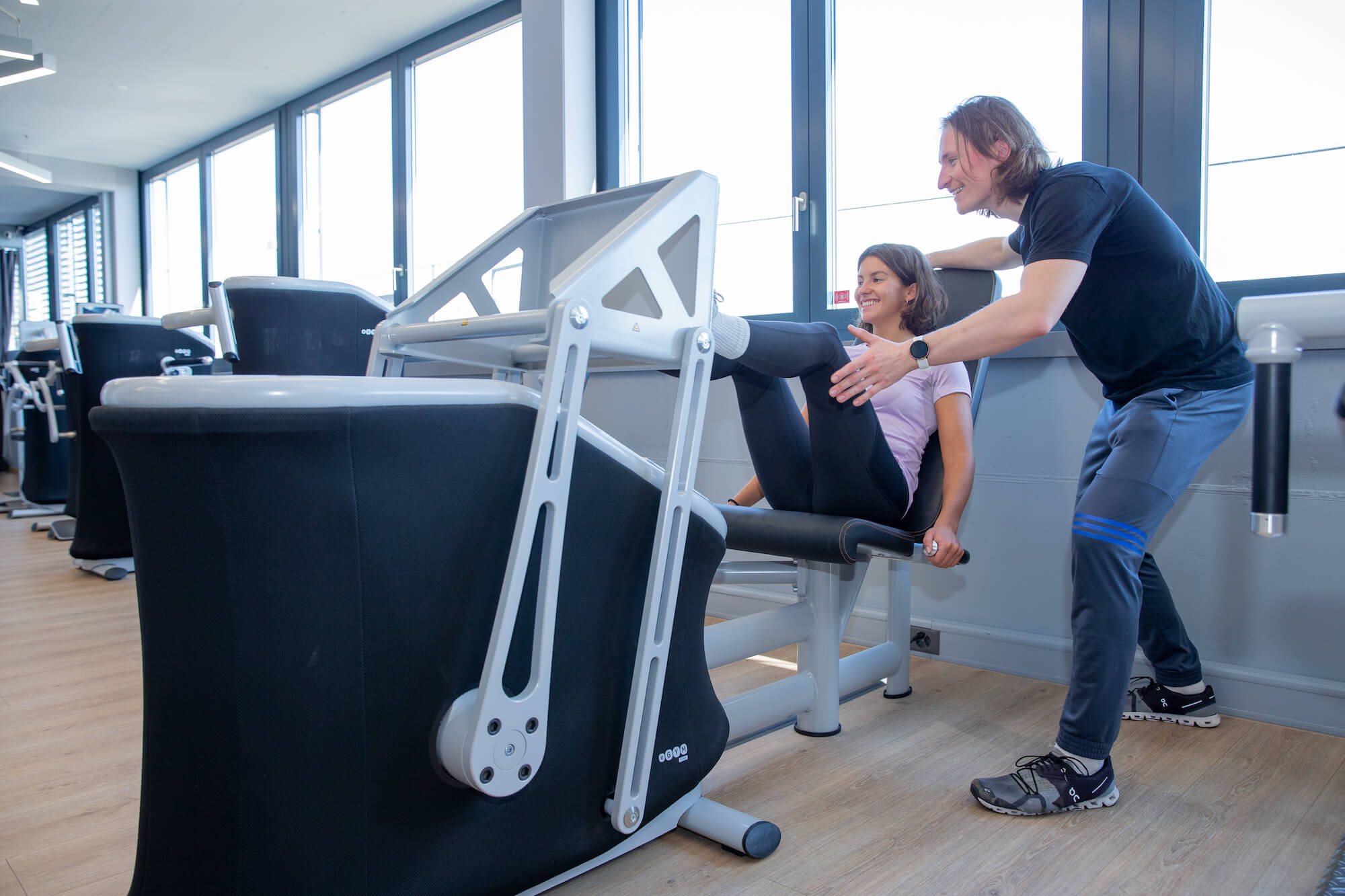

By Martino Crivelli, physiotherapist and co-founder of Kineo
Why training by feel often isn't enough
Most recreational athletes train by feel. The problem: easy runs often become too fast, and hard sessions aren't hard enough. The result is fatigue, stagnation and sometimes injuries. A lactate step test shows you how your body works in which zones, and makes your training plannable.
What is lactate?
Lactate is produced when your muscles get energy from carbohydrates. At easy effort, the body continually breaks it down again. As intensity rises, more lactate is produced than can be cleared, and the level in your blood goes up. The shape of this curve reveals a lot about your endurance: the later the lactate rises, the better your aerobic performance.

How does the test work?
A lactate step test takes about an hour including the debrief. Here is how to prepare and how it works in detail.
1. Preparation and procedure
- Preparation: No hard training the day before, eat normally, especially enough carbohydrates. Eat lightly two to three hours before the test.
- Initial conversation: Training volume, goals, injuries and medication that affects heart rate. Then we choose the starting stage.
- Stages: On the treadmill or the bike, the load typically increases every three to five minutes. This allows the lactate value to settle at each stage.
- Measurement: At the end of each stage, a drop of blood from the earlobe or fingertip, plus heart rate and your subjective feeling of effort.
- End: Until exhaustion or until the desired thresholds are clearly visible
2. What you read from the curve
- First threshold: The point at which lactate first rises above the resting value. Below it lies your easy base training.
- Second threshold: The range in which lactate rises steeply. The often-quoted 4 mmol/l is only an average. Your personal threshold can be considerably above or below it.
- Training zones: From the two thresholds, we derive heart rate and pace or watt ranges that you can enter directly into your watch.
- Repeat: After eight to twelve weeks of training, a second test shows whether the curve has shifted.
3. These Kineo services go with it
- Lactate step test at the Kineo Performance Lab in Seefeld
- Spiroergometry (CPET) at the Performance Lab, if you also want to know your VO₂max, ventilatory thresholds and fat burning
- Runners Physio, if you're returning after an injury and want to reset your zones
What you take away from the test
- Personal training zones by heart rate and pace or power output instead of general formulas
- Aerobic and anaerobic threshold: Where you can keep going for a long time and when it tips over
- Realistic race goals, for example for a half marathon, marathon or HYROX
- Concrete recommendations on how to structure your training week
Who benefits from a lactate test?
- Runners and cyclists preparing for a race
- HYROX and endurance athletes who want to control their pace in a targeted way
- Returners who want to build up safely after a break or injury
- Anyone who isn't improving any more despite a lot of training
A single test provides the starting point. It becomes really meaningful when you repeat it after a few months and see how your curve shifts.
How to use the zones in daily life
- Zone 1–2, easy: The majority of your runs or rides. You can still speak in full sentences.
- Threshold range: Tempo runs and intervals that raise your performance in a targeted way.
- High intensity: Short, hard sessions, used sparingly.
Many recreational athletes run their easy sessions too fast and their hard ones too slowly. The analysis shows exactly that in black and white.
Lactate test or spiroergometry: what is the difference?
Both tests work with stepwise load, but measure something different:
- Lactate step test: Measures via the blood how your metabolism responds to increasing load. This gives the thresholds and your training zones
- Spiroergometry (CPET): Measures via a breathing mask how much oxygen you take in and how much carbon dioxide you give off. This gives your maximal oxygen uptake (VO₂max), i.e. your aerobic ceiling. It also shows at which intensity your body burns more fat or more carbohydrates
For guiding training, the lactate test is often enough. If you also want to know where your performance limit lies and how your metabolism works, you combine both tests.
Same VO₂max, different time: running economy
Two runners with the same VO₂max can finish far apart in a race. The reason is running economy: how much energy you need for a given pace. It depends on technique, strength and tendon stiffness. That is why a running analysis complements performance diagnostics well: it shows where you lose energy, for example through overly long strides or long ground contact times. Targeted strength training has also been shown to improve running economy.

From our practice
We see the most common mistake again and again: many people wait too long before having their training checked, or increase too quickly after a break. Both cost progress or lead to injuries. If you know your zones and build up the load step by step, you progress faster and stay healthy.
Tests and packages at the Kineo Performance Lab
- Lactate step test: around 60 minutes, CHF 200
- Spiroergometry (CPET): measurement of maximal oxygen uptake (VO₂max), around 60 minutes, CHF 270
- Endurance Lab: lactate step test, spiroergometry and coaching, CHF 400
- Run Performance Lab: additionally with running analysis, CHF 650
The Performance Lab is at Kineo Seefeld on Seefeldstrasse 83, in the same building as the Runners Lab and physiotherapy. You can find all the details and available appointments on the Kineo Performance Lab page. If something twinges, our sports physiotherapists are not far away.
Frequently asked questions
Does taking the blood sample hurt?
Hardly. It is a small prick in the earlobe or fingertip, and a few drops are enough.
How often should I repeat the test?
Every three to six months, or before a new training block. That way you can see your progress.
Do I need to prepare in any way?
No hard training the day before, eat and drink normally, and bring your running shoes or cycling shoes.
Is a lactate test worthwhile for beginners too?
Yes, especially then. Many people train too intensely at the beginning. The test shows how easy easy really is.
You might also like
- Preparing for a marathon and half marathon without injury
- HYROX: preventing injuries
- Strength training for runners
Book an appointment
Do you want to know where you stand and train more precisely? Book your lactate step test at the Kineo Performance Lab.