
By Clara Benning, physiotherapist at Kineo Escher Wyss
Crossing the finish line together
Not everyone wants to tackle their first HYROX alone. In Doubles you start as a pair, in the Relay as a team of four. That lowers the barrier to entry and is fun, but it is still demanding. A team is only as good as its agreements. If you don’t know who takes which station, you lose time and, in the worst case, overload one person.
Here you’ll find out how the formats work, how to split the work and how to train together without overwhelming each other.
Doubles and Relay: the formats
- Doubles: you run all eight kilometres together. At the stations you split the work as you like, but only one person works at a time. Whoever isn’t working recovers.
- Relay: four people, each runs one kilometre twice and completes the two stations that follow. Then they hand over to the next person.
- Categories: there are women’s, men’s and mixed teams. The weights depend on the category.
Rules and weights can change from season to season. Check them in the current rulebook before you sign up.
What makes team formats different
- Higher intensity per block: because you recover between changeovers, you work faster and more powerfully at the station than in the singles race. That’s efficient, but puts more peak load on tendons and back.
- Your partner’s pace: in Doubles you run together. If one person is clearly faster, the other runs above their own pace and already arrives at the station tired.
- Ambition in the team: nobody wants to hold the team back. That’s exactly why pain is more likely to be ignored.
- The Relay is short and fast: many people run their two kilometres much faster than in the singles race, often after a long wait and without a proper warm-up. A typical scenario for calf and thigh strains.
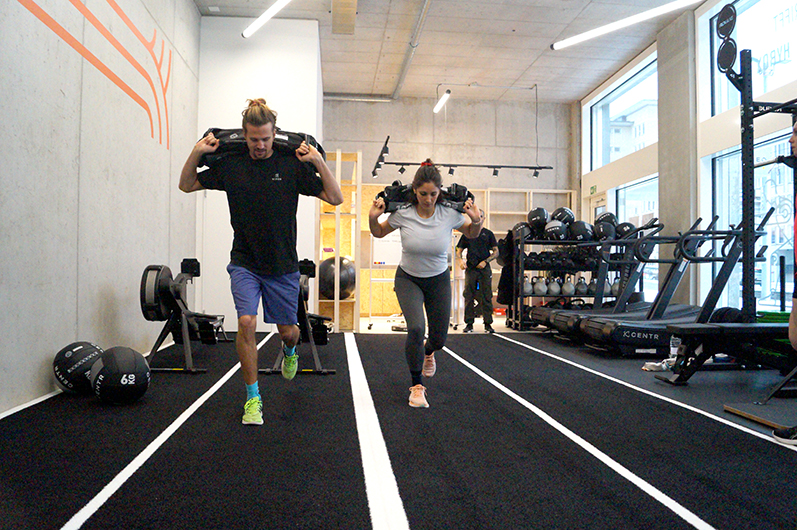
Splitting the work in Doubles
- By strengths: whoever has more strength takes on a bigger share of the sled push and sled pull. Whoever has more endurance does more SkiErg and rowing.
- Short changeovers for wall balls and burpee broad jumps: blocks of 10–20 wall balls or a few metres of burpees keep the technique clean.
- Farmers carry and lunges: switch before your grip gives out or your technique breaks down, not afterwards.
- Set a plan: agree beforehand who does what, and practise the changeovers in training.
Relay: the right order
In the Relay, the starting position determines who gets which stations:
- Position 1, SkiErg and sled push: suits strong people with endurance and a powerful upper body and legs.
- Position 2, sled pull and burpee broad jumps: requires pulling strength and lots of landings. If you have knee or back complaints, this is probably not the spot for you.
- Position 3, rowing and farmers carry: suits people with good endurance and a strong grip.
- Position 4, sandbag lunges and wall balls: demands strength endurance in the legs and shoulders.
How we prepare you at Kineo
A team prepares best together, but each person brings their own strengths and weak points. That’s why we look at each person individually and then plan the split.
1. Our check before the start
- History: injuries, current complaints and training level of each person
- Strength endurance: single-leg calf raises to fatigue, side plank hold and grip strength with a hand dynamometer
- Mobility: overhead arm raise, knee-to-wall test and hip extension
- Technique at the stations: hip hinge for the sled pull, squat and throw for the wall balls, landing in the broad jumps
- Jump and landing control: single-leg squat and hop tests compared side to side
2. How we build your training
- Weeks 1–4, base: each person works on their weak points. Strength training twice a week, easy runs, practising the station technique.
- Weeks 5–8, training together: at least one team session per week. Find a shared running pace and practise changeovers, for example 4 rounds of 1 kilometre running and one station, taking turns.
- Weeks 9–11, simulation: half or full race simulation with the planned changeover plan. In the Relay, practise the handovers and warming up before your leg.
- Last week, tapering: less volume, short fast stimuli, finalise the changeover plan.
3. Kineo services we use
- Sports physiotherapy: a check for each person and treatment for complaints
- High-intensity interval training for short, intense work blocks with changeovers
- Sport-specific training for technique at the stations
- Power training for Relay runners who go short and fast
- Lactate step test at the Kineo Performance Lab Seefeld to set a realistic team running pace
Warming up before your Relay leg
In the Relay, there is often a long time between the start and your own leg. Where possible, warm up again shortly before your turn:
- 5 minutes of easy jogging or brisk walking with arm circles
- Leg swings forwards and to the side, 10 per leg each
- Calf raises and lunges, 10 each
- 2–3 strides over 20–30 metres
Goal: warm and alert at the handover, not tired.

From our practice
In team training, we often see the stronger person taking on too much, especially on the sled. That works in training, but in competition they then lack the strength for the last stations. Teams that split the work realistically and practise the changeovers usually get through more evenly. And: complaints are more likely to be kept quiet in a team. A frank word early in the preparation often saves a long break later on.
Training and physio at Escher-Wyss-Platz
At Kineo Escher Wyss at Hardturmstrasse 18, sports physiotherapy and Kineo HYROX are in the same building: HYROX downstairs, physiotherapy upstairs. In group and personal training at Kineo HYROX, you practise the stations with guidance, and if something twinges, sports physiotherapy is close by. Find out more about the location on the Kineo Escher Wyss page.
Frequently asked questions
Is Doubles easier than singles?
The station work is shared, but you both run the eight kilometres. Many people go faster in Doubles than in singles, so it isn’t easy.
Do we have to be equally fast?
No, but the running pace is set by the slower person. In return, the faster person can take on more at the stations.
How long does an appointment last?
An appointment lasts 30 minutes. In the first session, we clarify the cause and start straight away with treatment and exercises.
Does health insurance cover physiotherapy?
Yes. With a doctor's prescription, your basic health insurance covers the cost. Kineo is recognised by all Swiss health insurers.
You might also like
- Your first HYROX: the 12-week plan
- HYROX: typical injuries and how to avoid them
- Muscle soreness, strain or torn muscle fibre? How to tell the difference
Book an appointment
Preparing for HYROX as a team? Book your check at Kineo Escher Wyss.