By Noah Stierli, physiotherapist at Kineo Seefeld
When your hip hurts while running
The first kilometres go well, then your hip makes itself known. Sometimes it stabs on the outside of the thigh, sometimes it pulls deep in the groin, sometimes it radiates into the buttock. Many runners keep going anyway, because the pain eases after training. The next morning it is back when you climb stairs or lie on your side.
“Hip pain” is not a diagnosis, but a location. Pain on the side has a different cause from pain in the groin. If you know exactly where it hurts and when, you get to the right solution faster.
Where does it hurt? The most common causes
- On the side of the hip: gluteal tendinopathy. The tendons of the small gluteal muscles (gluteus medius and minimus) attach to the greater trochanter. If they are overloaded or pressed against the bone, the outside of the hip hurts. In the past, people mostly spoke of “bursitis”. Today we know that the tendon is often the main problem.
- At the front, in the groin: hip joint. Hip impingement (FAI), where the head of the thigh bone and the rim of the socket bump into each other in deep flexion, or irritation of the joint lip (labrum) show up as deep groin pain. Many people point to it with a hand held in a C shape around the hip.
- At the front, in the groin: hip flexor. The iliopsoas can become irritated by hill running, intervals and a lot of knee drive.
- At the back, in the buttock: the attachment tendon of the hamstrings at the sit bone (proximal hamstring tendinopathy), the sacroiliac joint, or pain radiating from the lumbar spine.
- Hip osteoarthritis: more likely in the second half of life, with start-up pain, stiffness and limited internal rotation.
Often several factors work together: mileage increased too quickly, more hill running than usual, little strength in the hip muscles, and feet that land very close to the midline.
Warning signs: when you should not keep running
One important cause that must not be overlooked is a stress fracture of the femoral neck. It shows up as groin pain that comes earlier with every run, clearly increases when you hop on the affected leg, and is sometimes felt at rest or at night as well. Runners with a clear increase in mileage, very low body weight, too little energy intake relative to training, or missing periods have a higher risk.
Have your hip checked by a doctor if you limp, can no longer hop on one leg, the pain occurs at night or at rest, started after a fall, or comes with fever, weight loss or a general feeling of being unwell. Until then: no running.
What you can do yourself
- Adjust your load, don't stop completely: With tendon problems, reducing mileage, speed and hill running usually helps more than a complete break. Pain of up to about 3 out of 10 during the run that has settled again by the next day is considered acceptable.
- Relieve pressure when lying on your side: With pain on the side of the hip, don't sleep directly on the painful side. If you lie on the other side, put a pillow between your knees.
- Don't “hang” in the hip joint: When standing, don't shift your weight onto one leg and push the hip out to the side. This position presses the tendons against the greater trochanter.
- No intense stretching for pain on the side: Stretches in which the leg is pulled across the midline can compress the irritated tendons even more.
- Check your running style: If your feet land almost on one line, a slightly wider track and a slightly higher cadence can take the load off the side of the hip.
How we treat hip pain when running at Kineo
It starts with the question of which structure hurts. After that, we adjust load, training and running style specifically to it.
1. Assessment: what we examine in your first session
- Pain location and course: when in the run the pain starts, how it reacts the next day, what has changed in your training
- Hip joint: flexion with internal rotation (FADIR test), flexion with external rotation (FABER test) and internal rotation compared between sides
- Side of the hip: single-leg stance for 30 seconds, palpation at the trochanter and leg abduction against resistance. This combination is a good indicator of gluteal tendinopathy.
- Strength compared between sides: abductors, hip extensors and hip flexors, tested left and right against resistance
- Lumbar spine and sacroiliac joint as possible sources of pain, plus a hop test only if there is no suspicion of a stress fracture
- Running pattern: track width, pelvic drop and cadence on the treadmill
2. Treatment in phases
- Phase 1, weeks 1–2: calm the pain. Reduce running mileage, run on the flat instead of uphill, isometric exercises for the hip abductors, for example 5 x 30–45 seconds holding against a wall.
- Phase 2, weeks 2–6: build strength. Bridge, side plank variations, step-ups and single-leg deadlifts, 3 x 8–12 repetitions, two to three times a week with increasing load.
- Phase 3, from weeks 4–8: running-specific. Gradually bring back hopping, skipping rope, hill running and speed, and adjust your running style.
- Back to full training: single-leg stance and hopping pain-free, strength roughly equal between sides, no reaction the next day.
3. Kineo services we use
- Runners Physio: assessment, load management and a plan for your runs
- Currex 5D running analysis at the Runners Lab, when track width or pelvic drop play a role
- Medical training therapy for targeted strengthening of the hip muscles
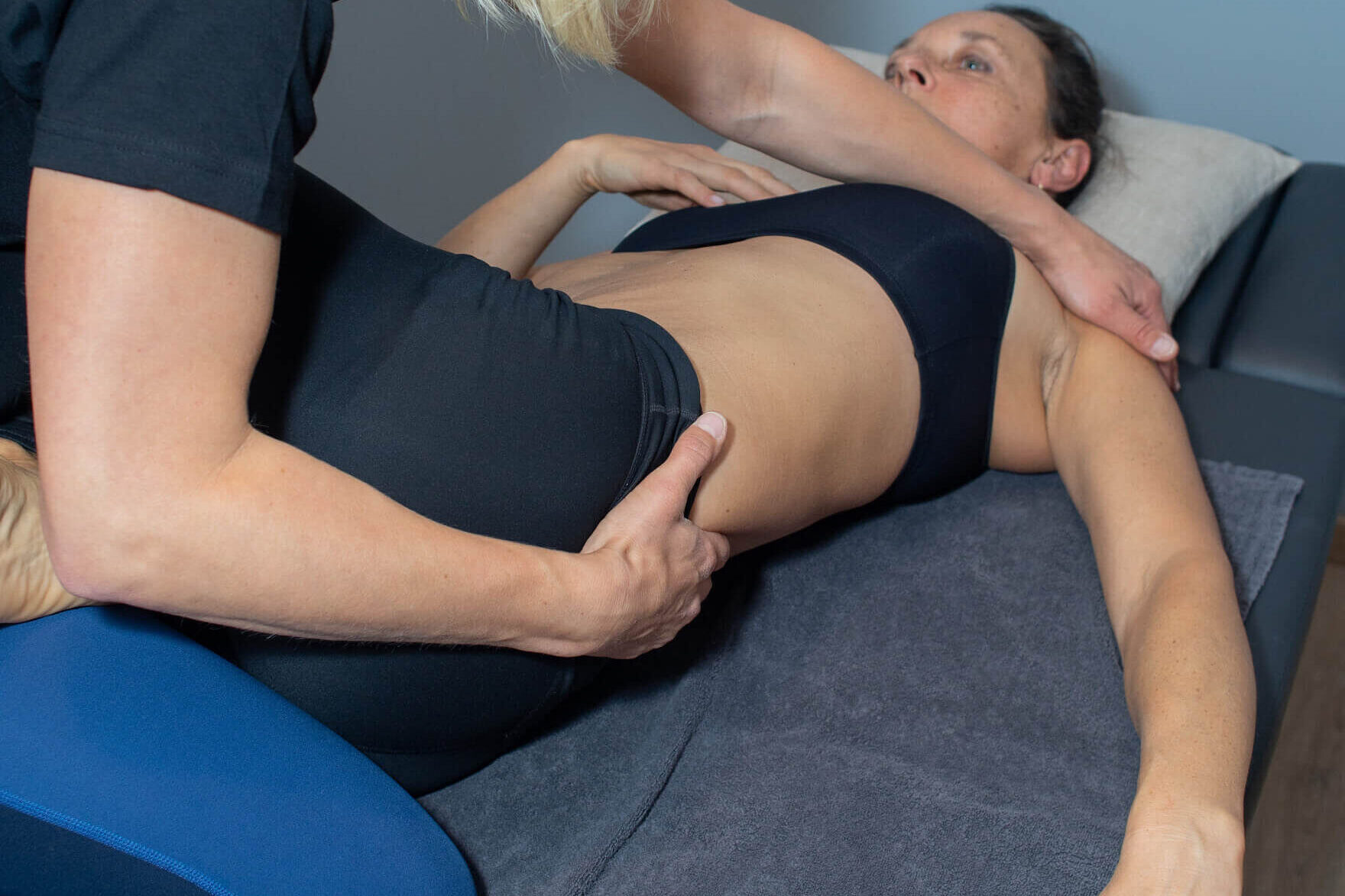
- Manual therapy for limited hip mobility or involvement of the lumbar spine and sacroiliac joint
- Shockwave therapy for stubborn gluteal tendinopathy, as a complement to strength training
Three exercises for a resilient hip
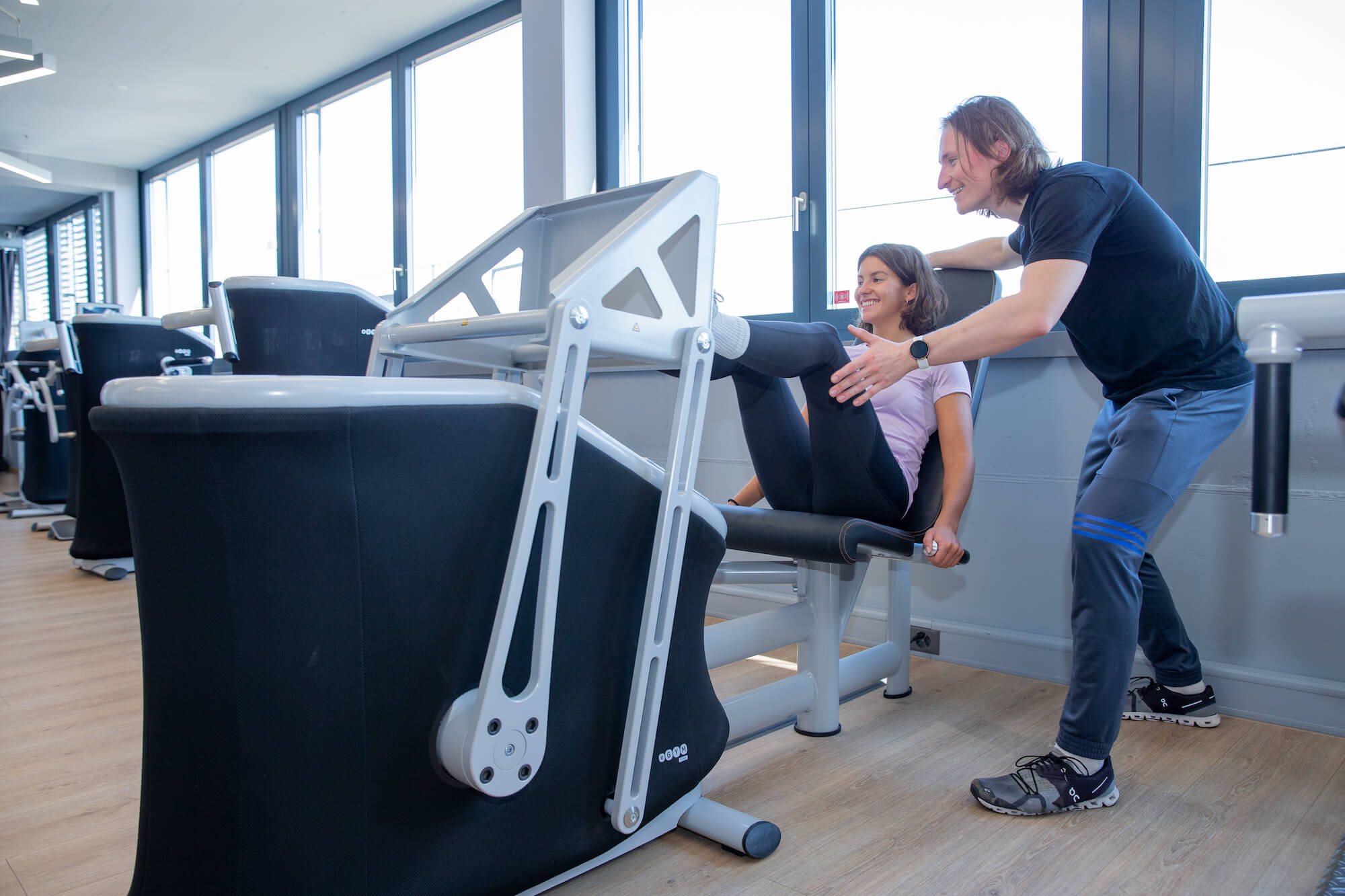
- Standing isometric abduction: Stand side-on to a wall with the leg nearest the wall slightly bent. Press the knee against the wall with moderate force and hold. 5 x 30–45 seconds. Well suited to the painful phase.
- Side plank with bent knees: On your forearm, knees and hips slightly bent, lift your pelvis. 3 x 20–30 seconds per side. Later with straight legs.
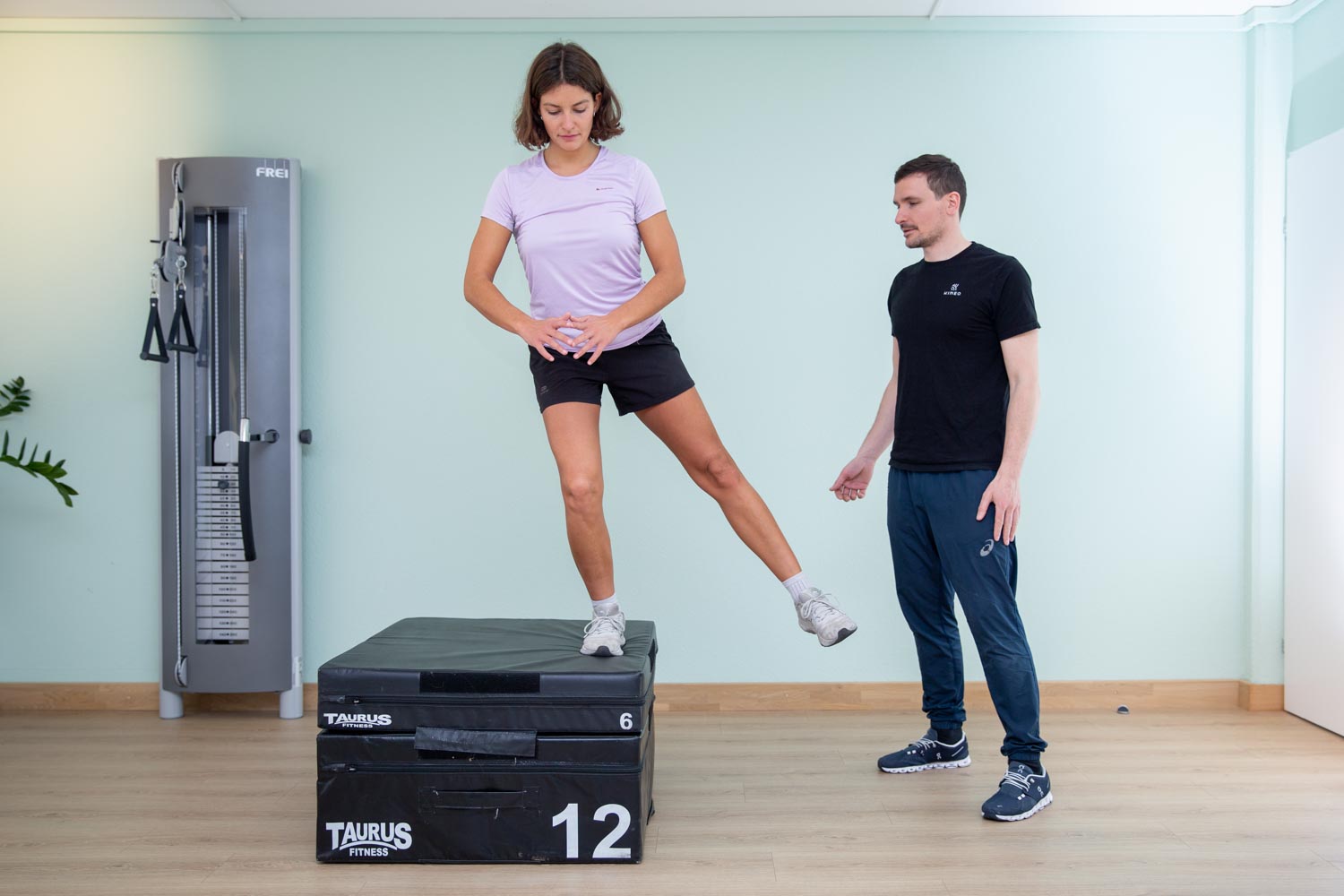
- Step-up onto a box: Place your foot on the box, step up over that leg, keep your pelvis level, knee pointing forwards. 3 x 8–12 per side, later with dumbbells.
Do the exercises two to three times a week. A slight pulling feeling during the exercise is fine, as long as it is not stronger the next day.
From our practice
Many runners with pain on the side of the hip come to us with a long list of stretching exercises. These rarely make the pain better. What is usually missing is strength in the muscles on the side of the hip and smart management of hill running. Once both are right, most people can keep running, often with somewhat less mileage, but without a long break.
Runners Physio and running analysis in Seefeld
At Kineo Seefeld at Seefeldstrasse 83, Feldeggstrasse stop with trams 2 and 4, running is a focus. On the first floor you will find physiotherapy with Runners Physio, and on the ground floor the Kineo Runners Lab with running shoes and the Currex 5D running analysis. That way we can bring assessment, running style and shoe together in one place.
Frequently asked questions
Can I keep running with hip pain?
With most tendon problems, yes, with less mileage and speed. Pain of up to about 3 out of 10 that has settled by the next day is acceptable. If you limp, have night pain or pain when hopping, stop running and have it checked by a doctor.
Do different running shoes help?
The shoe alone rarely solves hip pain. But it can be part of the solution, for example if a new model has changed your running pattern. We clarify that with the running analysis.
Does health insurance cover physiotherapy?
Yes. With a doctor's prescription, your basic health insurance covers the cost. Kineo is recognised by all Swiss health insurers.
You might also like
- Groin pain in athletes
- Strength training for runners
- Trail running: getting started and running downhill
Book an appointment
Is your hip holding you back when you run? Book your appointment at Kineo Seefeld and we will find out together where the pain comes from.