By Andrina Kümin, physiotherapist at Kineo Seefeld
From tarmac to trail
Forest paths, roots, metres of climbing and views: trail running brings variety to your running training. Many road runners take the step onto the trail and quickly notice that it feels different. Uphill your calves burn, downhill your thighs tremble, and the next day the muscle soreness is greater than after any city run.
With a well-planned start, good downhill technique and some strength training, trail running becomes a gentle and varied form of training. Here you can find out what matters.
What is different on the trail
- Uneven ground: Every step is slightly different. Your ankles and feet have to compensate constantly. This trains stability, but at the beginning it increases the risk of rolling your ankle.
- Uphill: The load shifts to your calves, glutes and cardiovascular system. Walking on steep sections is not a failure, but is often more efficient than running.
- Downhill: Your thigh muscles work eccentrically, meaning they brake while lengthening. This kind of loading produces a lot of muscle soreness and challenges the knee and kneecap.
- Time instead of pace: On the trail, pace says little. Plan runs by time and metres of climbing instead of kilometres.
Typical problems when starting out
- Severe muscle soreness in the front of the thighs after the first descents
- Pain at the front of the knee around the kneecap, especially downhill and on stairs
- Pain on the outside of the knee on long descents, typical of runner's knee
- Rolling your ankle on roots and stones
- Calf and Achilles tendon problems from many steep climbs
Running downhill: how to protect your knees and muscles
- Short, quick steps: The shorter the step, the less each leg has to brake.
- Land with your foot under your body: Don't jab it into the ground far in front of your body with a straight knee.
- Don't lean back: Your upper body stays upright or leans slightly forward. If you lean back, you brake harder and slip more easily.
- Look ahead: Look three to five metres ahead so that you can plan your steps.
- Arms for balance: Your arms can swing out further to the sides than on the road.
- Use poles: On long, steep descents, poles relieve your knees and thighs.
Good to know: your body gets used to downhill loading quickly. After the first short descents, muscle soreness in the next similar session is usually much smaller. So increase the length of descents step by step.
What you can do yourself
- Start slowly: At the beginning, replace one of your runs per week with a trail with little climbing.
- Increase climbing gradually: Raise climbs and especially descents moderately from week to week.
- Suitable shoes: Trail shoes with a tread give more grip on wet ground and roots.
- Equipment: On longer runs, water, a jacket, a charged phone and something to eat belong in your running vest. The weather in the mountains can change quickly.
- Train strength: Two strength sessions a week protect your knees and ankles.
How we prepare you for the trail at Kineo
Whether you are just starting out or preparing for your first trail race: we check whether your ankles, knees and muscles are ready, and build your training accordingly.
1. Our check before you start
- Ankle: single-leg stance with eyes closed, Y-Balance Test and questions about previous ankle sprains
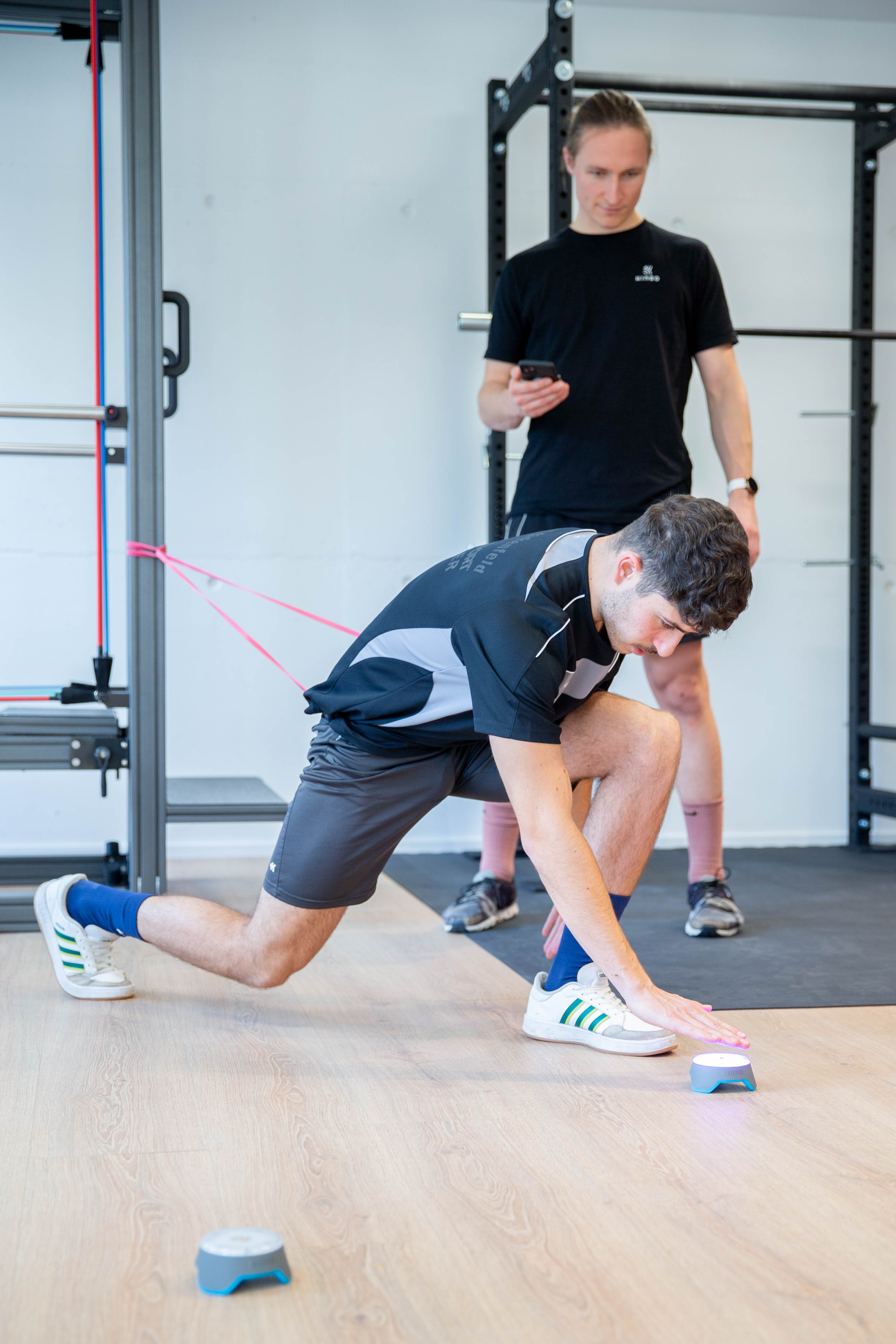
- Knee and leg alignment: step-down test from a step, in which we watch the control of your knee and pelvis as you lower
- Strength: single-leg calf raises to fatigue and single-leg squat, comparing both sides
- Hip and trunk: side plank and hip abduction against resistance
- Running pattern and shoe: stride length, foot strike and the tread of your shoe
2. How we build your training
- Weeks 1–4: getting used to it. One trail per week with little climbing, plus two strength sessions with step-downs and calf raises, 3 x 10–15 each.
- Weeks 5–8: build up climbing. Longer climbs, short controlled descents, slowly lowered Bulgarian split squats, 3 x 8–10 per side.
- From week 9: technique and length. Longer and more technical descents, jumping and stability exercises for quick reactions on the trail.
- If you have symptoms: Temporarily reduce descents or walk with poles, and continue the strength build-up.
3. Kineo services we use
- Runners Physio for knee, ankle or Achilles tendon problems
- Medical training therapy for strength in the thighs, calves and hips
- Sport-specific training with eccentrics, stability and jumps for the trail
- Currex 5D running analysis in the Runners Lab, to check stride length and running style
Warning signs on and after the trail
See a doctor if you can't put weight on your foot after rolling your ankle, if the ankle swells a lot or if bones are tender to the touch. A knee that swells, locks or gives way should also be checked. Very severe, persistent muscle pain with dark urine after an extreme run is an emergency.
From our practice
Many road runners bring good endurance and therefore underestimate their first longer trail. Uphill goes well, and the problems usually begin on the descent. If you deliberately keep descents short in the first weeks and add step-downs to your strength training, you usually get through the transition without knee pain.
Runners Physio and Runners Lab in Seefeld
At Kineo Seefeld at Seefeldstrasse 83, stop Feldeggstrasse with trams 2 and 4, running is a focus. On the 1st floor you will find the physiotherapy with Runners Physio, and on the ground floor the Kineo Runners Lab with running shoes and Currex 5D running analysis.
Frequently asked questions
Do I need trail shoes to get started?
On dry, wide forest paths your road shoe is often enough. On wet, steep or stony trails, trail shoes with a tread give much more grip.
Is running downhill bad for the knees?
Not in general. Downhill loads the knees more, but the muscles get used to it well. A gradual increase, good technique and strength in the thighs are important.
Can I walk uphill?
Yes. Brisk walking on steep climbs is often just as fast as running and saves energy for the rest of the run.
Does health insurance cover physiotherapy?
Yes. With a doctor's prescription, your basic health insurance covers the cost. Kineo is recognised by all Swiss health insurers.
You might also like
Book an appointment
Do you want to start trail running safely or prepare for your first trail race? Book your appointment at Kineo Seefeld.