
By Noah Stierli, physiotherapist at Kineo Seefeld
When your ear feels pressure, but the jaw is behind it
You have a feeling of pressure in your ear, a whistling or hissing, perhaps pain in front of the ear too. The doctor at the ENT practice finds nothing unusual, and your hearing is fine. Even so, it still feels as if your ear is "blocked". Sometimes it gets stronger when you clench your teeth, talk a lot or are stressed.
This is exactly the combination we often see in our jaw practice. The jaw joint sits directly in front of the ear canal, and the chewing muscles and the muscles of the ear and throat are partly supplied by the same nerves. Problems in the jaw and upper neck can therefore feel like an ear problem. Specialists then speak of CMD, cranio-mandibular dysfunction, a functional disorder between the skull and the lower jaw.
How the jaw, neck and ear are connected
- Close neighbours: The jaw joint sits just a few millimetres in front of the ear canal. Irritation in the joint is often felt as ear pain.
- Shared nerve supply: The trigeminal nerve supplies the chewing muscles and parts of the ear and face. Signals from the jaw can therefore "radiate" into the ear.
- Referred pain from muscles: Tense chewing muscles such as the masseter (the large chewing muscle in the cheek) or the lateral pterygoid muscle create typical pain patterns around the ear.
- Somatosensory tinnitus: In some people, the ear noise changes when they move or tense the jaw or head. This is called somatosensory tinnitus. Here, signals from muscles and joints influence how the brain processes sound.
- Upper neck: The upper cervical spine is closely linked with the jaw. Faulty loading in the neck often makes jaw complaints worse, and the other way round.
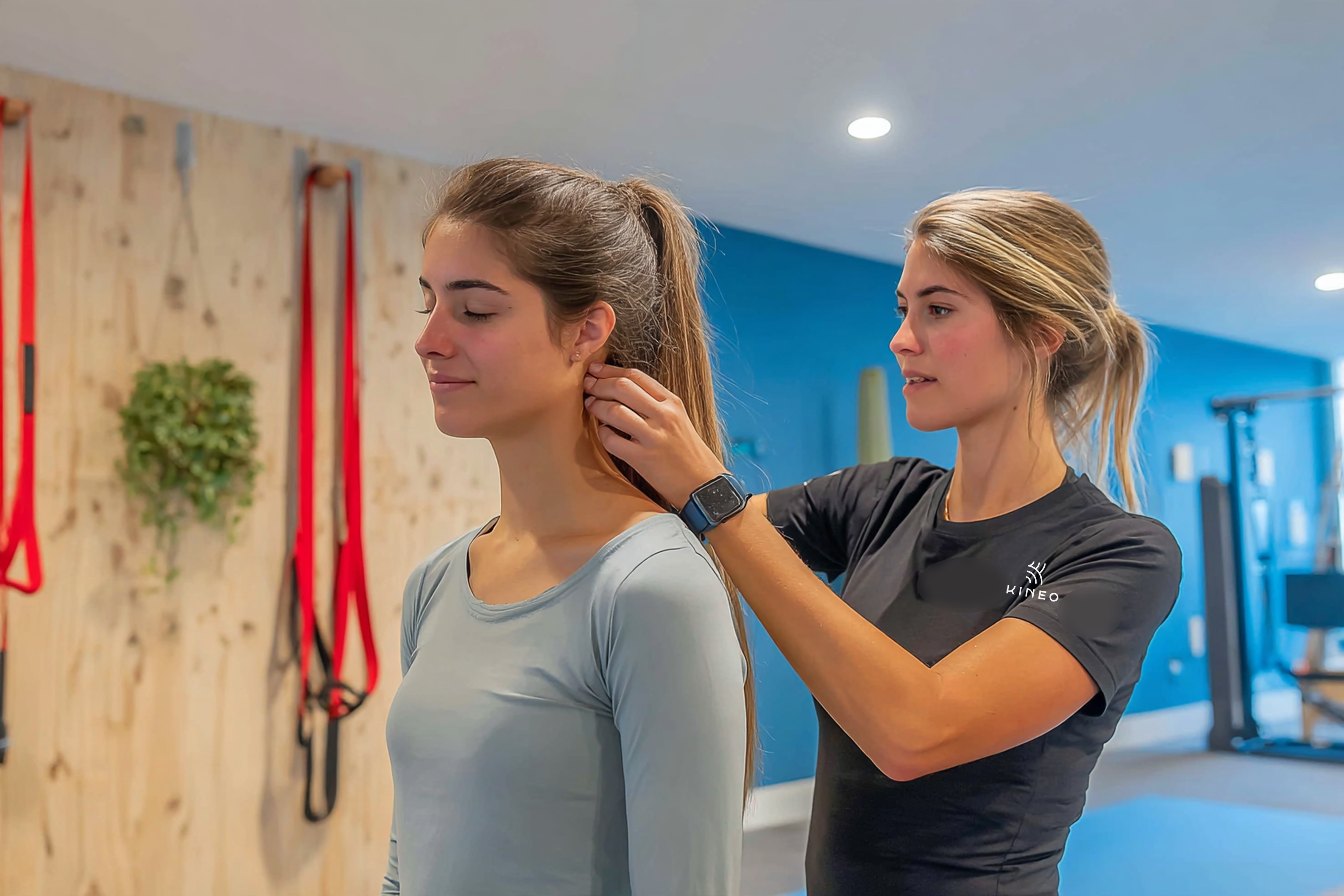
Typical signs that the jaw is involved
- A feeling of pressure or fullness in the ear, with nothing found in the ear itself
- Tinnitus that gets louder or quieter when you open your mouth, clench your teeth or turn your head
- Pain in front of the ear, at the temple or at the angle of the jaw
- Clicking or grinding in the jaw joint
- Accompanying neck pain or headaches
- Symptoms increase clearly in stressful periods
Not every tinnitus has to do with the jaw. Most ear noises arise in the hearing system itself. But if the noise can be changed by movements of the jaw or neck, it is worth taking a close look at these structures.
Warning signs: see a doctor first
Before we start physiotherapy, your ear should have been examined by a doctor. See a doctor quickly if you notice any of these signs:
- Sudden hearing loss or muffled hearing on one side (possible sudden sensorineural hearing loss, get it checked on the same day if possible)
- Pulsatile tinnitus, that is, a whooshing in time with your heartbeat
- One-sided tinnitus that is new and persists
- Discharge from the ear, fever or severe ear pain
- Spinning dizziness with nausea, visual disturbances, paralysis or speech problems
- Numbness in the face
What you can do yourself
- Practise the jaw rest position: Lips loosely closed, teeth slightly apart, the tip of your tongue resting on the palate behind the upper front teeth. Check briefly several times a day whether you are clenching.
- Notice clenching in daily life: Small coloured dots on your screen or phone remind you to release your teeth. Many people clench unconsciously while working, driving or doing sport.
- Heat: A warm cloth or cherry stone pillow on your cheek and temple for 10–15 minutes relaxes the chewing muscles.
- Gentle jaw opening: Keep your tongue on the palate and open your mouth slowly, only as far as your tongue stays up. 2 x 10 repetitions, two to three times a day.
How we treat CMD with tinnitus and ear pressure at Kineo
Our aim is to find out whether and how much the jaw and neck are involved in your ear symptoms, and to treat those parts specifically.
1. Assessment: what we examine in your first session
- Modulation test: You bite, open or push your jaw against light resistance, and you also move your head against our hand. We ask whether your tinnitus or ear pressure changes as you do so.
- Mouth opening: We measure the maximum opening in millimetres and observe whether the lower jaw opens straight or deviates to the side.
- Jaw joint: We check for noises such as clicking or grinding and the mobility of the joint in sideways and forward movements.
- Palpating the chewing muscles: Masseter, temporalis muscle and the muscles under the jaw. We check whether pressure triggers your familiar ear symptoms.
- Upper neck: Mobility of the upper cervical joints, for example with the flexion-rotation test, and tension in the neck muscles.
- Habits: Clenching, grinding, sleep, stress and workstation. These factors often determine how quickly you get better.
2. Treatment in phases
- Phase 1, weeks 1–2: Relieve and understand. We explain the connections, treat the chewing muscles and upper neck manually and give you the rest position and two to three simple exercises to take home.
- Phase 2, weeks 3–6: Mobility and control. Targeted mobilisation of the jaw joint, coordination exercises for straight mouth opening and strengthening of the deep neck flexors, 1–2 x 10 repetitions daily.
- Phase 3, from week 6: Becoming independent. We reduce the appointments and you take over your programme. We discuss strategies for stressful periods and setbacks.
3. Kineo services we use
- CMD jaw therapy: assessment, treatment of the jaw joint and chewing muscles, and your exercise programme
- Manual therapy for the upper cervical spine, when the neck contributes to your symptoms
- Trigger point treatment on the masseter, temporalis and neck muscles, which refer pain into the ear
- Dry needling for stubbornly tense chewing and neck muscles
- Digital home programme, so you can continue your exercises safely at home
What physiotherapy can realistically do
If the jaw and neck are involved in your tinnitus, physiotherapy can help make the noise quieter or less bothersome. Tinnitus does not disappear completely in everyone.
We treat the part that comes from muscles and joints. For tinnitus that arises mainly in the hearing system, ENT doctors, hearing care professionals and tinnitus counselling are the right partners. The two often complement each other well.

From our practice
Many people with ear pressure have already had several doctor's appointments before anyone looks at the jaw. When we palpate the masseter in the first session and suddenly the familiar pressure in the ear appears, the relief is often great. Simply understanding where the symptoms come from takes away part of the worry for many people.
Jaw expertise in Zürich Seefeld
At Kineo Seefeld on Seefeldstrasse 83, right by the Feldeggstrasse stop (trams 2 and 4), the jaw is one of our areas of focus. We treat CMD using the CRAFTA concept, which looks at the jaw, head, face and neck together. You can find out more about the location on the Kineo Seefeld page.
Frequently asked questions
Can tinnitus really come from the jaw?
In some people, yes. Typically, the noise changes with jaw movements, clenching or head movements. We check whether this applies to you in your first session.
Do I need an ENT check-up first?
Yes, we recommend it. Ear diseases and sudden hearing loss must be ruled out first. After that, we can target the jaw and neck.
How long does an appointment last?
An appointment lasts 30 minutes. In your first session, we clarify the cause and start straight away with treatment and exercises.
Does health insurance cover physiotherapy?
With a doctor's prescription, your basic health insurance covers the cost. Kineo is recognised by all Swiss health insurers.
You might also like
- CMD (cranio-mandibular dysfunction)
- Teeth grinding (bruxism): causes and physiotherapy
- The CRAFTA concept: physiotherapy for the jaw, head and face
Book an appointment
Ear pressure or tinnitus, and your jaw feels tense? Book your appointment at Kineo Seefeld and have your jaw and neck examined thoroughly.