By Noah Stierli, physiotherapist at Kineo Seefeld
When your jaw works at night
You wake up with a tense jaw, have headaches at your temples, or your dentist has noticed worn teeth? Then bruxism is often behind it, meaning teeth grinding or jaw clenching. Many people don't notice it themselves, because it happens in their sleep or unconsciously during the day.
Two forms
- Sleep bruxism: grinding or clenching during the night, often noticed by a partner
- Awake bruxism: unconsciously clamping your teeth together during the day, for example when concentrating, at the screen or under stress

Common causes and triggers
- Stress and high tension
- Sleep disorders
- Head and neck posture, for example from long hours of office work
- Changes to the bite
- Caffeine, alcohol and nicotine can make it worse
Typical effects
- Tense, tender chewing muscles
- Pain in the jaw joint, clicking or restricted mouth opening
- Headaches at the temples and forehead, especially in the morning
- Neck and shoulder tension
- Wear and sensitivity of the teeth
What you can do yourself
- Practise the resting position: lips closed, teeth slightly apart, tongue resting loosely on the roof of the mouth
- Set reminders: A dot on your screen reminds you to release your jaw
- Plan breaks and relaxation into your day
- Check your posture at your workstation
A splint and physiotherapy complement each other
A bite splint from your dentist protects your teeth. It does not treat the tense muscles or the causes, however. This is where physiotherapy comes in. We work with the CRAFTA concept, a specialist approach for the jaw, head and face.
1. Assessment: what we examine in your first session
- Measuring mouth opening: We measure the opening between the cutting edges of the teeth in millimetres. Around 40 to 50 mm is normal. Less suggests a blockage in the joint or tense chewing muscles.
- Watching the opening path: Does the lower jaw deviate to the side when opening and return to the middle, or does it stay to one side? The pattern shows whether the joint disc or the muscles are more involved.
- Interpreting noises: If it clicks at different points when opening and closing, this suggests a displaced joint disc that snaps back into place. Grinding points more towards changes in the joint surfaces.
- Palpating the chewing muscles: masseter, temporalis and, from the inside, the lateral pterygoid. We check which points reproduce your familiar pain.
- Testing the cervical spine: With the flexion-rotation test we check the mobility of the upper neck vertebrae, and with the cranio-cervical flexion test the endurance of the deep neck flexors.
- Asking about habits: Clenching during the day, grinding at night, sleep, stress and headache patterns are all part of the assessment.
- Signs on the teeth and in the mouth: Wear surfaces, tooth imprints on the edge of the tongue or a white line on the inside of the cheek are typical signs of clenching.
2. Treatment in phases
- Phase 1: Become aware. Most people clench during the day without noticing. With small reminders in everyday life, for example a dot on your screen, you check regularly: teeth apart, tongue on the roof of the mouth, shoulders relaxed.
- Phase 2: Relieve the muscles. We treat the masseter, temporalis and neck manually, with trigger point techniques or dry needling. You will get a self-massage for the masseter.
- Phase 3: Train control and relaxation. We practise a guided jaw movement and breathing exercises that lower your state of tension. Training for the neck and posture is added.
- Phase 4: Everyday life and sport. Recognise clenching during strength training and under stress, and replace it with conscious breathing.
3. Kineo services we use
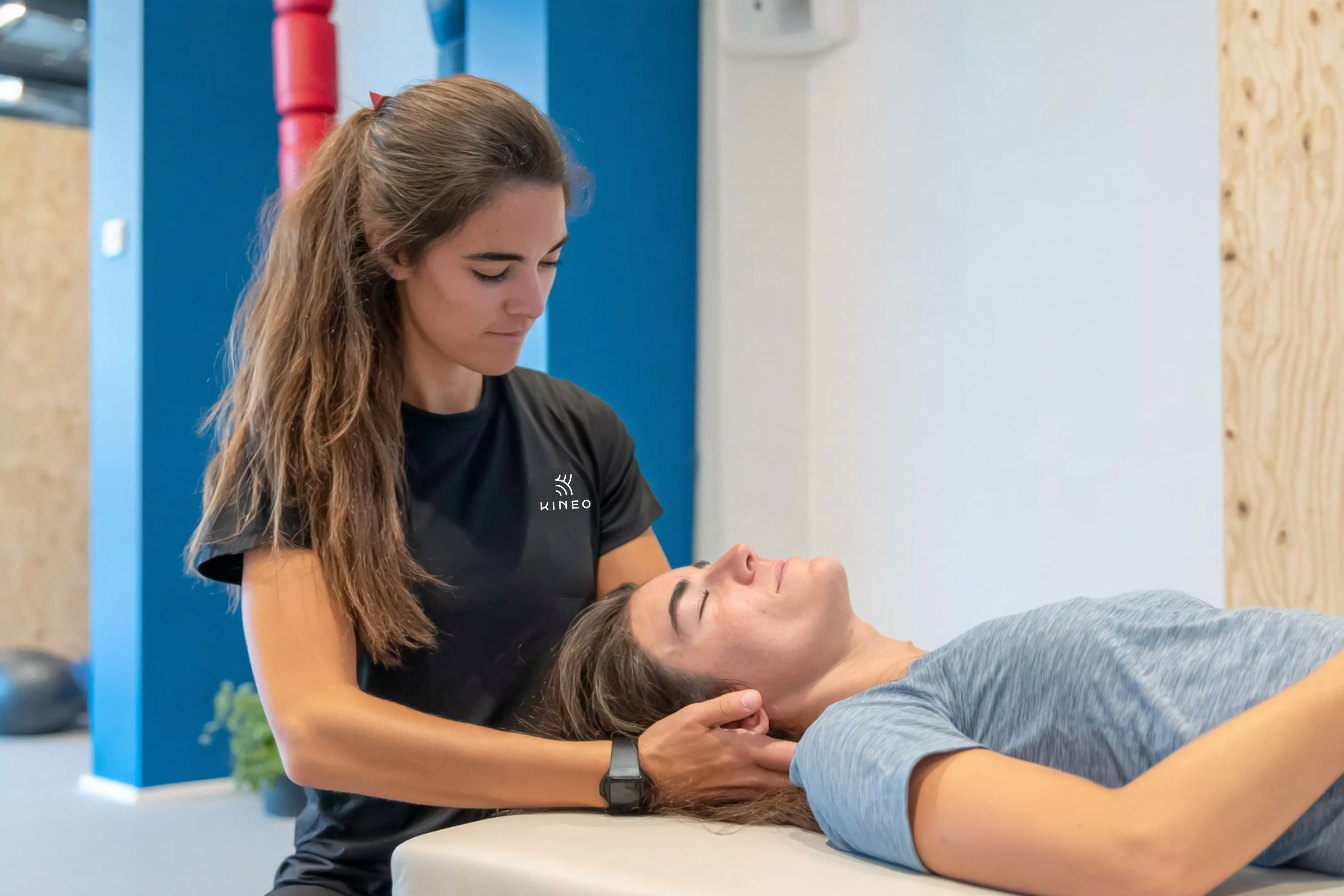
- CMD jaw therapy: mobilisation of the jaw joint and treatment of the chewing muscles, from the inside too
- Trigger point treatment of the masseter and temporalis, which often trigger tooth and temple pain
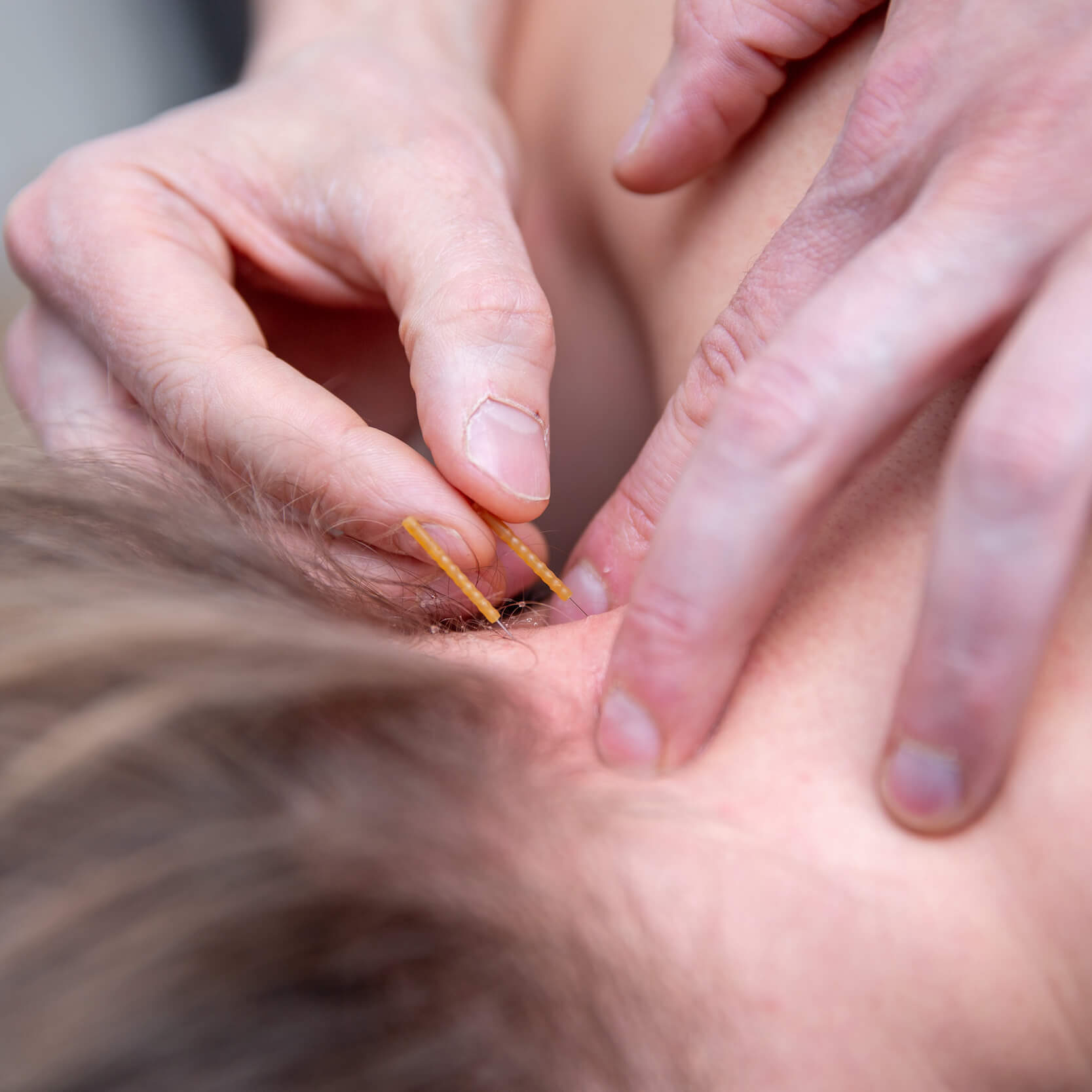
- Dry needling for very strong, hardened chewing muscles
- Manual therapy of the cervical spine
- Medical massage for the neck and shoulders
- Craniosacral therapy to lower baseline tension
A splint, physiotherapy and, where needed, stress management work best together. We coordinate the splint with your dentist.
A simple exercise for in between
Place the tip of your tongue on the roof of your mouth behind the upper front teeth. Open your mouth slowly, as far as you can without the jaw deviating, and close it again. 10 repetitions, several times a day. The exercise encourages a calm, straight opening movement and relaxes the chewing muscles.
How do you know you grind or clench?
- Tense or tired chewing muscles in the morning
- Flattened or sensitive teeth, often noticed by the dentist
- Imprints of the teeth on the edge of the tongue or a white line on the inside of the cheek
- Your partner hears grinding at night
- You catch yourself clamping your teeth together during the day
Jaw clenching during sport
Many people clench their teeth not only at night but also during training: when lifting heavy, during wall balls or on the last metres of a run. This happens reflexively, because the body builds up tension under effort. If you are already prone to jaw problems, this puts extra load on the chewing muscles.
- Breathe out under effort: In the hard phase of an exercise, deliberately breathe out instead of holding your breath and biting down
- A relaxed jaw as a technique cue: Our coaches in HYROX training also watch for a relaxed face under high load. This saves energy and protects the jaw
- Check between sets: Quickly check whether your teeth are touching, and deliberately release your jaw
Breathing as a tool against tension
Slow breathing with a longer exhale lowers baseline tension in the body, including in the jaw and neck. In the yoga and Pilates classes at Kineo Fitness this is a fixed part of the class. For everyday life a simple exercise is enough: breathe in through your nose while counting to four, breathe out through your slightly open mouth while counting to six. Two to three minutes, ideally before going to sleep.
From our practice
We see the most common mistake again and again: many people wait too long, often months, before they come to us with jaw problems. By then the chewing muscles and neck are long since affected too. If you come early, you are usually free of symptoms much faster.
Jaw focus in Seefeld
At our practice Kineo Seefeld on Seefeldstrasse 83, CMD jaw therapy is a focus area. We look at the chewing muscles, jaw joint, neck and posture together and, if needed, coordinate with your dentist, for example if you wear a splint. Feldeggstrasse stop, trams 2 and 4.
At other locations too: Seefeld is our jaw focus. But you can also find specialised physiotherapists for jaw therapy in Wipkingen, at Stauffacher, in Escher Wyss, in Thalwil and in Zollikon. This way you can get treatment close to where you are.
Frequently asked questions
Does a splint on its own help?
It protects the teeth, but it usually doesn't release the tension in the muscles. A splint and physiotherapy complement each other well.
How many treatments do I need?
Many people notice a clear improvement after three to six sessions, combined with exercises for at home.
Do I need a prescription?
To bill through your health insurance you need a doctor's prescription. Ask your GP.
How long does an appointment last?
A physiotherapy appointment at Kineo lasts 30 minutes. In the first session we clarify the cause and start straight away with treatment and first exercises.
You might also like
- CMD: cranio-mandibular dysfunction
- Clicking jaw joint: what to do?
- Headaches and neck pain from the jaw
Book an appointment
Tense jaw in the morning? Book your appointment at Kineo Seefeld.