By Martino Crivelli, physiotherapist and co-founder of Kineo, Kineo Escher Wyss
When cycling suddenly starts to hurt
Cycling is considered easy on the joints, and that is true. Even so, many cyclists come to us with knee pain or a sore lower back. Whether commuting through Zürich, riding a road bike at weekends or mountain biking in the Alps: the complaints usually have an identifiable cause.
When cycling, you repeat the same movement thousands of times per ride. Small deviations in your riding position, building up your training too quickly or a lack of strength add up. The good news: often a few adjustments to the bike and to your body are enough.
Knee pain: where it hurts often reveals the cause
- At the front of the knee, around the kneecap: Often a saddle that is too low or too far forward. The knee stays strongly bent and the kneecap is loaded more. Heavy gears at a low cadence make this worse.
- At the back of the knee: Often the saddle is too high. The leg is overextended at the bottom and the muscles at the back are irritated.
- On the outside of the knee: Can come from the iliotibial band. An unfavourable position of the cleats or too narrow a foot stance plays a role here.
- On the inside of the knee: Also often a question of foot position on the pedal, when the knee has to work against the natural rotation of the foot.
Back pain on the bike
On the bike, you sit in a bent-forward position for a long time. If the handlebars are too far away or too low, the lower back rounds more and the neck has to hold the head far up. A stiff hip and short hamstrings also pull the pelvis backwards, so the back takes over the bending.
A second factor is the trunk: when it gets tired, you "hang" on the saddle and handlebars. A strong trunk keeps the position stable and takes strain off the back. On long rides in particular, this often only shows after one to two hours.
What you can do yourself
- Check your saddle height: With the pedal at the very bottom, the knee should still be slightly bent. A simple check: with your heel on the pedal, the leg is almost straight in the bottom position.
- Fit the saddle level and not too far forward or back
- Lighter gears, higher cadence: This takes strain off the knee, especially on climbs.
- Increase volume slowly: After the winter, don't start straight away with long mountain rides. Increase duration and metres of climbing step by step.
- Change position: On long rides, occasionally get out of the saddle and change your hand position.
- Bike fitting: If you have recurring complaints or train a lot, a professional bike fit at a specialist shop can make sense.
Exercises for cyclists
Cycling trains the legs, but hardly the trunk, glutes and hip mobility. These exercises balance that out. Two to three times a week:
- Single-leg hip bridge: 3 x 10 per side, hold for 2 seconds at the top
- Bulgarian split squat: 3 x 8 per side, lower slowly
- Side-lying leg raise or monster walk with a band: 3 x 12–15 per side for the lateral hip muscles, which keep the knee tracking correctly
- Bird dog: 3 x 8 per side with a 3-second hold
- Hip flexor stretch in a half-kneeling position: 2 x 30–45 seconds per side
- Open up the thoracic spine: On all fours, one hand behind your head, rotate your elbow towards the ceiling, 2 x 8 per side
How we treat cycling complaints at Kineo
We don't just look at the painful spot, but at the interaction between your body and your bike. The aim is for you to be able to keep riding without pain.
1. Assessment: what we examine in your first session
- Precise pain localisation: front, back, inside or outside of the knee, or in the lower back
- Single-leg squat and step-down: Does the knee stay in line or collapse inwards?
- Hip mobility and muscle length: Thomas test for the hip flexor, hamstring length compared side to side
- Strength of the glutes, thighs and trunk, including hold times in the side plank
- Spine: Movement tests and a brief neurological check if there is radiating pain
- Your riding position: Photos or a short video of you on the bike help us a lot
2. Treatment in phases
- Phase 1: calm the irritation (weeks 1–2): Adjust riding time and intensity, light gears, correct obvious position errors. Pain-relieving treatment.
- Phase 2: strength and mobility (weeks 2–6): Exercises for the glutes, thighs and trunk, 3 x 8–12, two to three times a week
- Phase 3: return to load: Gradually increase riding time and climbing, then intervals and mountain rides
3. Kineo services we use
- Sports physiotherapy: assessment, analysis of your position and load plan
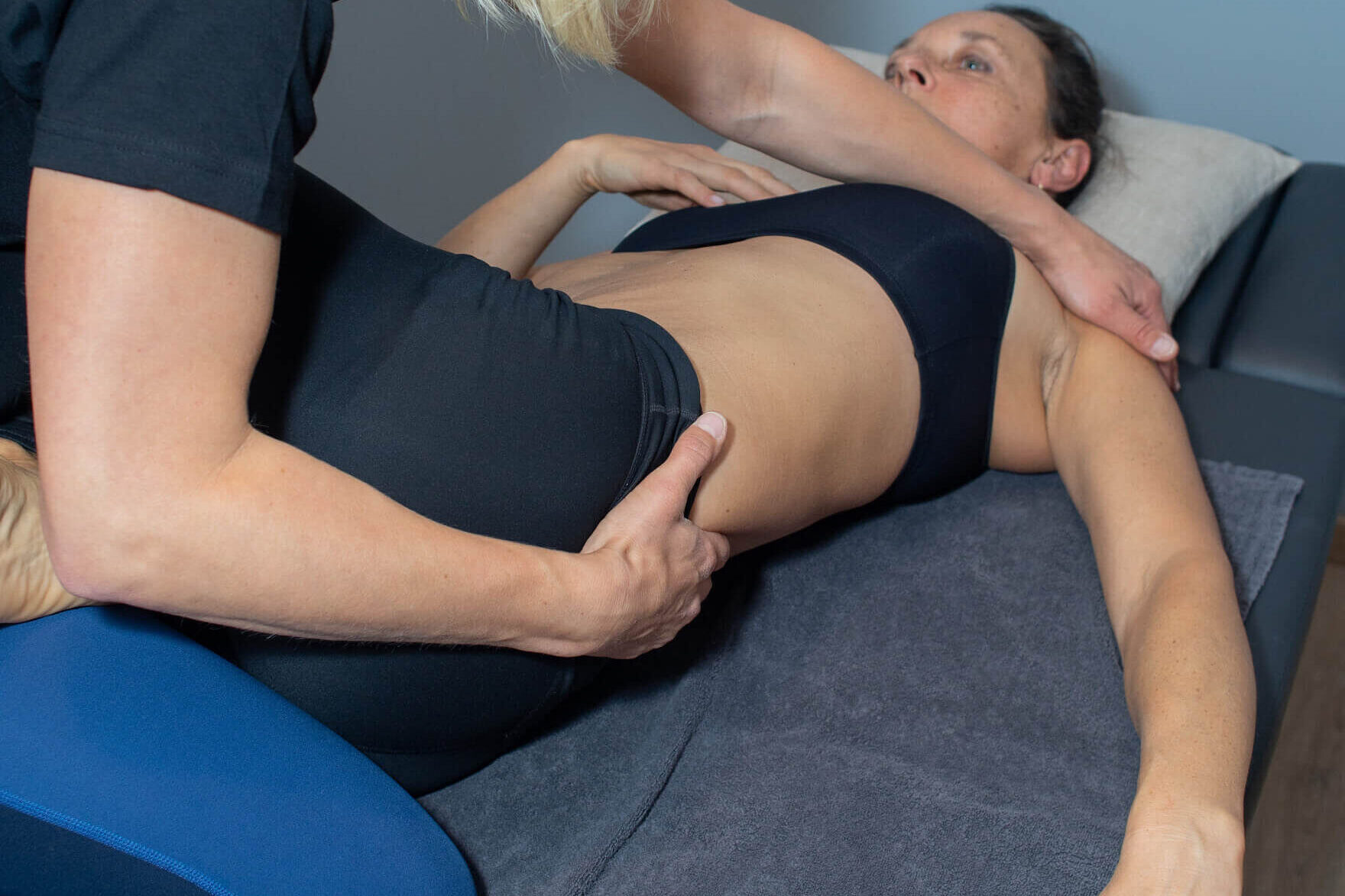
- Manual therapy for the lumbar spine, pelvis and hip, when they are stiff
- Trigger point treatment on the thigh, glutes and back extensors
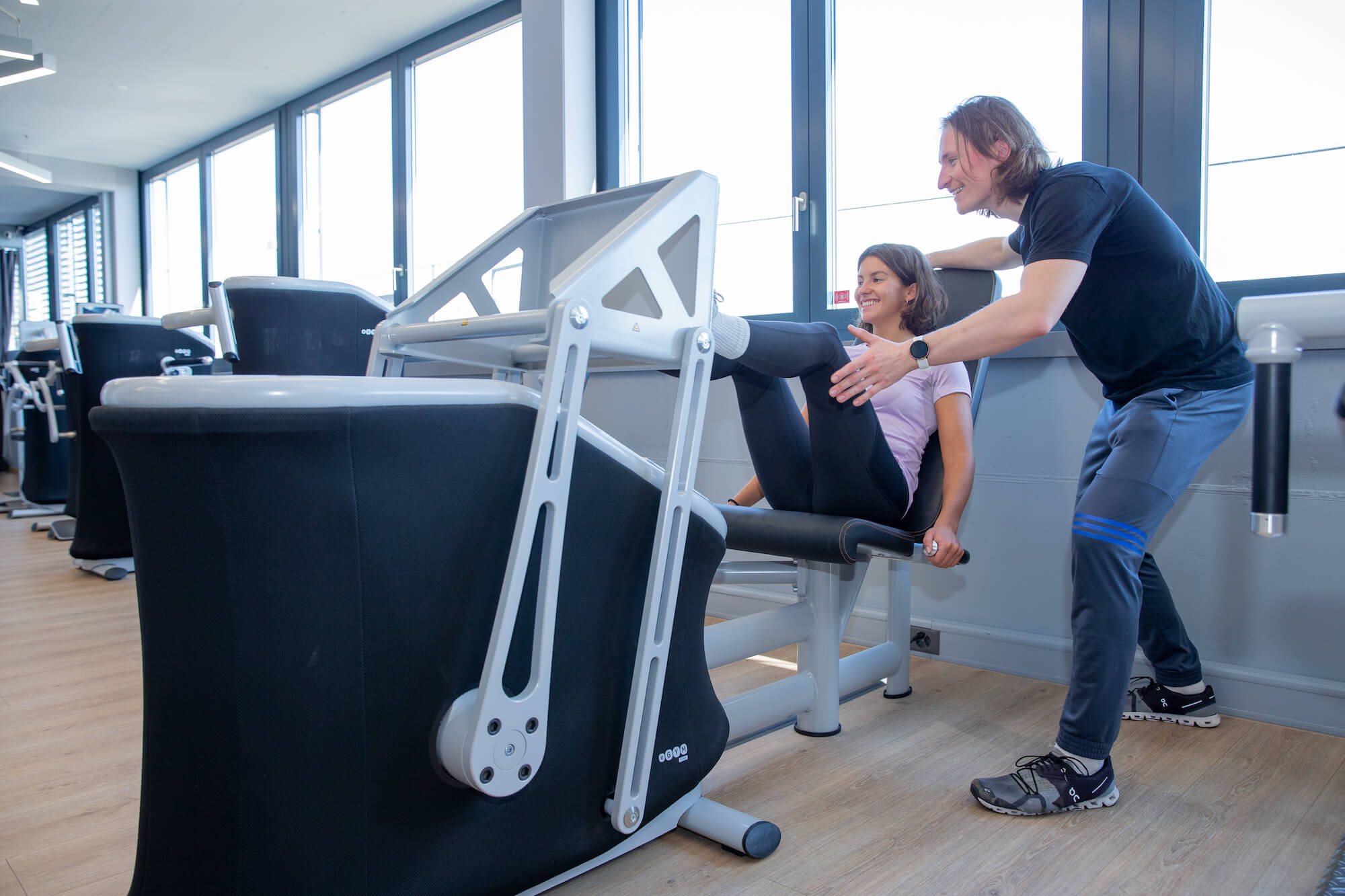
- Medical training therapy for targeted strength building
- Shockwave therapy for stubborn tendon complaints, for example at the patellar tendon
Warning signs: when to see a doctor
- A swollen, warm or locked knee, or a knee that gives way
- Back pain radiating into the leg, numbness or weakness
- Sensory changes in the buttock or genital area or problems passing urine: get checked by a doctor immediately
- Persistent numbness in the saddle area even after riding
From our practice
We often see knee pain after a new bike, new shoes or a change of saddle. The complaints then begin a few weeks after the change. This often lets us narrow down the cause quickly. With back pain, on the other hand, there is usually a lack of strength in the trunk and glutes, and the symptoms improve as soon as these are trained in a targeted way.
Sports physio for cyclists at Kineo Escher Wyss
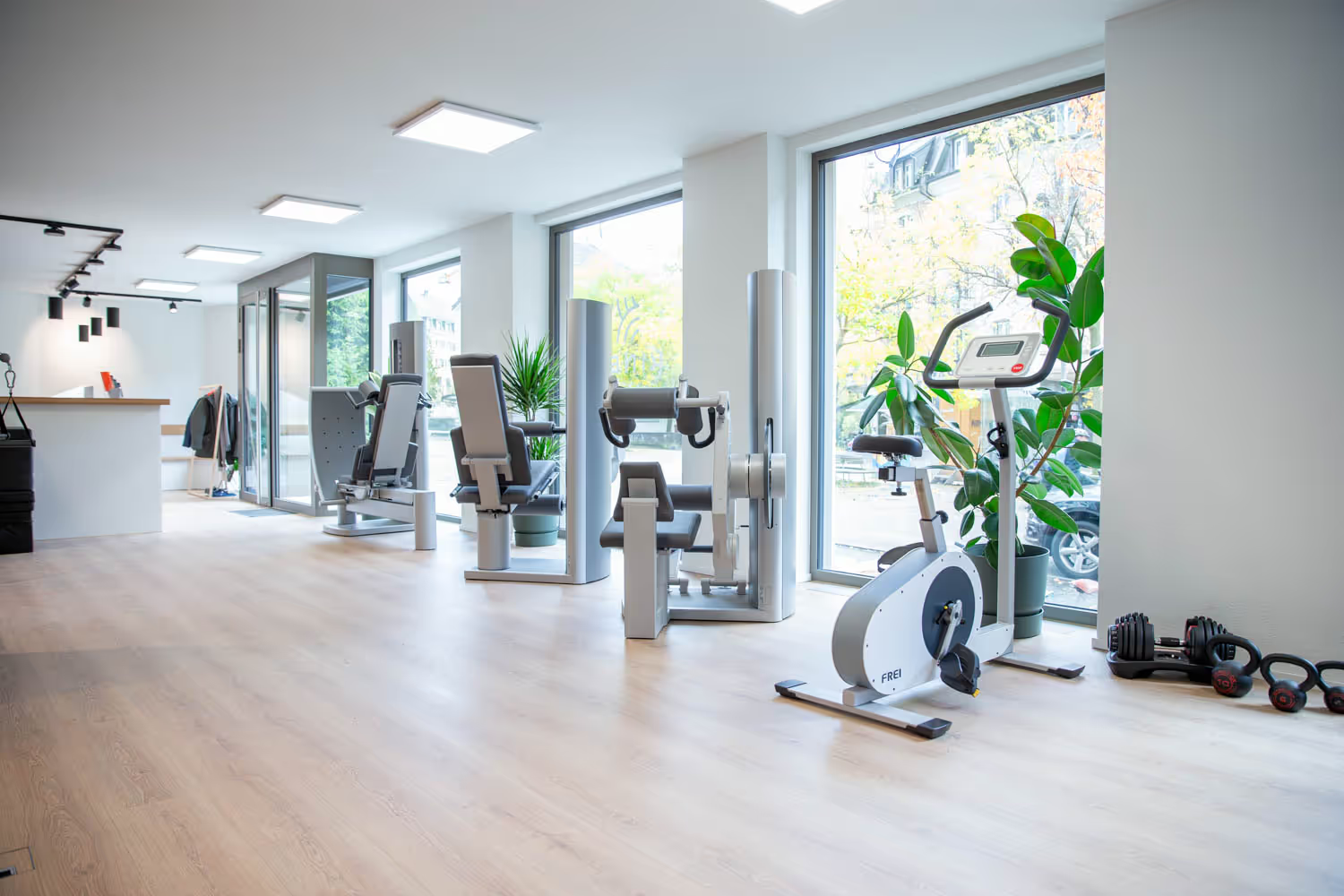
Kineo Escher Wyss on Hardturmstrasse 18 is right at Escher-Wyss-Platz and easy to reach by bike. As a sports physio location with a supervised training floor, we do the strength exercises with you on site. For stubborn tendon complaints, shockwave therapy is available. You can find all the information on the Kineo Escher Wyss page.
Frequently asked questions
Do I have to pause cycling?
Usually not. Often it is enough to temporarily reduce duration and intensity and ride in lighter gears.
Do I need a bike fitting?
Not always. For many people, correcting the saddle height is enough. If you ride a lot or the complaints return despite training, a bike fitting at a specialist shop can help.
How long does an appointment last?
An appointment lasts 30 minutes. In the first session we clarify the cause and start straight away with treatment and exercises.
Does health insurance cover physiotherapy?
Yes. With a doctor's prescription, your basic health insurance covers the cost. Kineo is recognised by all Swiss health insurers.
You might also like
- Runner's knee (patellofemoral pain syndrome)
- Iliotibial band syndrome (ITBS)
- Low back pain: pain in the lower back
Book an appointment
Are your knee or back no longer playing along on the bike? Book your appointment at Kineo Escher Wyss.