By Martino Crivelli, physiotherapist and co-founder of Kineo, Kineo Escher Wyss
When the tendon just won't settle
The pain in your heel, Achilles tendon or below the kneecap has been with you for months. You have rested, stretched, maybe even tried insoles, and it still comes back with every run. At some point, the term shockwave therapy comes up.
Shockwaves can be a good addition for certain stubborn tendon complaints. But they are not a miracle cure and they don't replace training. Here you can find out how the method works, for which complaints it is well researched and when it isn't suitable.
What is shockwave therapy?
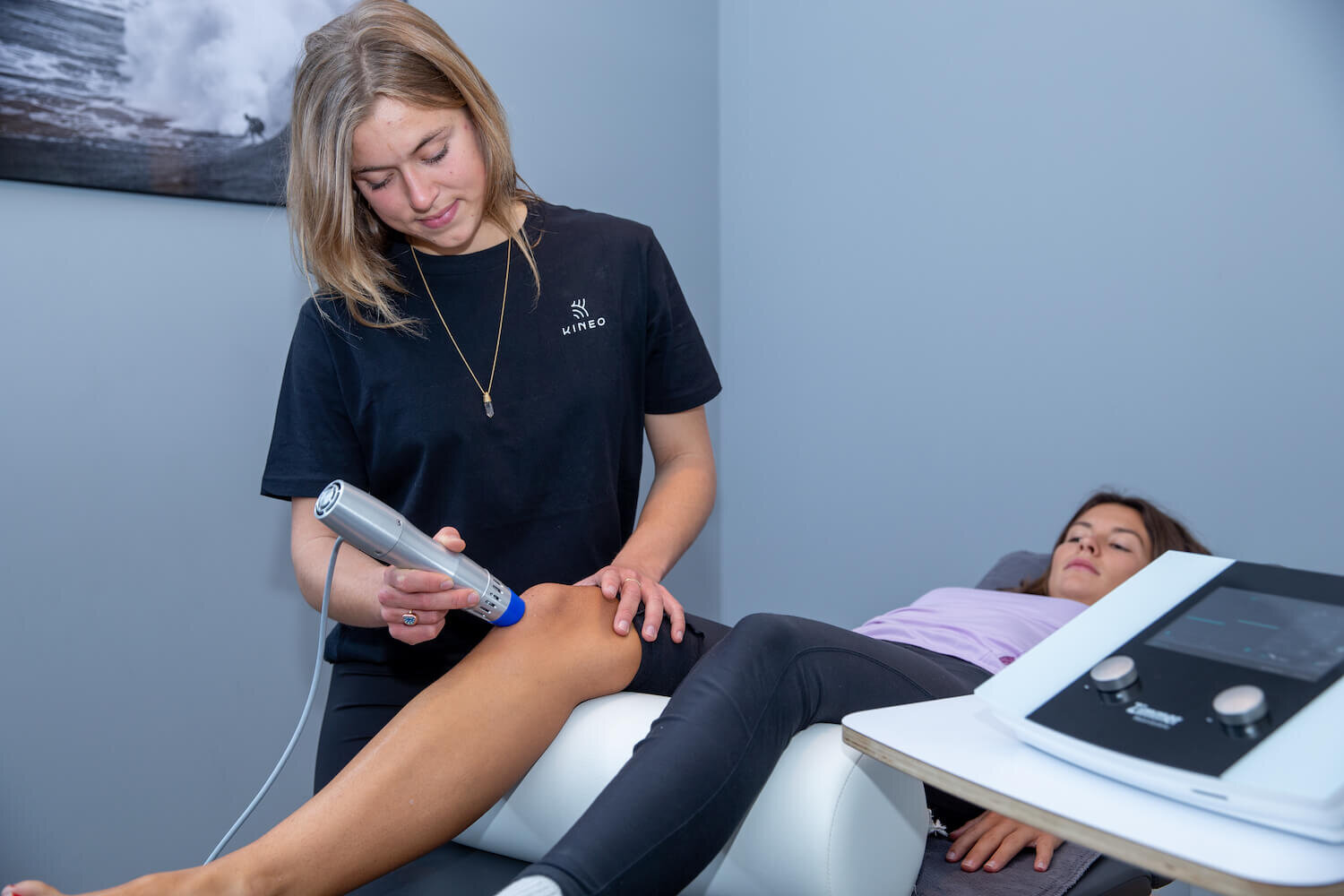
In shockwave therapy, or ESWT for short, high-energy sound impulses are delivered through the skin into the tissue using an applicator. There are two forms:
- Focused shockwave: The energy is concentrated at a point deep in the tissue. It is used, for example, for calcium deposits in the shoulder.
- Radial shockwave: The energy spreads out in a fan shape from the surface. It is suited to tendon attachments close to the surface and to muscle.
Exactly how shockwaves work is not fully understood. Discussed mechanisms include altered pain processing, better circulation and a stimulus for the remodelling of tendon tissue. In calcific shoulder, the shockwave can help to dissolve the calcium deposit.
Which complaints shockwaves can be useful for
Shockwaves are mainly a consideration for chronic complaints, that is, when pain lasts longer than about three months despite good treatment. The best-researched are:
- Calcific shoulder (calcific tendinopathy): The focused shockwave is well supported here.
- Plantar fasciitis and heel spur: pain under the heel, especially with the first steps in the morning
- Achilles tendon pain: especially in the middle of the tendon and at its attachment
- Patellar tendinopathy: pain below the kneecap in jumping sports
- Pain on the outside of the hip (greater trochanteric pain) caused by irritated tendons of the gluteal muscles
- Tennis elbow: The results are mixed here. Strength training takes priority.
For fresh injuries such as strains, ligament tears or acute inflammation, shockwave is generally not the treatment of choice.
Shockwave plus training: why the two belong together
A tendon becomes resilient when it is loaded in a measured and regular way. The shockwave can ease pain and so open a window in which training works better. The actual adaptation of the tendon, however, comes from strength exercises.
Typical exercises for tendon complaints:
- Isometric holds: for example, calf raises, holding at the top, 5 x 30–45 seconds. Can ease pain in the short term.
- Slow strength training: 3 x 8–15 repetitions with 3 seconds up and 3 seconds down, for example calf raises on a stair or the Spanish squat for patellar tendon complaints.
- Faster loading: Hopping, jumping and running, once strength and pain allow.
Pain during the exercises is usually fine as long as it doesn't go above 3–4 on a scale of 0 to 10 and isn't worse than before the next morning.
When not to have shockwave therapy
- Pregnancy
- Clotting disorders or blood-thinning medication, depending on the medication and the situation
- Tumours, infections or open wounds in the treatment area
- Growth plates in children and adolescents in the treatment area
- A cortisone injection at the same spot in recent weeks
- Over the lungs, large nerves and blood vessels, and with pacemakers, depending on location
Warning signs: Night pain unrelated to activity, fever, unexplained weight loss, severe swelling or redness need to be checked by a doctor before any treatment.
How we treat with shockwaves at Kineo
We decide whether shockwave therapy makes sense for you after a thorough examination. At our practice, it is always part of an overall plan.
1. Assessment: what we examine in your first session
- Pain location and course: Since when, with which activity, how does the tendon react the next day?
- Palpation of the course of the tendon and its attachment
- Load tests: for example, single-leg calf raises to fatigue, single-leg squat on a decline board or single-leg stand on the affected side
- Functional tests such as hopping on the spot, to assess resilience
- Ruling out contraindications and, if necessary, consulting your doctor, for example if you have imaging of a calcific shoulder
2. Treatment in phases
- Weeks 1–2: Adjust the load. Reduce the activities that provoke pain, without pausing completely. Start with isometric exercises.
- Weeks 2–6: Shockwave and strength. Usually 3–5 shockwave sessions about a week apart, with strength training 3 times a week in parallel.
- Weeks 6–12: Increase resilience. Heavier strength exercises, then jumping and running in stages.
- Review: We repeat the load tests. If nothing has changed after several sessions, we rethink the plan.
3. Kineo services we use
- Shockwave therapy: for chronic tendon complaints, when training alone isn't enough
- Medical training therapy: the strength training that makes the tendon resilient in the long term
- Sports physiotherapy: load plan and return to running and sport
- Deep friction: transverse friction at the tendon attachment, as a complement for some tendon complaints
- Currex 5D running analysis: when running style or choice of shoes plays a role in heel or Achilles tendon complaints
What a treatment feels like
A session lasts only a few minutes. The impulses feel like quick, firm tapping and can be uncomfortable at the painful spot. We adjust the intensity so that it is easy to tolerate. After the treatment, the area is sometimes a little more sensitive for a day or two, rarely with small bruises. In the first days after a session, you should avoid very intense loading of the treated tendon. Easy training is usually possible.
The effect rarely shows straight away. Complaints often improve over weeks, even after the last session.

From our practice
Many people come hoping that a few shockwave sessions will resolve the tendon complaints while they change nothing else. We see the best outcomes when the shockwave lowers the pain enough for consistent strength training to become possible. If you combine both and stick with it, you are usually pain-free for longer.
Shockwave therapy at Kineo
We offer shockwave therapy at our Seefeld, Stauffacher, Wipkingen and Thalwil locations. In Wipkingen and Thalwil there is a supervised training area in the same building, so strength training follows directly after the treatment. If you have problems when running, you can also have a running analysis at the Kineo Runners Lab in Seefeld.
Frequently asked questions
Does shockwave therapy hurt?
It can be uncomfortable at the painful spot. We adjust the intensity so that it is easy to tolerate.
How many sessions do I need?
Usually 3–5 sessions about a week apart. The exact number depends on your complaints and how they progress.
Can I train after the treatment?
Easy training, yes. It is better to postpone very intense loading of the treated tendon by a day or two.
How long does an appointment last?
An appointment lasts 30 minutes. In your first session, we clarify the cause of your complaints and start straight away with treatment and exercises.
You might also like
Book an appointment
Is your tendon just not settling? Book your appointment at Kineo Wipkingen and we will check whether shockwave and training are right for you.