By Barbara Victorio, physiotherapist at Kineo Wipkingen
What is a calcific shoulder?
In a calcific shoulder, medically calcific tendinopathy (Tendinosis calcarea), calcium deposits form in a tendon of the shoulder. The tendon most often affected is the supraspinatus, a muscle of the rotator cuff that works when you lift your arm out to the side.
Calcific shoulder usually appears between the ages of 30 and 50, and women are affected slightly more often. Many people have calcium in the shoulder without ever noticing it. In others, it causes recurring pain or suddenly very severe pain.
How does the calcium form?
The exact cause is not fully understood. It is assumed that tendon tissue remodels itself in an area with a poor blood supply and stores calcium in the process. So a calcific shoulder is not the result of too much calcium in your diet. The course often follows typical phases:
- Formation phase: Calcium is deposited, often with few or no symptoms.
- Resting phase: The deposit stays stable. Pain occurs mainly with overhead movements, when the calcium gets pinched under the roof of the shoulder, similar to impingement.
- Resorption phase: The body starts to break down the calcium. This phase can be very painful, often at night and at rest too.

Typical symptoms
- Pain when lifting the arm out to the side, especially between about 60 and 120 degrees
- Pain when lying on the affected side
- Pain radiating into the upper arm
- In the resorption phase, sudden, very severe pain, even without any load
- Restricted mobility, because every movement hurts
Diagnosis
A doctor confirms a calcific shoulder with ultrasound or X-ray. This shows the size and shape of the deposit. If needed, your doctor will also issue the prescription for physiotherapy.
What you can do yourself
- Reduce painful overhead movements, but do not immobilise the arm completely, so that the shoulder does not become stiff
- Cool it in acute phases, and use warmth rather in quiet phases
- Adjust your sleeping position: A pillow under the arm takes the load off the shoulder at night
- Mind your posture: An upright thoracic spine gives the shoulder more room
How we treat calcific shoulder at Kineo
Treatment depends on the phase of the calcific shoulder. The painful resorption phase needs something different from a quiet deposit that gets pinched during overhead movements.
1. Assessment: what we examine in your first session
- Painful arc: Does lifting the arm to the side hurt mainly between about 60 and 120 degrees?
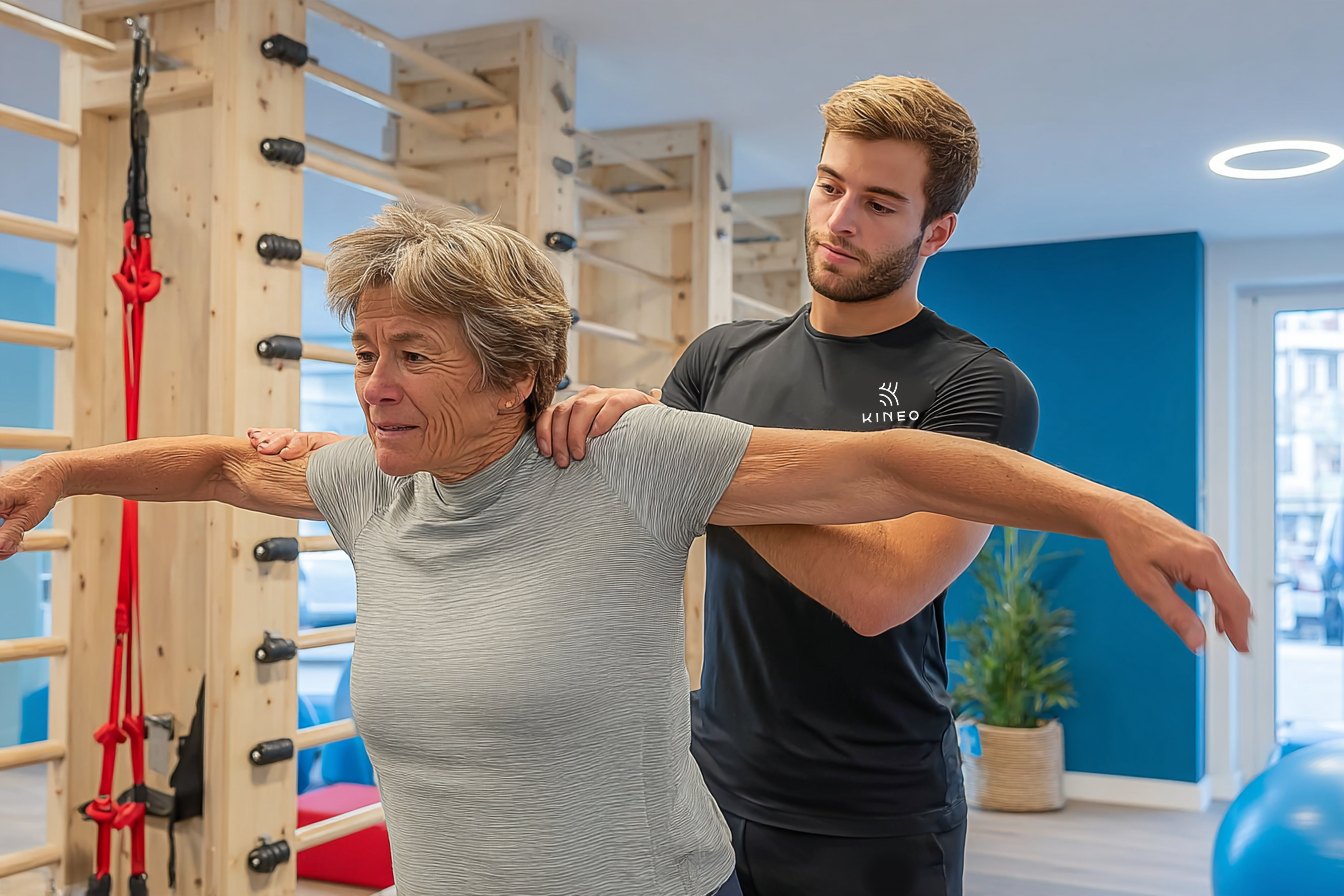
- Tendon tests: With the Jobe test we check the supraspinatus tendon, and with the Hawkins-Kennedy test we check for pinching under the roof of the shoulder.
- Active versus passive: We compare how far you can move the arm yourself with how far we can move it. If passive external rotation is severely limited, that points more towards a frozen shoulder.
- Shoulder blade and thoracic spine: Does the shoulder blade move properly with the arm? A rounded thoracic spine reduces the space under the roof of the shoulder.
- Cervical spine: Pain radiating into the arm can also come from the neck. We rule that out.
- Imaging: The size and structure of the calcium deposit on ultrasound or X-ray help us choose the treatment.
2. Treatment in phases
- Acute resorption phase: Pain relief comes first. Cold and compression, pain-free movement and a sleeping position that takes the load off.
- Quiet phase: Shockwave on the calcium deposit, usually three to four sessions at weekly intervals. Alongside this, mobilisation of the shoulder, shoulder blade and thoracic spine.
- Strengthening phase (from about week 3): Isometric exercises, then training of the rotator cuff and shoulder blade muscles with increasing load. The goal is a well-centred head of the upper arm bone.
- Back to everyday life and sport: Overhead loads such as shoulder presses, pull-ups or swimming come last.
3. Kineo services we use
- Shockwave therapy: one of the best-studied conservative treatments for calcific shoulder. It can relieve pain and support the breakdown of the calcium.
- Manual therapy: downward glide mobilisation of the head of the upper arm bone, mobilisation of the shoulder blade and thoracic spine
- Trigger point treatment and dry needling of the infraspinatus, trapezius and the muscles around the shoulder blade
- Cold therapy with Game Ready in the acute phase
- Medical training therapy to build up shoulder strength
- Digital home programme with your exercises as videos
In most cases, a calcific shoulder can be treated well without surgery. Surgery is only considered if the symptoms persist for a long time despite consistent therapy.
Calcific shoulder or frozen shoulder?
Both cause severe shoulder pain, but they differ. In a calcific shoulder, lifting the arm hurts most, and passive mobility is usually preserved. In a frozen shoulder, the shoulder becomes stiff in every direction, even when someone else moves the arm. The distinction matters because the treatment is different.
Exercises for the quiet phase
- Pendulum: Bend your upper body forward, let the arm hang loose and make circles. This takes the load off and keeps you mobile.
- External rotation with a resistance band: Elbow at your side, slowly rotate the forearm outwards. 3 x 12.
- Squeeze the shoulder blades together: While seated, pull your shoulder blades back and down and hold for 5 seconds. 10 repetitions.
In the acute resorption phase, pain relief and rest come first, and the exercises follow afterwards.
Back to training: what applies in the gym
After a calcific shoulder, many people want to train again but are unsure which exercises are allowed. A few principles help:
- Start with isometrics: Holding exercises, where you push against a resistance without moving the arm, often relieve pain and are a good way in
- Overhead last: Shoulder presses, pull-ups or lat pulldowns behind the head only once lifting the arm to the side is pain-free
- Pull before push: Rowing and exercises for the shoulder blades are added early, because they create room for the head of the upper arm bone
- Adapt in yoga and Pilates: In the acute phase, modify or skip positions that put a lot of weight on the arms, such as downward dog or the push-up
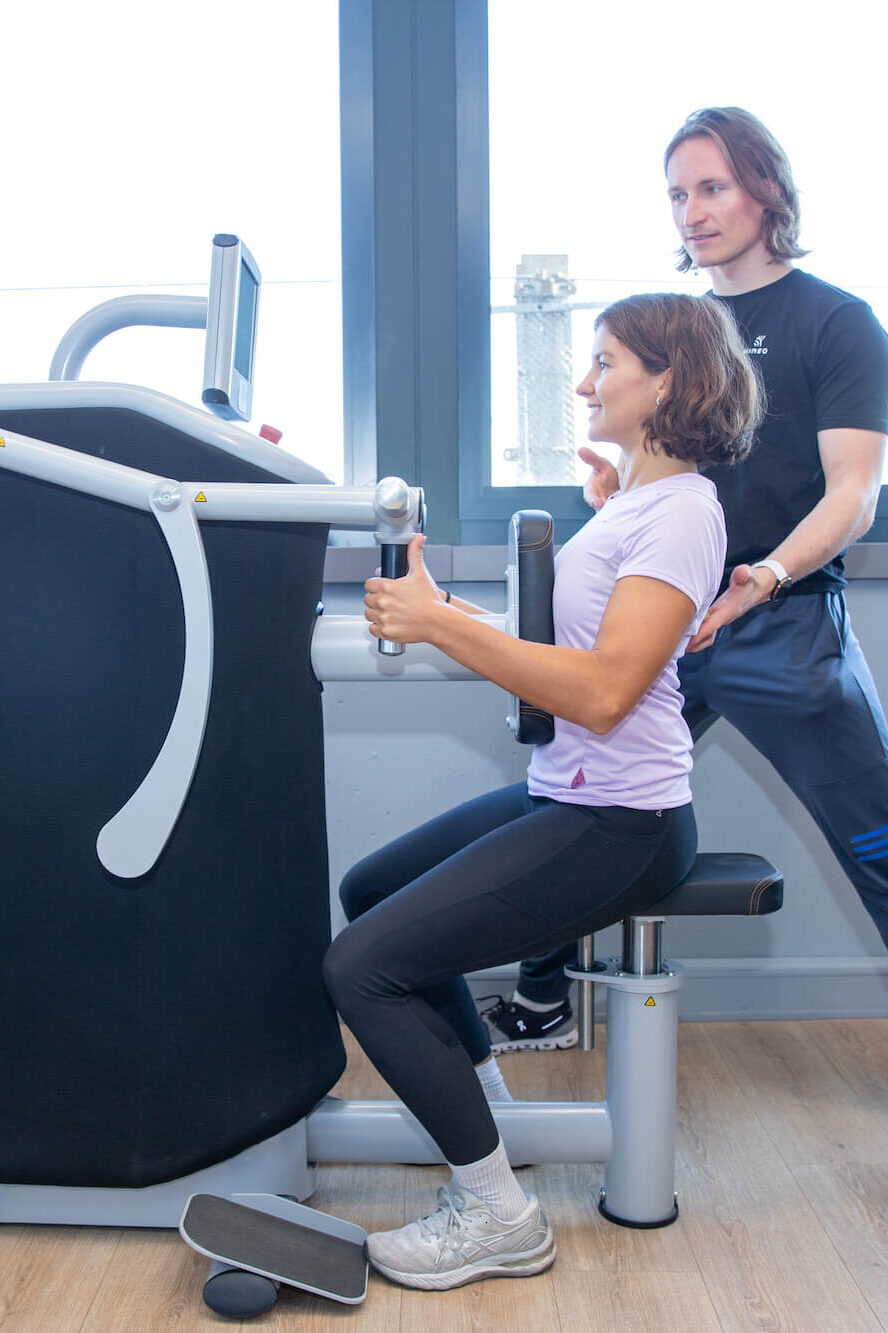
On the machines at Kineo Fitness in Thalwil, weight and range of motion can be fine-tuned. This lets you build up again step by step after physiotherapy.
From our practice
We see the most common mistake again and again: many people wait too long and hope it will get better on its own, or load the shoulder fully again too early after the first improvement. Those who come early and build the shoulder up gradually are usually pain-free much faster.
Calcific shoulder treatment at Kineo Wipkingen
At our practice Kineo Wipkingen at Röschibachstrasse 79 in 8037 Zürich, we treat shoulder complaints with shockwave therapy, manual therapy and targeted training. With a doctor's prescription, your basic health insurance covers the cost. Kineo is recognised by all Swiss health insurers.
Frequently asked questions
Does the calcium dissolve on its own?
It can, often during a painful resorption phase. After that, symptoms frequently improve clearly.
How many shockwave treatments do I need?
Usually several sessions about a week apart. We discuss this after the examination.
Does a calcific shoulder need surgery?
Rarely. Surgery only comes into question if the symptoms persist for a long time despite consistent therapy.
How long does an appointment last?
A physiotherapy appointment at Kineo lasts 30 minutes. In your first session, we find the cause and start straight away with treatment and first exercises.
You might also like
Book an appointment
Do you have shoulder pain and suspect a calcific shoulder? Book your appointment at Kineo Wipkingen.