By Martino Crivelli, physiotherapist and co-founder of Kineo, Kineo Escher Wyss
Heavy, heavier, sled
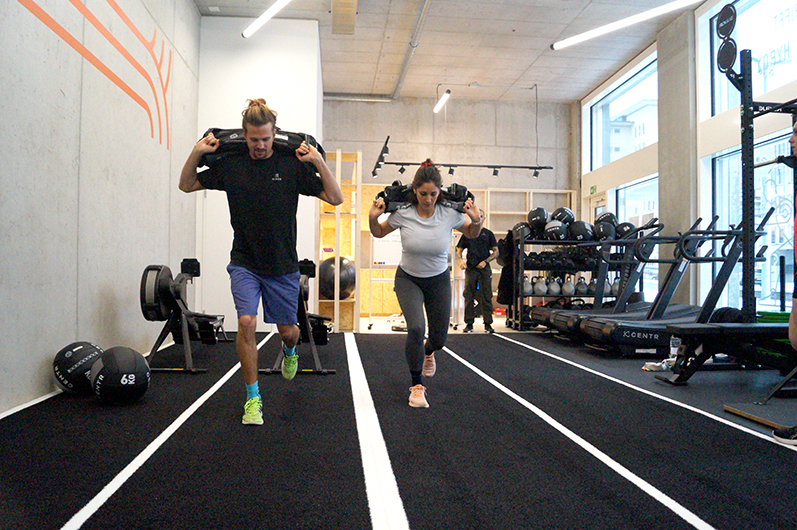
Sled push and sled pull are the second and third stations at HYROX: 50 metres each, straight after the second and third kilometre of running, with a sled that feels heavier than it looks. Many people feel their lower back afterwards. A dull pulling feeling, stiffness when getting up the next morning, or a stabbing pain when they lean back while pulling the rope.
There is usually no injury behind it, but a technique that makes the back work instead of the legs when you are tired. If you understand how the force gets into the sled, you protect your back and are often faster too.
What happens during the sled push
In the push, you drive with your legs and your arms transfer the force to the sled. The trunk is the link between the two. The ideal is a line from head to heel, similar to a forearm plank, only tilted forward at an angle.
- Low body angle: The flatter the upper body, the more force goes forward. But your trunk has to be able to hold this position.
- Short, powerful steps: On the forefoot, with the knees driving forward. Long steps often cause the pelvis to tilt and the lower back to drop into an arch.
- Arms: Straight arms transfer force more directly, bent arms allow a lower body angle. Both work as long as the trunk stays stable.
- Common mistake: The lower back sags as soon as the trunk tires. Then the force doesn't end up in the sled but in the lumbar spine.
What happens during the sled pull
In the pull, you draw the sled towards you on the rope, hand over hand. Your back is challenged more here than in the push.
- Position like a deadlift: Knees slightly bent, hips back, back long. From this position you pull with your whole body, not just your arms.
- Leaning back: Many people lean far back and walk backwards. This is efficient, but it loads the back if the pelvis tips into an arch.
- Rounded back under load: If the back rounds as fatigue builds and the force comes in jerks, the load on the lumbar spine rises.
Why your back hurts
- Muscular overload of the back extensors: dull pain on both sides of the lumbar spine, stiffness the next day. This is the most common cause and is usually harmless.
- Lack of hip extension: If the hip flexors are stiff from a lot of sitting, the body gets its extension in the push from the lower back arch.
- Little trunk endurance: It is not maximal strength but the endurance of the trunk muscles that decides whether the position holds over 50 metres.
- Pre-fatigue from running: If you only train the sled when fresh, you will experience different technique in the competition.
You should have these checked by a doctor: pain radiating into the leg below the knee, numbness or loss of strength in the leg, fever, night pain unrelated to movement, or pain after a fall. Numbness in the buttock or genital area, or problems passing urine or stool, is an emergency.
What you can do yourself
- Keep moving: Bed rest doesn't help back pain. Walking, easy cycling or light running usually feel better.
- Reduce the load, keep the technique: Temporarily train push and pull with less weight and a focus on trunk position.
- Mobilise the hip flexors: kneeling hip flexor stretch with the glutes tensed, 2–3 x 30–45 seconds per side.
- Heat: A warm bath or a heat pad relieves muscular complaints in the short term.
How we treat back pain from the sled at Kineo
First we clarify whether it is a muscular overload or whether nerves or a disc are involved. After that, it is about load capacity and technique.
1. Assessment: what we examine in your first session
- Movement testing of the lumbar spine: bending forward, backward and sideways, and rotation, and which direction increases or eases your symptoms
- Neurological check: straight leg raise (Lasègue test) and slump test, plus reflexes, strength and sensation in the legs
- Hip: Thomas test for the hip flexors, hip extension and rotation compared side to side
- Trunk endurance: Biering-Sørensen test for the back extensors and side plank hold compared side to side
- Ankle: knee-to-wall test. If ankle mobility is lacking, the deep push angle becomes difficult.
- Technique analysis: hip hinge and video analysis of your push and pull
2. Treatment in phases
- Phase 1, weeks 1–2: settle the symptoms. Cut the sled right back, move within the low-pain range, manual treatment. Bird dog and dead bug, 3 x 8–10 per side.
- Phase 2, weeks 2–5: strengthen trunk and hips. Side plank, hip thrust, Romanian deadlift with light weight, 3 x 8–12, two to three times a week.
- Phase 3, from week 4: bring the sled back. Light sled, short distances of 10–15 metres with a focus on position, then gradually increase weight and distance.
- Phase 4: under fatigue. Push and pull after running intervals, so that your technique holds in competition too.
3. Kineo services we use
- Sports physiotherapy: assessment, technique analysis and build-up right up to competition
- Manual therapy when the lumbar spine, pelvis or thoracic spine move less freely
- Trigger point treatment for hardened back extensors and glute muscles
- Medical training therapy for trunk endurance and hip strength
- Sport-specific training with sled technique under fatigue
Trunk programme for the sled
- Plank with shoulder taps: High plank, alternately tapping the opposite shoulder with one hand without letting the pelvis tilt. 3 x 10 per side.
- Side plank: On the forearm, body in one line. 3 x 20–40 seconds per side.
- Bear crawl: Knees just above the floor, back flat, forwards and backwards. 3 x 10 metres. Similar to the push pattern.
- Romanian deadlift: Hips back, back long, dumbbell close to your legs. 3 x 8–10. Trains the pulling position of the pull.
Technique tips for competition
- Breathe in and tense your trunk before the first step
- In the push, look at the floor a few metres ahead of you, so your neck stays in line with your spine
- In the pull, work with your legs and hips, and let your arms just reach for the rope
- Short pauses in a safe position are better than jerky pulling with a rounded back
From our practice
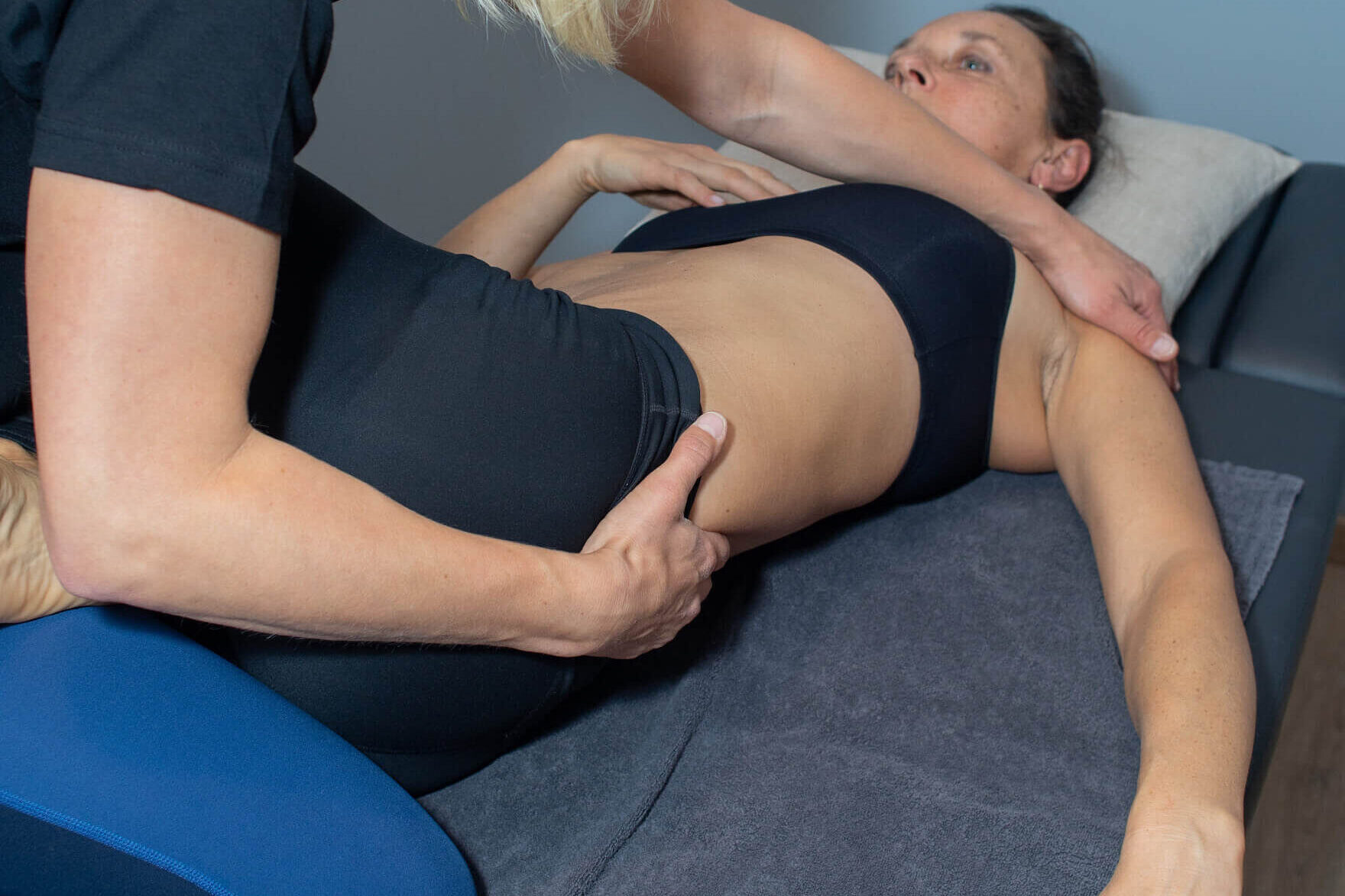
People who come to us with back pain from the sled often have a lot of strength in their legs. What is usually missing is the endurance in the trunk to hold the position over the whole distance. Often the technique is clean over the first metres and only breaks down towards the end. That is exactly where we start: trunk endurance, hip mobility and sled training under fatigue.
Treat your back, train your sled: Kineo Escher Wyss
At Kineo Escher Wyss on Hardturmstrasse 18, right at Escher-Wyss-Platz, we combine sports physiotherapy and a supervised training floor across two floors. Kineo HYROX is in the same building: HYROX downstairs, physiotherapy upstairs. That keeps the way from treatment back to training short. You can find all the information on the Kineo Escher Wyss page.
Frequently asked questions
Do I have to stop training completely with back pain?
Rarely. Running, cycling or rowing at easy intensity can usually continue. We reduce the sled temporarily and then build it back up in a targeted way.
Is a rounded back dangerous in the pull?
A slight rounding is not automatically dangerous, as the spine is built to bend. It becomes unfavourable when it rounds in jerks under high load and fatigue. Control matters more than perfect posture.
Does health insurance cover physiotherapy?
Yes. With a doctor's prescription, your basic health insurance covers the cost. Kineo is recognised by all Swiss health insurers.
You might also like
- HYROX: typical injuries and how to avoid them
- Deadlifting without back pain
- Low back pain: pain in the lower back
Book an appointment
Is your back complaining after the sled? Book your appointment at Kineo Escher Wyss.