By Asier Gochicoa, physiotherapist at Kineo Wipkingen
When your forearm burns after work
In the morning everything is fine, but after a few hours at the computer there’s a pulling sensation on the outside of your forearm. The mouse suddenly feels heavy, and lifting a cup or unscrewing a bottle hurts. In the evening your arm burns, at the weekend it gets better, and on Monday it all starts again.
Colloquially, this is called “mouse arm”. Clinically, it is usually an overload of the tendons and muscles that extend the wrist and fingers. With the right mix of relief, workplace adjustments and strength training, you can get the complaints well under control in most cases.
What’s behind mouse arm
When you work with a mouse and keyboard, the extensor muscles of the forearm keep the wrist slightly raised for hours. This holding work is small, but it never stops. On top of that come thousands of small clicks and scrolling movements. Tendons adapt to load, but they need time and variety to do so. If they get more load than they can process, they respond with pain. This is called tendinopathy, a load-related tendon irritation.
The term mouse arm covers several different conditions:
- Irritation of the wrist extensors on the forearm, often with pain up to the outer elbow. This corresponds to “tennis elbow” without the tennis.
- Overloaded finger extensors with pain on the back of the hand and the forearm
- Tendon sheath irritation at the thumb (de Quervain’s tenosynovitis) with pain on the thumb side of the wrist
- Tense, tender muscles with trigger points in the forearm
Typical symptoms
- Pulling or burning pain on the top of the forearm, often up to the elbow
- Pain when gripping, lifting with a straight arm or unscrewing lids
- Stiffness in the morning or after breaks that improves with movement
- Tender spots in the forearm muscles
- Complaints increase over the course of the working day
Differentiation: what it isn’t
Tingling and numbness in the fingers point more towards an irritated nerve, for example carpal tunnel syndrome, than towards tendon irritation. If the pain radiates from the neck into the hand, the cervical spine may be involved. Severe swelling, redness and warmth, pain after a fall or complaints in several joints at once should be checked by a doctor.
What you can do yourself
- Mouse close to your body: place the mouse directly next to the keyboard, with your elbow relaxed beside your body. Arms stretched far out put extra strain on the extensors.
- Support your forearm: if your forearm rests on the desk or an armrest, the muscles have less holding to do.
- Vary rather than sit perfectly: a vertical mouse, keyboard shortcuts instead of clicks or switching your mouse hand can relieve the load. Variety is more important than any aid.
- Short breaks: every half hour to hour, take your hands off the desk briefly, loosen them and stand up.
- Don’t rest completely: total rest weakens the tendon. It needs dosed loading to adapt.
How we treat mouse arm at Kineo
Our goal is for your tendons to tolerate more again than your working day demands of them. To do this, we combine pain relief with targeted strength training.
1. Assessment: what we examine in your first session
- Tendon tests: Cozen’s test (extending the wrist against resistance) and Maudsley’s test (extending the middle finger against resistance)
- Pain-free grip strength: how hard can you squeeze before it hurts? This is our most important progress marker.
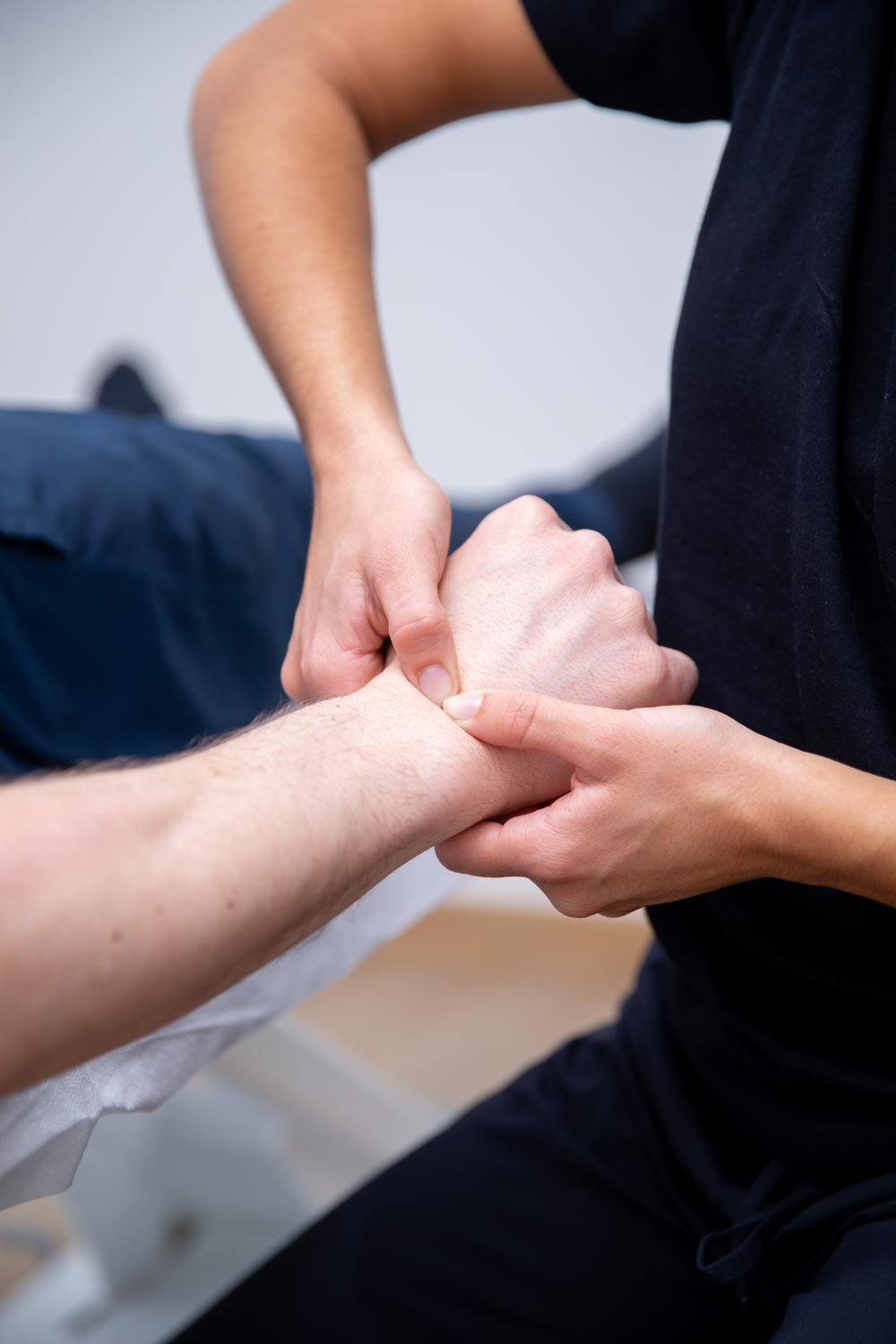
- Finkelstein test to detect tendon sheath irritation at the thumb
- Palpation of tendon attachments and muscles on the forearm
- Cervical spine, shoulder and nerves: movement tests and neurodynamic tests to rule out radiating complaints
- Workplace and daily life: screen time, breaks, sport and hobbies such as climbing or guitar
2. Treatment in phases
- Phase 1, weeks 1–2: calm the pain. Adjust your workplace, isometric exercises for the wrist extensors, 5 x 30–45 second holds, once or twice a day.
- Phase 2, weeks 2–6: build strength. Slowly lifting and lowering a dumbbell with the wrist, 3 x 15 repetitions, every other day, increase the weight when it feels easy.
- Phase 3, from week 6: capacity for everyday life. Gripping, carrying, rotating movements with a hammer, training for the shoulder and upper back.
- Load rule: pain up to about 3 out of 10 during the exercise is fine, as long as it is no worse the next morning than before.
3. Kineo services we use
- Medical training therapy: the core element for making the tendons more resilient
- Trigger point treatment for tense and tender forearm muscles
- Dry needling when trigger points clearly contribute to the pain
- Deep friction as transverse friction at the painful tendon attachment
- Shockwave therapy as an addition for stubborn, longer-standing tendon complaints
Four exercises for strong forearms
- Isometric extension: forearm on the table, palm down. Use your other hand to press down on the back of your hand and hold. 5 x 30–45 seconds, moderate intensity.
- Wrist extension with a dumbbell: forearm supported, hand over the edge of the table. Lift the dumbbell with the help of your other hand, then lower it slowly over 3–4 seconds. 3 x 15.
- Rotation with a hammer: hold a hammer at the end of the handle and slowly rotate your forearm inwards and outwards. 3 x 10 in each direction. The further forward you grip, the easier it gets.
- Grip strength: squeeze a soft ball or a rolled-up towel and hold for 5 seconds. 3 x 10.
Do the exercises three to four times a week. With tendons, a noticeable improvement usually takes several weeks of patience.
From our practice
Many people with mouse arm have already tried braces, new mice and gels before they come to us. What is usually missing is targeted strength training. Once the forearms get stronger and the workplace is adjusted a little, the working day is often no longer enough to overload the tendons. The shoulder and upper back also play a role: if you are stable there, you work more relaxed with your hands.
Physiotherapy and training in Wipkingen
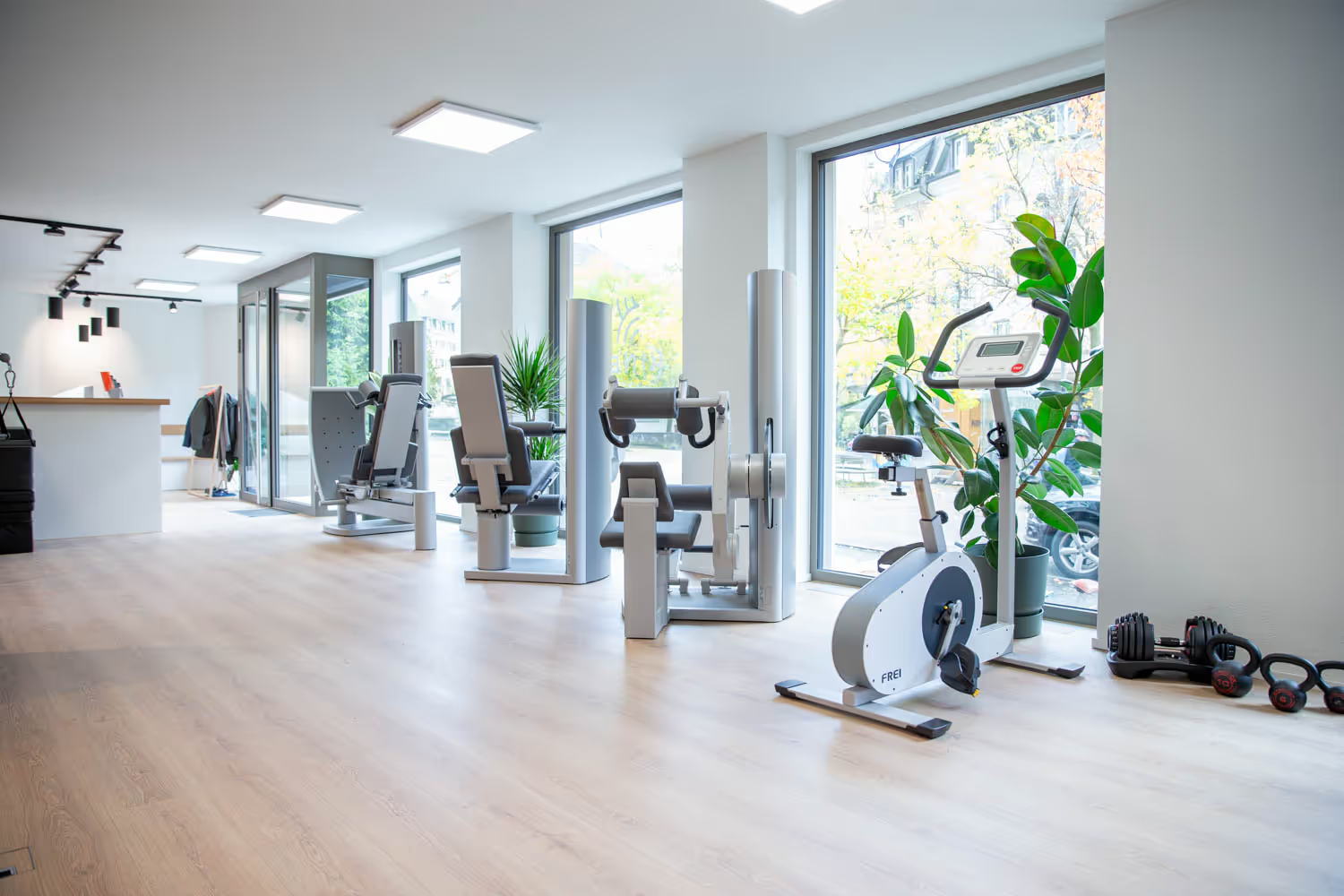
At Kineo Wipkingen at Röschibachstrasse 79 on Röschibachplatz, you can work on grip, forearm and shoulder strength on the training floor with strength equipment directly after treatment. We also offer shockwave therapy and dry needling at this location. You’ll find more information on the Kineo Wipkingen page.
Frequently asked questions
Should I wear a brace?
An epicondylitis clasp can provide some short-term relief. But it doesn’t replace strength training and shouldn’t be the only measure for months on end.
Does stretching help with mouse arm?
Gentle loosening does many people good. But intense stretching can further irritate an irritated tendon. Dosed strength work is usually more effective.
How long does it take to get better?
That depends on how long the complaints have existed. Many feel the first improvements after a few weeks; it often takes longer for the tendon to be fully resilient.
Does health insurance cover physiotherapy?
Yes. With a doctor's prescription, your basic health insurance covers the cost. Kineo is recognised by all Swiss health insurers.
You might also like
Book an appointment
Does your forearm complain every working day? Book your appointment at Kineo Wipkingen and we’ll make your tendons resilient again.