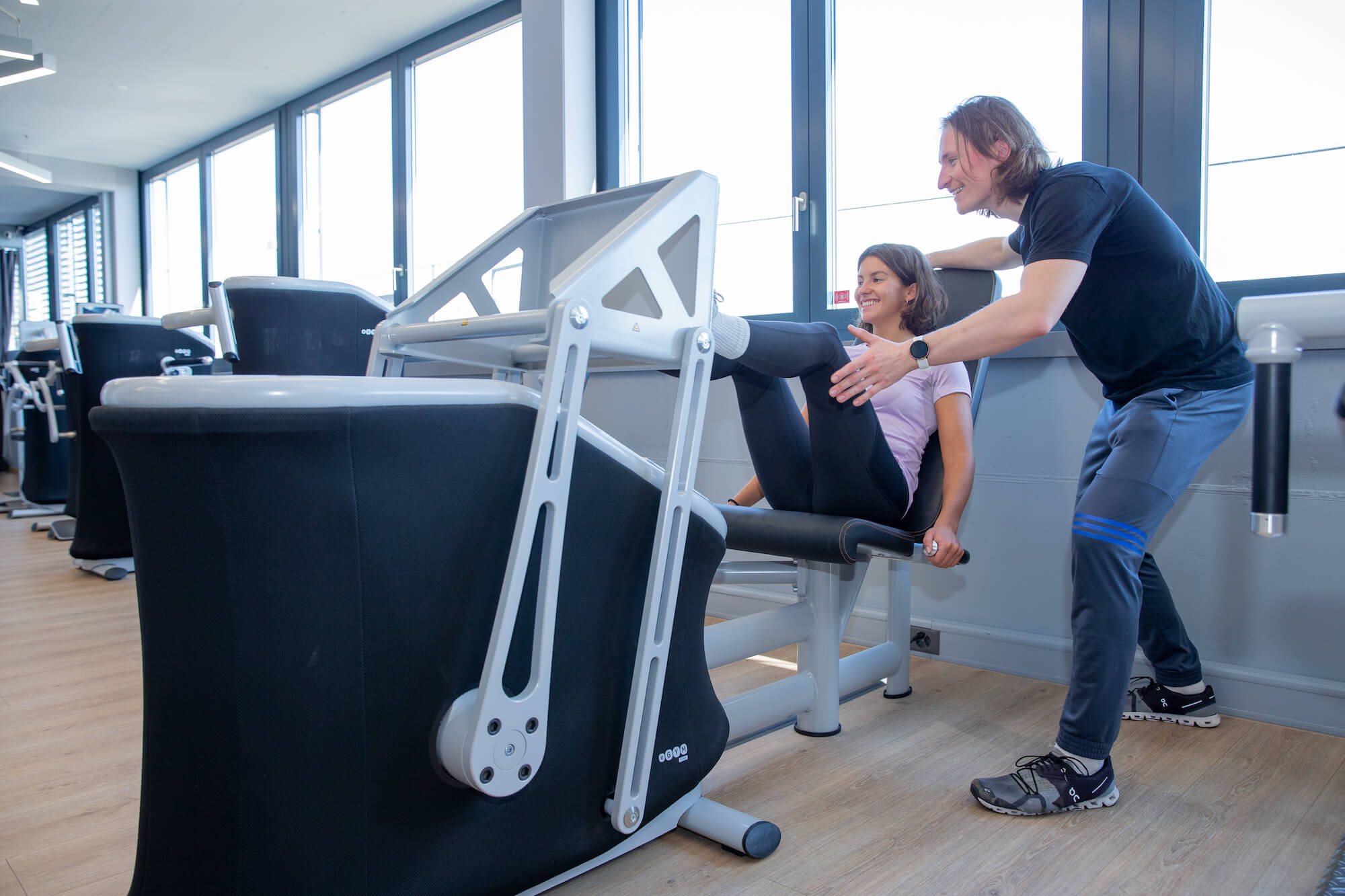
By Andrina Kümin, physiotherapist at Kineo Seefeld
How do you actually run?
Most runners have no idea how they run. You feel your own running style from the inside, but you don't see it. Only on video do you notice that your foot lands far in front of your body, a knee tips inwards or the pelvis drops on one side.
A running analysis makes these things visible. It helps with pain, with choosing shoes and when you want to run more efficiently. But it is not a magic trick and does not replace an examination. In this article you will learn what a running analysis can show, where its limits are and who it really helps.
What happens in a running analysis
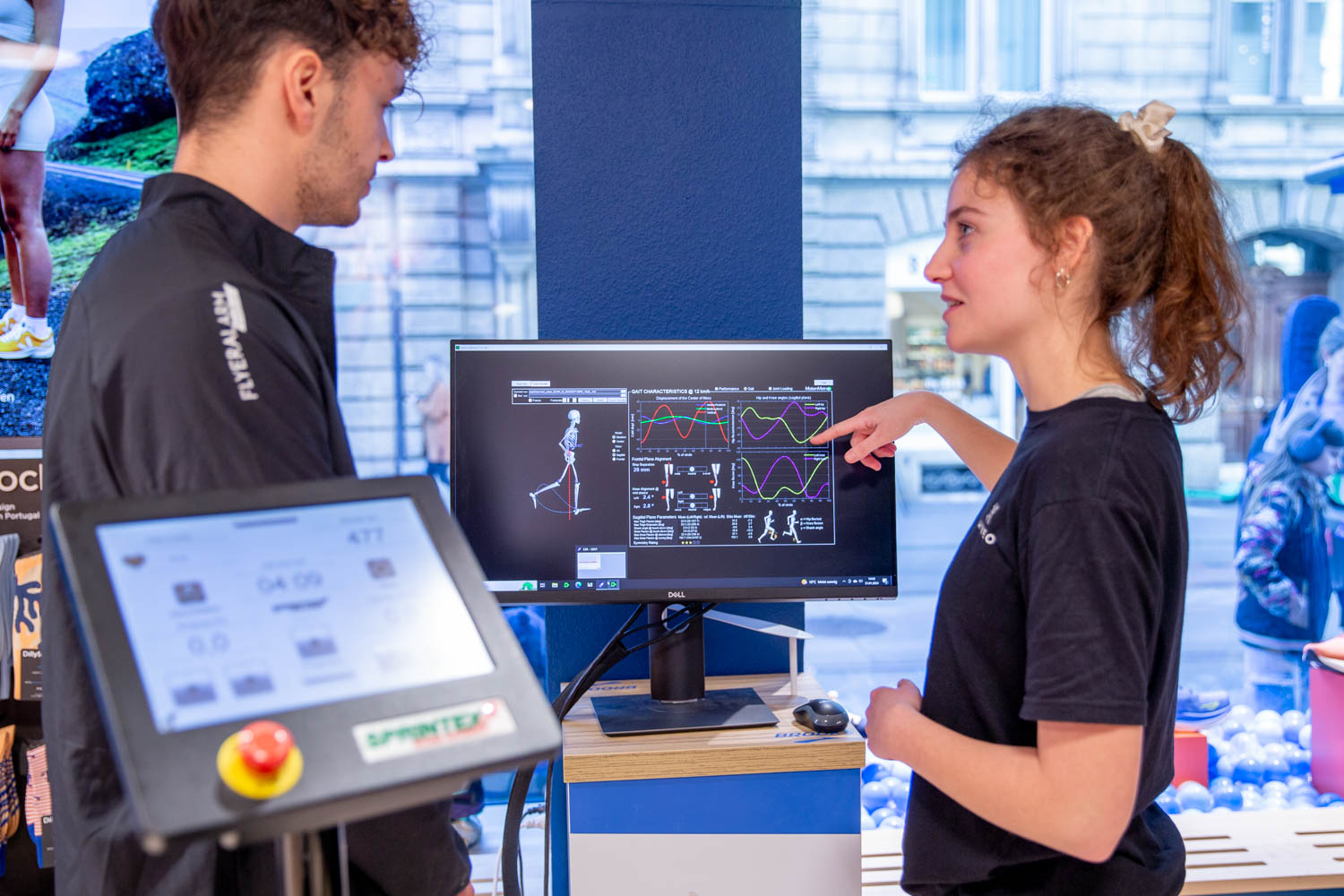
You run on the treadmill at your usual pace. Your running style is recorded on video and evaluated on screen, from the side and from behind, often in slow motion. This makes it possible to spot movements that happen too fast for the naked eye. At the Kineo Runners Lab, we use the Currex 5D running analysis for this.
A short warm-up is important. The first minutes on the treadmill are often unfamiliar, and your running style only becomes representative after you have settled in.

What the analysis can show
- Foot strike: Do you land more on the heel, midfoot or forefoot? No variant is right in principle, but each distributes the load differently across the knee, calf and Achilles tendon.
- Overstriding: Does your foot land far in front of your centre of mass, with an almost straight knee? This brakes you with every step and increases the load on the knee and shin.
- Cadence: How many steps do you take per minute? A rather low cadence often goes along with long strides and overstriding.
- Knee alignment: Does the knee tip inwards on landing? Specialists speak of a dynamic knee valgus. It can be linked to pain at the front of the knee.
- Pelvic stability: If the pelvis drops clearly on the side of the swing leg, this often points to weak muscles on the side of the hip.
- Pronation: How much does the foot roll inwards? Pronation is a normal, cushioning movement. It tends to become a problem when it is pronounced and symptoms come with it.
- Upper body and arms: rotation, forward lean, arm swing and differences between sides
What a running analysis cannot do
- No diagnosis: A striking running style does not automatically explain pain. Many people run “unattractively” and have no symptoms.
- A snapshot: On the treadmill you run a little differently than outdoors, and after 25 kilometres differently than after two.
- No ideal line: There is no single correct running style. The aim is a style that suits your body and your goals.
- No strength measurement: Whether a finding comes from strength, mobility or habit only a physical examination can show.
Who benefits from a running analysis
- Runners with symptoms such as runner's knee, shin splints, Achilles tendon or heel pain, combined with a physiotherapy examination
- Runners returning after an injury, to see whether a protective pattern has crept in
- Choosing shoes: The analysis helps you find shoes that suit your running style and your feet.
- Ambitious runners who want to work on technique and efficiency before a marathon or half marathon
- Beginners who want to start from the outset with a sensible shoe and a good feeling
How we use running analysis at Kineo
When you have symptoms, we combine the running analysis with a physiotherapy examination in Runners Physio. That way we connect what we see when you run with what your body can do.
1. Our check before and after the treadmill
- Conversation: training volume, increases over the last few weeks, shoes, earlier injuries and your goals
- Strength: single-leg squat, single-leg calf raises to fatigue and strength of the muscles on the side of the hip
- Stability: single-leg stance and Y-Balance Test, to spot differences between sides
- Mobility: ankle in the knee-to-wall test, hip extension and big toe
- Video analysis: running on the treadmill, evaluation of foot strike, knee alignment, pelvis and cadence
2. How we build up your training
- Weeks 1–2: adjust the load. Temporarily reduce volume or pace, keep the pain-free runs
- Weeks 2–6: build strength in a targeted way. For example calf raises, lunges and hip exercises for the side of the hip, two to three times a week, 3 x 8–12 repetitions
- Weeks 3–8: adjust running style. Where it makes sense, small changes such as a slightly higher cadence, one change at a time
- Follow-up: A repeat analysis shows whether the changes in your running style have become established.
3. Kineo services we use
- Currex 5D running analysis at the Runners Lab for the video picture of your running style
- Runners Physio, when pain when running should be investigated and treated
- Medical training therapy for targeted strength building of the hip, knee and calf
- Lactate step test, if you also want to determine your training zones
From our practice
Many runners come with the expectation of getting the perfect shoe after the analysis, and everything is solved. Often, though, it turns out that shoe, strength and training build-up have to fit together. Someone who overstrides a lot and has increased their volume too quickly, for example, usually benefits more from small adjustments in training than from a new shoe alone.
Running analysis and Runners Physio under one roof
At Kineo Seefeld at Seefeldstrasse 83, Feldeggstrasse stop with trams 2 and 4, on the ground floor you will find the Kineo Runners Lab with running shoes and Currex 5D running analysis. On the first floor is physiotherapy with Runners Physio. In the same building, the Kineo Performance Lab measures your endurance performance, for example with a lactate step test for CHF 200. More about the location on the Kineo Seefeld page.
Frequently asked questions
Do I need a running analysis as a recreational runner?
Not necessarily. It is worthwhile mainly for recurring symptoms, when buying shoes or when you want to work on your running style in a targeted way.
What should I bring to the running analysis?
Sports clothing that you normally run in, and your current running shoes. Worn soles also tell us a lot about your running style.
What is the difference between running analysis and Runners Physio?
The running analysis shows how you run. In Runners Physio, we also examine why, and treat symptoms in a targeted way. An appointment in physiotherapy lasts 30 minutes.
Does health insurance cover physiotherapy?
With a doctor's prescription, your basic health insurance covers the cost. Kineo is recognised by all Swiss health insurers.
You might also like
- Finding the right running shoe: what matters
- Increasing your cadence: how to do it
- Runner's knee (iliotibial band syndrome)
Book an appointment
Do you want to know how you run and what is behind your symptoms? Book your appointment at Kineo Seefeld.