By Lucrecia Guerra, physiotherapist at Kineo Escher Wyss
When your hip pinches at the bottom of the squat
The squat goes smoothly until just past parallel. Then, right at the bottom, a stabbing or dull pain deep in the groin. Sometimes it feels as if something is "bumping" at the front of the hip. You may know the feeling from getting up from a low sofa or putting on your socks, too.
In athletes, this pattern is often caused by femoroacetabular impingement, or FAI for short. That sounds complicated, but it is easy to explain. And in many cases it can be managed well with adjusted technique and targeted training.
What is FAI?
In FAI, the head of the thigh bone and the hip socket touch earlier than normal in deep flexion. There are two forms, which can also occur together:
- Cam type: The transition from the femoral head to the femoral neck is less waisted, so the head is slightly "thicker" there. More common in young, athletic men who jumped and sprinted a lot while growing.
- Pincer type: The hip socket covers the head more than usual.
Important: these shape variants also show up on X-rays in many people without symptoms. A FAI syndrome is only diagnosed when the shape, typical symptoms and matching examination findings come together. A shape variant is therefore no reason to stop training.
Typical symptoms
- Pain deep in the groin, often shown with the hand in a C shape on the side of the hip ("C sign")
- Worse in a deep squat, with long sitting, getting into a car and when pulling the knee to the chest
- Restricted internal rotation of the hip
- Sometimes clicking or brief locking, which can point to irritation of the joint lip (labrum)
Warning signs: Severe groin pain under load after a marked increase in training, especially in runners, can point to a stress fracture of the femoral neck. Pain at rest at night, fever, a fall or pain that doesn't depend on load should also be checked by a doctor.
Your hip is individual, and so is your squat
How deep and how narrow someone can squat depends heavily on the bony shape of the hip. Socket orientation and femoral neck angle differ clearly from person to person. That is why there is no single right squat. These adjustments help many people:
- Stand wider: A slightly wider stance creates room at the front of the hip.
- Turn your feet slightly outwards: The hip rotates with them, and contact at the front is often reached later.
- Limit depth: Squat to a box or bench, only as deep as stays pain-free.
- Hold the load in front: Goblet squats or front squats allow a more upright upper body and are often tolerated better.
- More hip extension in your programme: Hip thrusts, Romanian deadlifts and lunges train the legs without deep hip flexion.
How we treat hip pain when squatting at Kineo
First we clarify whether the symptoms come from the hip joint or whether the groin, lumbar spine or muscles are behind them. Then we adjust your training and technique.
1. Assessment: what we examine in your first session
- FADIR test: hip flexion with internal rotation, a key provocation test when FAI syndrome is suspected
- Internal rotation and flexion compared on both sides, lying on your back and sitting
- FABER test and palpation of the groin, adductors and hip flexors, to rule out other causes
- Hip muscle strength: abductors, external rotators and hip extensors, compared on both sides
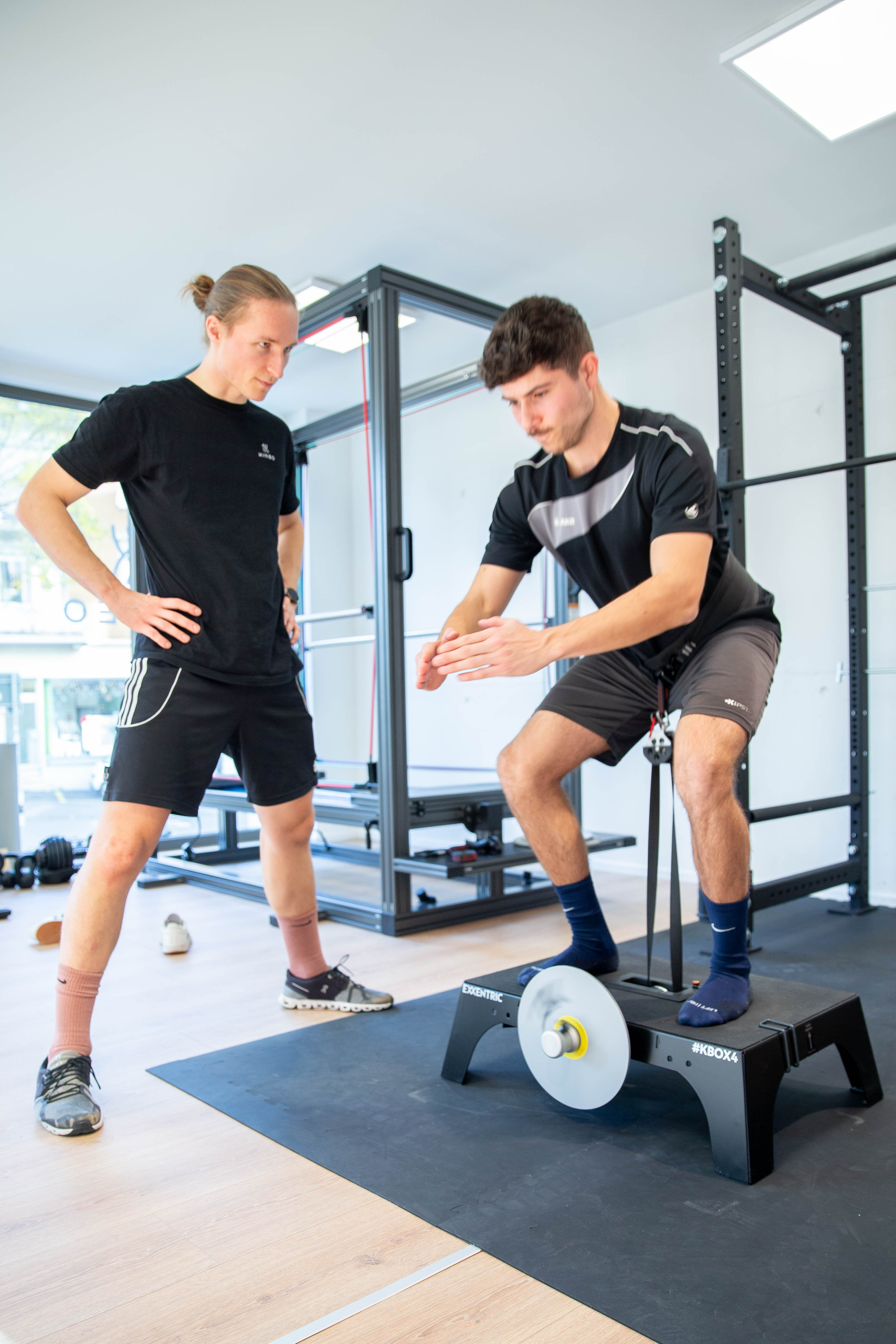
- Squat analysis: We test different stance widths, foot positions and depths and see which variant works with little pain
- Lumbar spine: ruling out radiating pain from the back
2. Treatment in phases
- Phase 1, weeks 1–3: adjust the load. Squats with limited depth, hip extension and side plank variations, pain during the exercise up to about 3 out of 10.
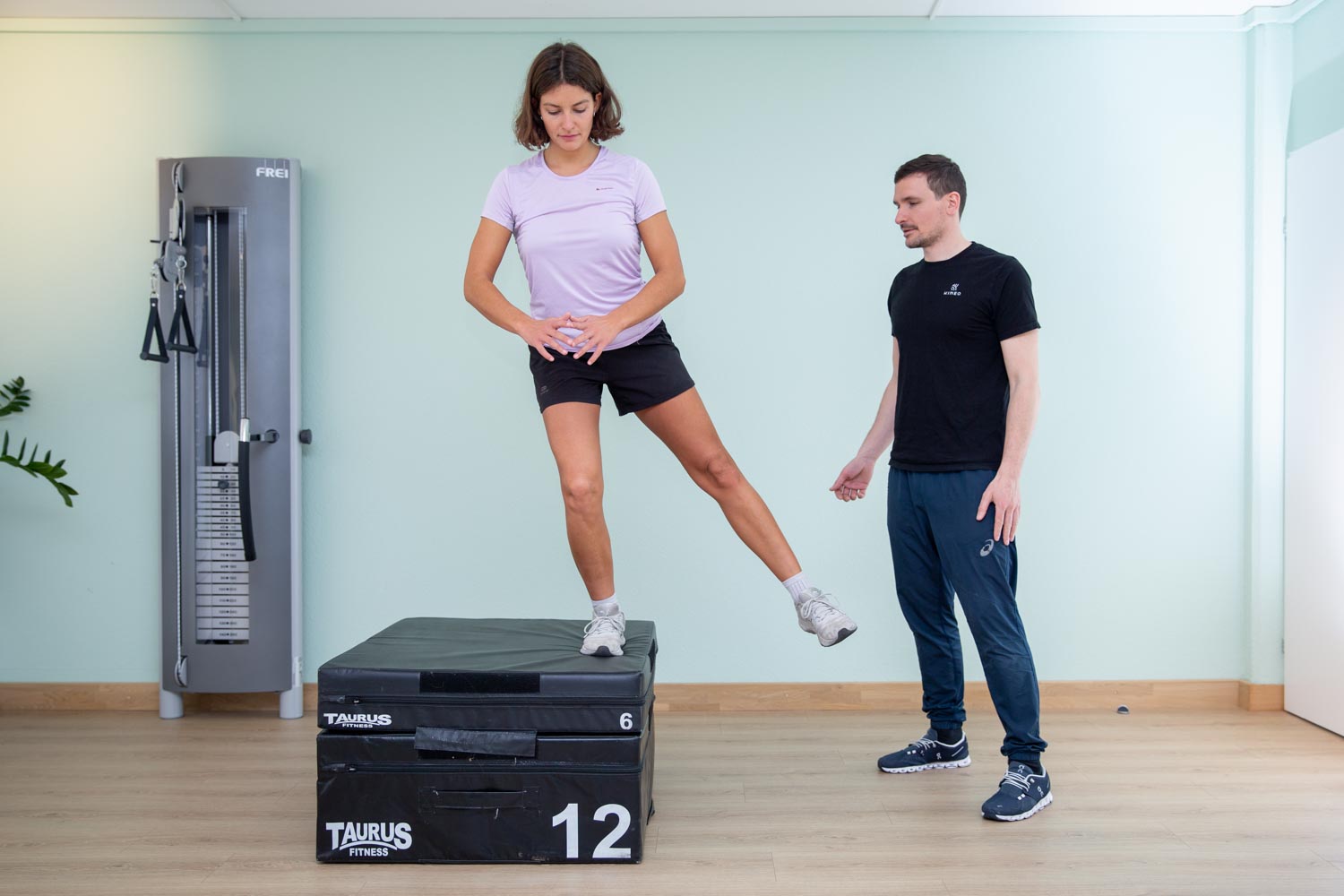
- Phase 2, weeks 3–8: strengthen the hip. Hip thrusts, Copenhagen exercise, side-stepping with a band and single-leg squats, 3 x 8 to 12, two to three times a week.
- Phase 3, from week 8: regain depth. Gradually lower the box height, reintegrate the barbell, in the stance width that suits you individually.
- If it doesn't get better: If three months of consistent training bring no improvement, we recommend an orthopaedic assessment with imaging.
3. Kineo services we use
- Sports physiotherapy: assessment, technique adjustment and load plan
- Manual therapy for the hip joint and lumbar spine, when mobility is restricted
- Medical training therapy for building strength around the hip
- Trigger point treatment for tense hip flexors and adductors, as a complement
Three exercises for the hip
- Hip thrust: Shoulders on the bench, push your pelvis up, hold for one second at the top. 3 x 10 to 12.
- Side plank with abduction: Side plank on your forearm, slowly raise and lower the top leg. 3 x 8 to 10 per side.
- Box squat: Sit down onto a box with a goblet hold, hold tension briefly, stand up. Set the box only as low as stays pain-free. 3 x 8.
From our practice
We often see strength athletes who squat as deep as possible with a narrow stance and feet pointing forward, because that is considered the "correct" technique. Even small changes to stance width and foot position make the squat much more comfortable for many people. Your hip then mainly needs strength and patience, not fear of the movement.
Hip training at Kineo Escher Wyss
At Kineo Escher Wyss at Hardturmstrasse 18, we test your squat directly on the supervised training area. This way you find the variant that suits your hip with us, and build strength under guidance. If you train at Kineo HYROX in the same building, you can build wall balls and lunges back up in a coordinated way.
Frequently asked questions
Does FAI need surgery?
Not necessarily. Many people cope well with training and technique adjustments. Surgery is discussed if symptoms persist despite consistent therapy.
Does FAI lead to arthritis?
Pronounced shape variants can increase the risk of hip osteoarthritis. Whether surgery lowers this risk has not been established. Maintaining strength and mobility makes sense in any case.
How long does an appointment last?
An appointment lasts 30 minutes. In the first session we clarify the cause and start straight away with treatment and exercises.
You might also like
Book an appointment
Is your hip stopping your squat? Book your appointment at Kineo Escher Wyss and find the technique that suits you.