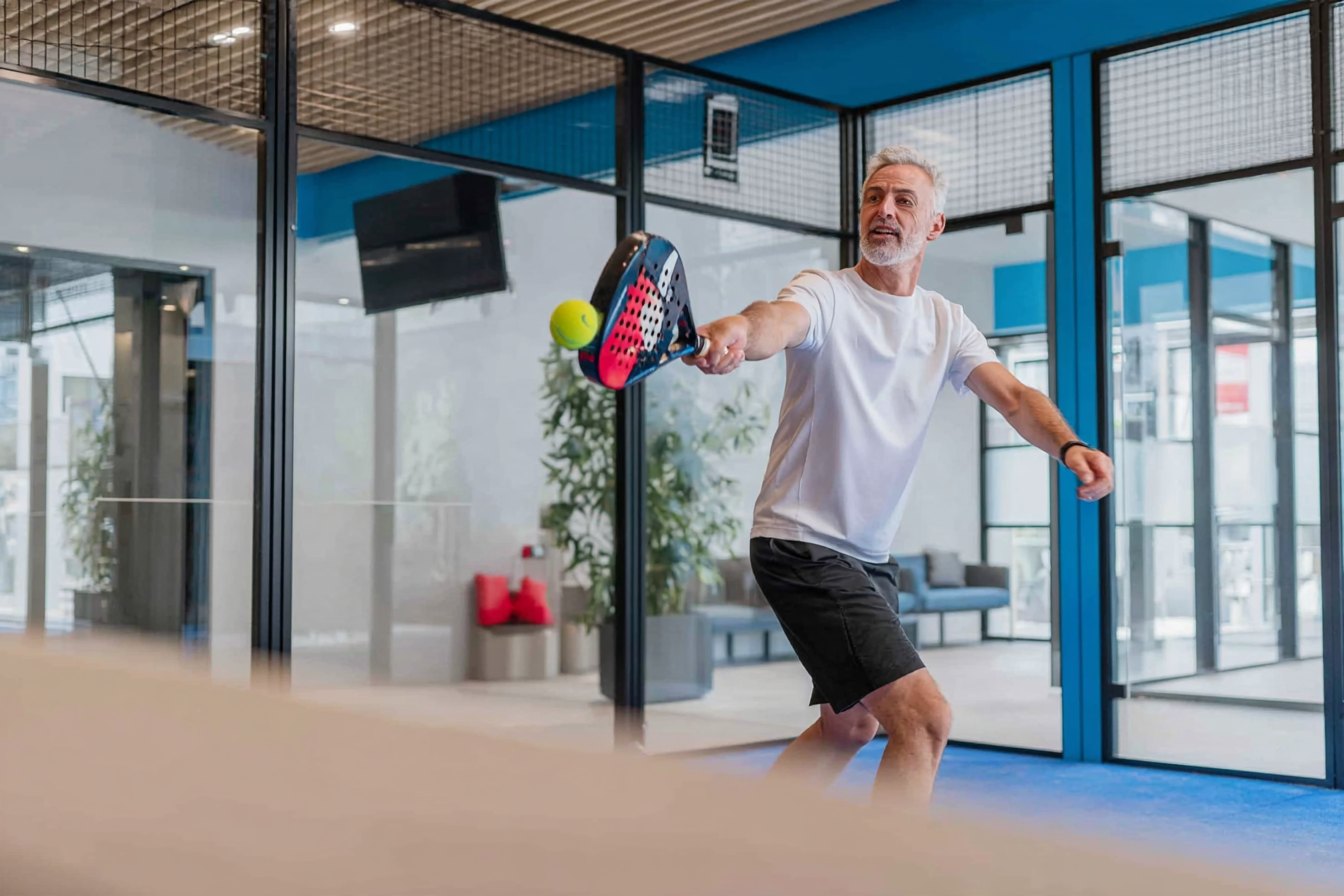
By Martino Crivelli, physiotherapist and co-founder of Kineo, Kineo Escher Wyss
Slipped disc: is strength training over now?
For many people who train, the diagnosis “slipped disc” sounds like a verdict. No more deadlifts, no squats, ideally no heavy lifting at all. On top of that comes pain radiating into the leg, and uncertainty about which movement might do harm.
The reality is usually much better. Discs are resilient tissue, and a large proportion of disc herniations recede over time on their own. Strength training is not a risk here but an important part of treatment, as long as you dose it correctly.
What happens in a slipped disc
The intervertebral disc consists of a firm fibrous ring and a softer core. In a herniation (disc prolapse), material from the core pushes outwards through the fibrous ring. If it compresses or irritates a nerve root, pain radiates into the leg, sometimes with tingling, numbness or weakness. This is called radiculopathy.
Important to know: bulges and herniations also show up on MRI in many people without any complaints at all. The image alone therefore says little about how resilient your back is. What matters is how you move and how the complaints respond to load.
Warning signs that need immediate medical attention
- Numbness in the genital or buttock area (“saddle area”)
- New problems passing urine or opening your bowels
- Rapidly increasing weakness in the leg, for example if you can no longer lift your foot
- Fever, unexplained weight loss or back pain after an accident
The first two points are an emergency. Go to an emergency department immediately.
What you can do yourself
- Keep moving: bed rest delays recovery. Walks at a comfortable pace are often the best training in the acute phase.
- Find a relieving position, but don’t cling to it: many people have a direction of movement that does them good, for example gently extending the back while lying face down. If the leg pain decreases or retreats towards the back, that’s a good sign.
- Watch the radiating pain: if the pain spreads further down the leg after an exercise, the load was too much. Back pain alone is less critical than increasing leg pain.
- Adapt your training instead of giving up: upper body training, riding a bike or swimming are often possible again early on.
How we rebuild strength training at Kineo
We don’t go by the MRI, but by your symptoms and how your body responds to load.
1. Assessment: what we examine in your first session
- Neurological examination: strength of the key muscles, reflexes and skin sensation in the legs, to identify the affected nerve root and rule out warning signs
- Nerve tests: the straight leg raise test (Lasègue) and slump test show how sensitive the nerve is to stretch
- Repeated movements: we check whether extending, bending or shifting the pelvis sideways reduces the leg pain
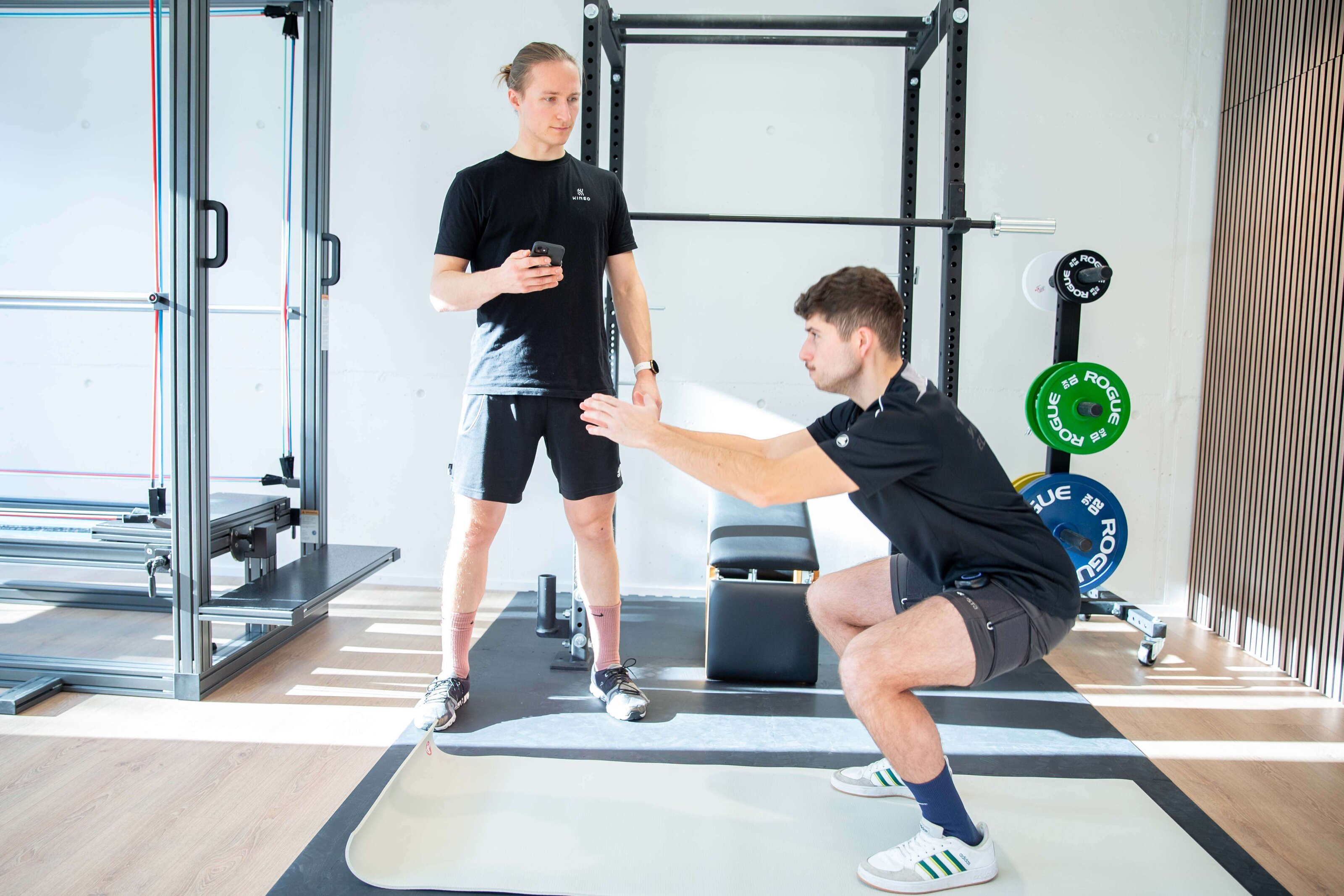
- Movement analysis: hip hinge, squat and lifting from the floor with a light load
- Load history: which positions and activities make the pain worse or better, including sitting and sleep
2. Treatment in phases
- Phase 1, first 1–3 weeks: settle things down. Walking, relieving positions, gentle nerve gliding exercises and light trunk exercises such as bird dog and glute bridge, 2–3 x 10 daily.
- Phase 2, from week 3: basic strength. Goblet squat to a box, dumbbell rows, side plank, hip hinge with a stick and light weight. 3 x 8 to 12, two to three times a week.
- Phase 3, from around week 6: back to the barbell. Trap bar deadlift or Romanian deadlift, front squat, increase the weight as long as the leg pain doesn’t increase.
- Phase 4: full load. Your usual exercises and weights, with clean technique and sensible progression over the weeks.
The time frames are guidelines. Some people progress faster, for others the nerve needs longer.
3. Kineo services we use
- Sports physiotherapy: assessment, load management and return to heavy compound lifts
- Medical training therapy for gradual, guided strength building
- Neurodynamics to improve the mobility and resilience of the irritated nerve
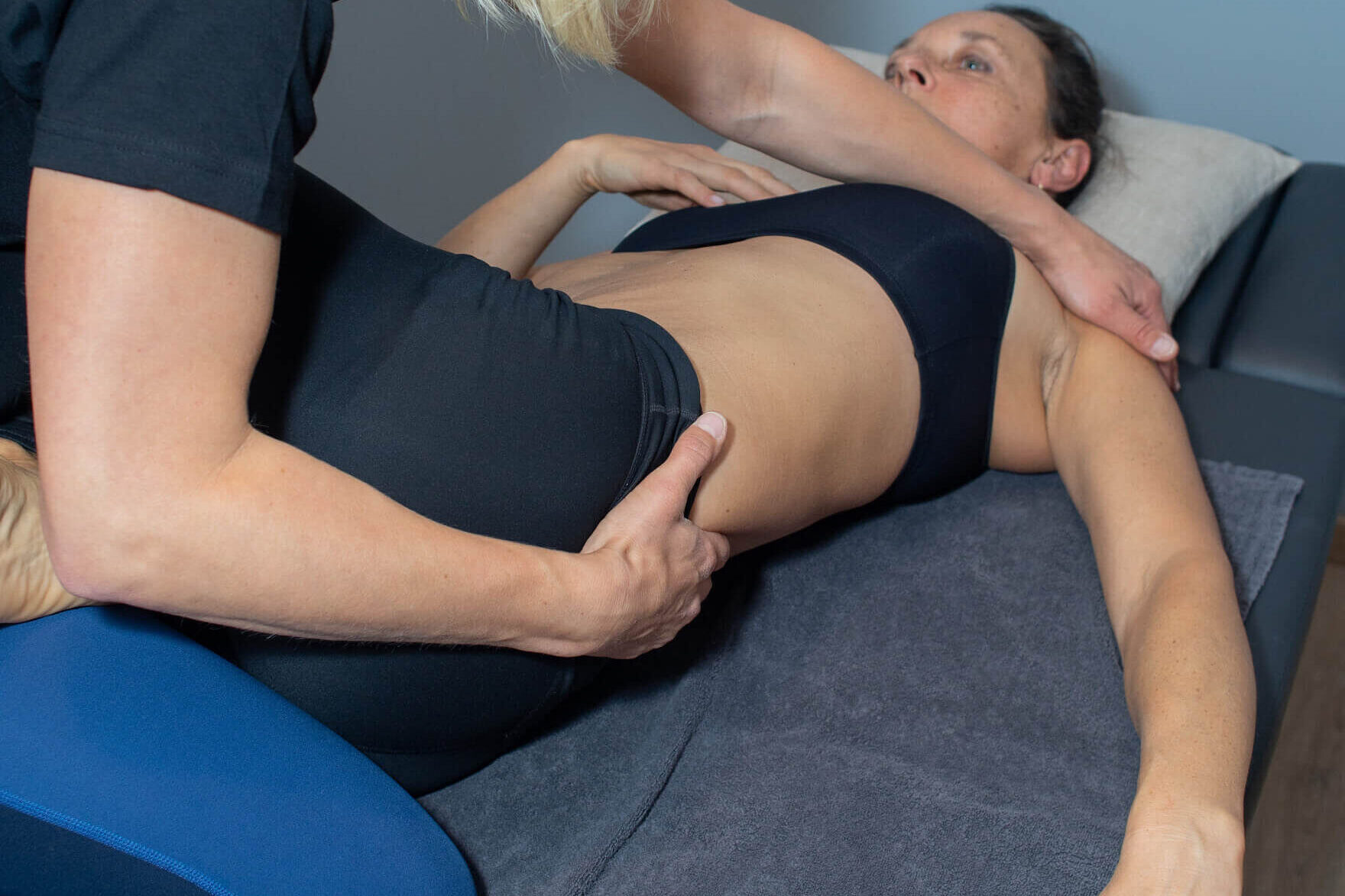
- Manual therapy in the acute phase for pain relief
Three myths about discs and training
“Deadlifts are off limits after a slipped disc.” Not in principle. Many strength athletes lift heavy again after a structured build-up. The exercise just has to come back at the right time and with a suitable load.
“Your back must always be dead straight when lifting.” A stable, controlled position under heavy load makes sense. But slight rounding in everyday life is normal and not dangerous. Fear of every bend tends to make movement stiff and insecure.
“A weak core is to blame.” A strong trunk helps, but it is only one building block. Load management, sleep, stress and progression in training play just as big a role.
From our practice
Many people who train come to us expecting to have to drop heavy compound lifts for good. As soon as they see that their leg pain responds well to certain movements and that the weight can come back in small steps, they lose their fear of training. This confidence is often just as important as the exercises themselves.
From your back to the barbell at Kineo Escher Wyss
At Kineo Escher Wyss at Hardturmstrasse 18, we treat you upstairs in the physiotherapy practice and train with you on the supervised training floor. There we rebuild deadlifts, squats and rows under guidance. If you want to keep training at Kineo HYROX in the same building afterwards, you benefit from the short line between physio and coaching.
Frequently asked questions
Do I need surgery?
Usually not. Most slipped discs are treated conservatively. Surgery is discussed in cases of paralysis, bladder or bowel disorders, or severe complaints that persist over a longer period despite good therapy.
When can I lift heavy again?
When the leg pain has clearly decreased, the neurological tests are stable and you can manage the basic exercises with moderate weights without a reaction the next day. This is often the case after a few weeks to a few months.
Does health insurance cover physiotherapy?
Yes. With a doctor's prescription, your basic health insurance covers the cost. Kineo is recognised by all Swiss health insurers.
You might also like
Book an appointment
Want to train safely again after a slipped disc? Book your appointment at Kineo Escher Wyss.