By Eva Danko, physiotherapist at Kineo Wipkingen
When your thumb hurts as you grip
Unscrewing a jar, turning a key in the lock, squeezing a clothes peg: suddenly your thumb hurts at its base, right where it joins the wrist. Over time your grip gets weaker, sometimes the area swells and the thumb looks different from before.
Behind these complaints there is often osteoarthritis in the thumb saddle joint, known as thumb base osteoarthritis (rhizarthrosis). It is one of the most common forms of osteoarthritis in the hand and affects women in particular from around midlife. With targeted exercises, joint protection and good advice, the symptoms can in many cases be eased significantly.
What is the thumb saddle joint?
The thumb saddle joint lies between the first metacarpal bone and the trapezium, a small carpal bone. The joint surfaces are shaped like two saddles set into each other. This lets the thumb move in almost all directions and oppose the other fingers. This mobility comes at a price: the joint is guided little by bone and relies on ligaments and muscles.
In pinch grip and key grip, large forces act on the small joint surface. Over the years the cartilage can become thinner, the ligaments become looser and the metacarpal bone slips slightly outwards. The joint reacts with pain, irritation and sometimes swelling.
Typical symptoms
- Pain at the base of the thumb, especially when gripping, twisting and pressing
- Loss of strength in pinch grip, for example when opening packaging
- Stiffness after rest, often in the morning
- Swelling and tenderness at the joint
- In later stages, a visible step at the base of the thumb, a narrowing space between thumb and index finger and a thumb knuckle that hyperextends when you grip
Causes and risk factors
- Age and hormones: Women after the menopause are affected significantly more often.
- Predisposition: Osteoarthritis in the fingers runs in some families.
- Loose ligaments: Very mobile joints are guided less stably.
- Load: A lot of forceful gripping and twisting at work or in a hobby
- Previous injuries to the thumb or wrist
When to see a doctor
An X-ray shows how far the osteoarthritis has progressed. Important: what the X-ray shows and how much it hurts don't always match. You should definitely see a doctor if the joint suddenly swells a lot and is red and warm, if several finger joints are inflamed at the same time, or if morning stiffness lasts a long time. This can point to an inflammatory rheumatic condition.
What you can do yourself
- Joint protection in everyday life: Large handles, opening aids for jars and bottles, keys with a grip enhancer. Carry things with your whole hand or over your forearm instead.
- Round instead of flat grip: In pinch grip, keep your thumb slightly bent so that thumb and index finger form an "O". A thumb knuckle pushed straight puts more load on the saddle joint.
- Splint if needed: A thumb splint can give relief during phases of severe pain and during demanding activities. Get advice from your doctor or a hand therapy specialist.
- Move instead of rest: Regular, gentle movement keeps the joint supple and the muscles strong.
- Warmth: Many people find warm water or a heat pad in the morning pleasant against the stiffness.
Exercises for a stable thumb
The exercises should cause only mild discomfort at most, which quickly fades again after training.
- Thumb "O": Thumb and index fingertip form a round "O", while the thumb knuckle stays slightly bent. Press gently against each other for 5 seconds, 10 repetitions, then repeat with the other fingers.
- Thumb abduction against resistance: Place a light rubber band around your thumb and fingers. Slowly move the thumb forwards, away from the index finger. 3 x 10–15 repetitions.
- Index finger abduction: Hand flat on the table, rubber band around the index and middle finger. Push the index finger away towards the thumb side. This strengthens a muscle that stabilises the saddle joint. 3 x 12.
- Stretch the thumb and index finger web: With your other hand, gently open the space between thumb and index finger, pressing at the thumb knuckle, not at the tip. 3 x 30 seconds.
Short sessions are ideal, once a day or every second day.
How we treat thumb base osteoarthritis at Kineo
We want you to be able to grip with less pain in everyday life again. To do this, we combine advice, manual techniques and targeted strengthening.
1. Assessment: what we examine in your first session
- Grind test: We press the thumb gently into the joint and rotate it. Pain and grinding point to osteoarthritis.
- Mobility: Abduction, opposition and the opening between thumb and index finger, compared side to side
- Strength: Pinch grip, key grip and fist closure, compared side to side
- Position: How stable is the saddle joint, does the thumb knuckle hyperextend when you grip?
- Differential diagnosis: Finkelstein test for tendon sheath irritation and tests for the median nerve, because carpal tunnel syndrome can also cause thumb complaints
- Everyday life: Which grips hurt, which activities matter to you?
2. Treatment in phases
- Phase 1, weeks 1–3: Calm things down. Discuss joint protection, adapt grips, gentle mobility exercises and mobilisation of the joint.
- Phase 2, weeks 3–8: Stabilise. Targeted strengthening of the muscles around the saddle joint, 2–3 sets of 10–15 repetitions, every second day.
- Phase 3, from week 8: Everyday life and hobbies. Grip strength under real conditions, for example for gardening, crafts, climbing or musical instruments. Plus a home programme that you keep up in the long term.
3. Kineo services we use
- General physiotherapy: education, joint protection and adapting your grips
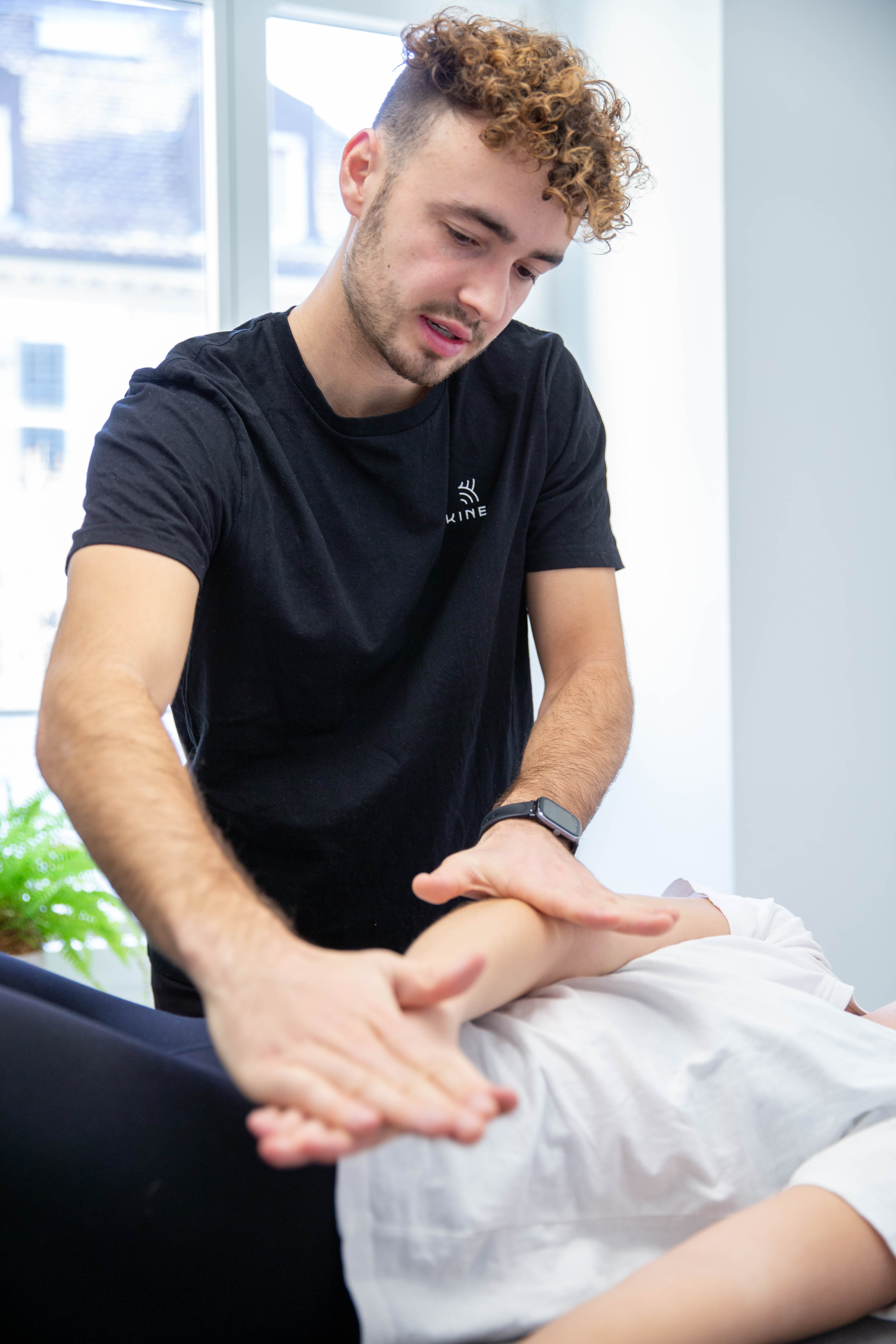
- Manual therapy for gentle mobilisation of the saddle joint and carpus
- Medical training therapy for grip, forearm and shoulder strength
- Digital home programme, so that the thumb exercises become part of your daily routine
And if it doesn't get better?
If the pain stays severe despite exercises, joint protection and a splint, your doctor may suggest an injection into the joint. For advanced osteoarthritis with a clear limitation in everyday life, there are various operations, for example removal of the trapezium. After such an operation, a longer period of follow-up treatment is usual so that mobility and strength come back.

From our practice
Many people with thumb base osteoarthritis rest the thumb so much that the muscles around the joint get weaker. The joint then becomes even less stable and hurts with small loads. When we change the grip and strengthen the right muscles, many people tell us that everyday things like opening jars or writing feel easier again.
Physiotherapy in Wipkingen
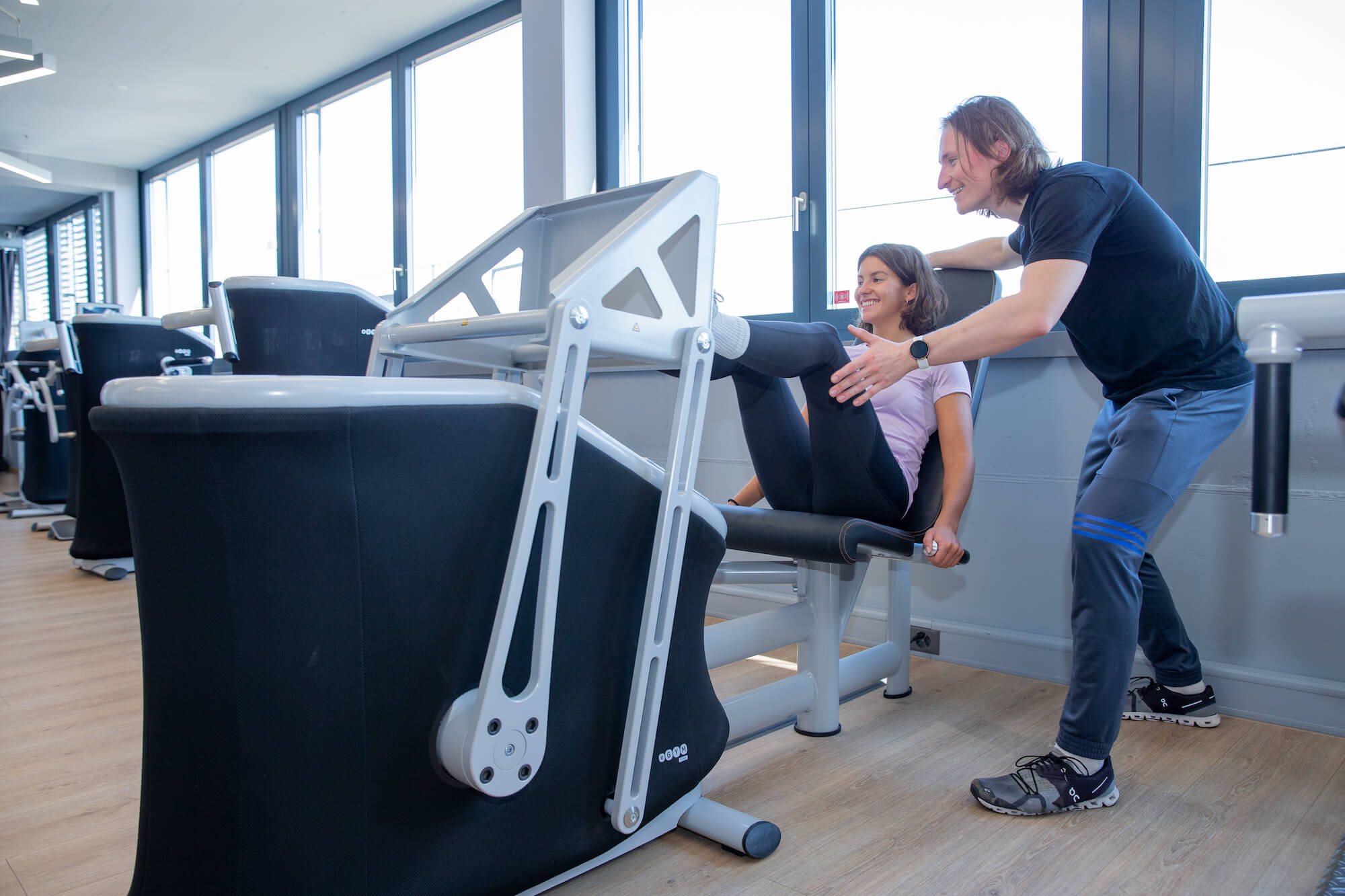
You will find Kineo Wipkingen at Röschibachstrasse 79, right on Röschibachplatz. Alongside treatment of the hand and arm, you also work on your forearm and shoulder with us on the training floor using strength machines, so that the whole chain supports you. You can find all the information about the location at Kineo Wipkingen.
Frequently asked questions
Can osteoarthritis in the thumb be reversed?
Cartilage cannot be rebuilt. But the symptoms can often be reduced significantly, because muscles, grips and load have a big influence.
Can I still climb or garden with thumb base osteoarthritis?
Usually yes, with adjusted dosage and good grip technique. We will discuss with you which loads your thumb tolerates well at the moment.
How long does an appointment take?
An appointment lasts 30 minutes. In the first session we clarify the cause and start straight away with treatment and exercises.
Does health insurance cover physiotherapy?
Yes. With a doctor's prescription, your basic health insurance covers the cost. Kineo is recognised by all Swiss health insurers.
You might also like
- Osteoarthritis in the shoulder, elbow and hands
- Carpal tunnel syndrome
- Mouse arm: tendon irritation in the forearm
Book an appointment
Does your thumb hurt when you grip? Book your appointment at Kineo Wipkingen and we will make your grip stable again.