By Clara Benning, physiotherapist at Kineo Escher Wyss
When your knee complains during burpee broad jumps
For many people, burpee broad jumps are the least popular HYROX station: 80 metres where you repeatedly lie down on the floor, get up and jump forward with both feet. The knee usually doesn't feel it on take-off, but on landing. At the front under the kneecap, around the kneecap or on the inside of the knee.
Many landings in a row, after the fourth kilometre of running and with tired legs: this is a real stress test for the tendons and the kneecap. With good landing technique and targeted strength training, this load can be spread much better.
What happens in the knee on landing
On take-off, mainly the hip, thigh and calf muscles do the work. On landing, the knee has to brake the movement. The muscle at the front of the thigh (quadriceps) then works eccentrically and pulls hard on the kneecap via the patellar tendon.
- Hard, stiff landing: If you land on your heels with almost straight knees, you pass the impact on with hardly any cushioning.
- Knees collapse inwards: If the knees tilt clearly inwards on landing (dynamic valgus), the load on the kneecap and the inside of the knee increases.
- Maximum distance on every jump: means more braking work. Even, controlled jumps are often faster over 80 metres.
- Tired calves and glutes: When they tire, the knee takes over more of the braking work.
- Jumping up out of the burpee: Jumping quickly into a deep squat puts extra load on a kneecap that is already irritated.
Typical knee complaints
- Patellofemoral pain syndrome: Pain around or behind the kneecap, typical when walking downstairs, in a deep squat or after sitting for a long time.
- Patellar tendon irritation (jumper's knee): Localised pain directly below the kneecap. Often felt at the start of training, then better, then stronger again afterwards.
- Quadriceps tendon: Pain above the kneecap, less common, but possible with a lot of jumping and deep squats.
- Inside of the knee: Irritation at the pes anserinus, the shared tendon attachment below the inner joint line, when the knees often collapse inwards.
You should see a doctor if you have: clear swelling soon after a fall or twist, a knee that locks or can no longer be fully straightened, repeated giving way, redness and warmth, or fever.
The landing: how to protect your knee
- Land quietly: The quieter the landing, the better you spread the force. Land on your whole foot and let your knee and hip give.
- Hips back: Push your bottom back on landing as in a squat. That way your glutes and hamstrings help out.
- Knees over your feet: Your knees point in the direction of your toes.
- Rhythm rather than record distance: Even jumps keep your technique stable right to the end.
- Burpee with a step: If you have knee problems, in training you can step your legs back one after the other and forward again instead of jumping.
What you can do yourself
- Dose the load: Reduce jumping for a while and carry on running and strength work in the low-pain range.
- Pain as a guardrail: Up to about 3 out of 10 during the exercise is fine, as long as the knee settles by the next morning.
- Hold exercises for tendon pain: Wall sit or a static leg extension hold, 4–5 x 30–45 seconds. This can ease tendon pain in the short term.
- Don't just stretch: Stretching feels good, but it doesn't replace building strength in the thighs, glutes and calves.
How we treat knee pain from jumping at Kineo
We first find out which structure is irritated and which movement is overloading it. Then we build your load capacity step by step, right up to landing when fatigued.
1. Assessment: what we examine in your first session
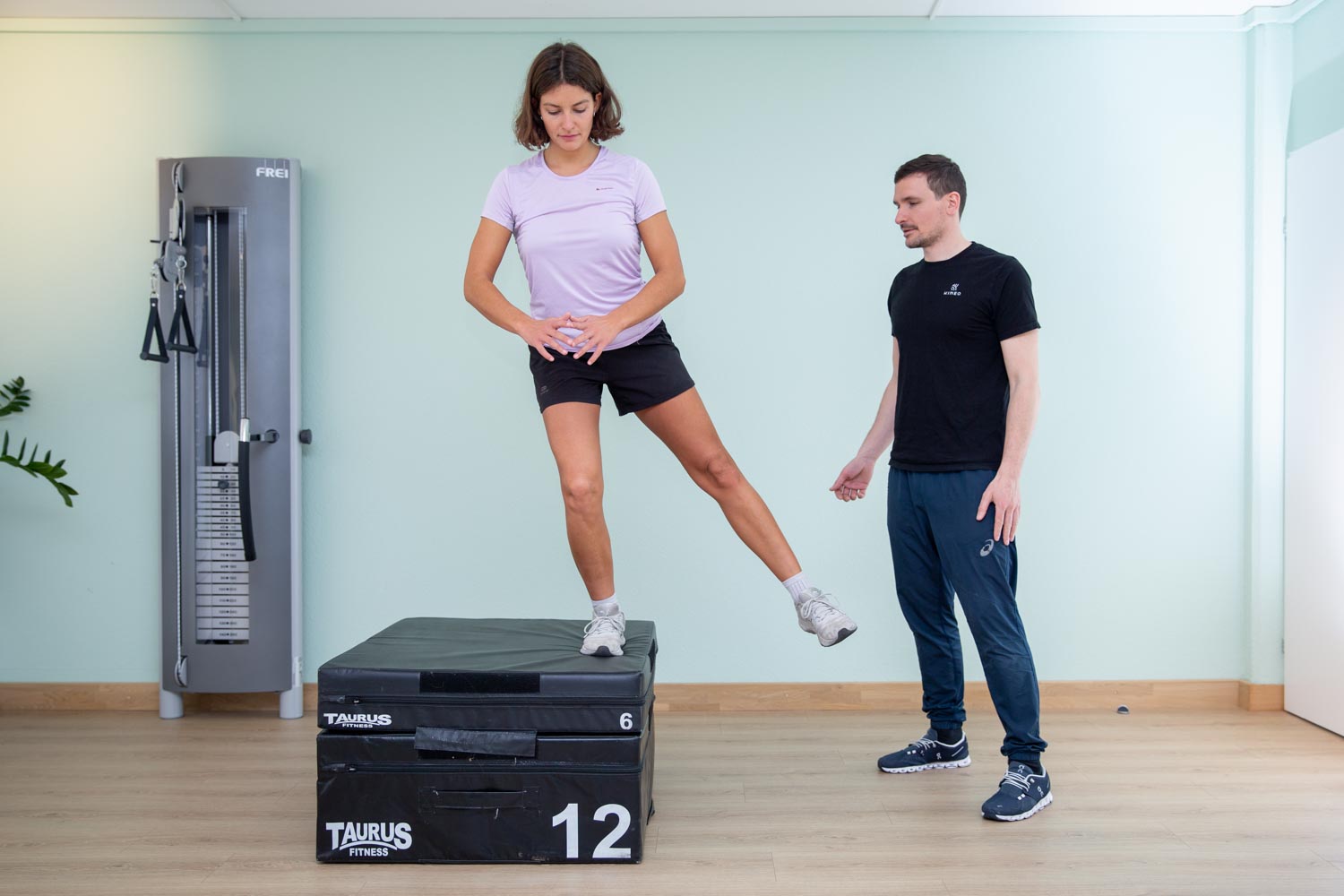
- Palpation and provocation: Patellar tendon, edge of the kneecap, quadriceps tendon and inside of the knee, plus the single-leg squat on a decline board (decline squat), which specifically loads the patellar tendon
- Single-leg squat: Leg alignment, pelvis and trunk control during the single-leg squat
- Landing analysis: Drop jump from a box and a few broad jumps, filmed and analysed in slow motion
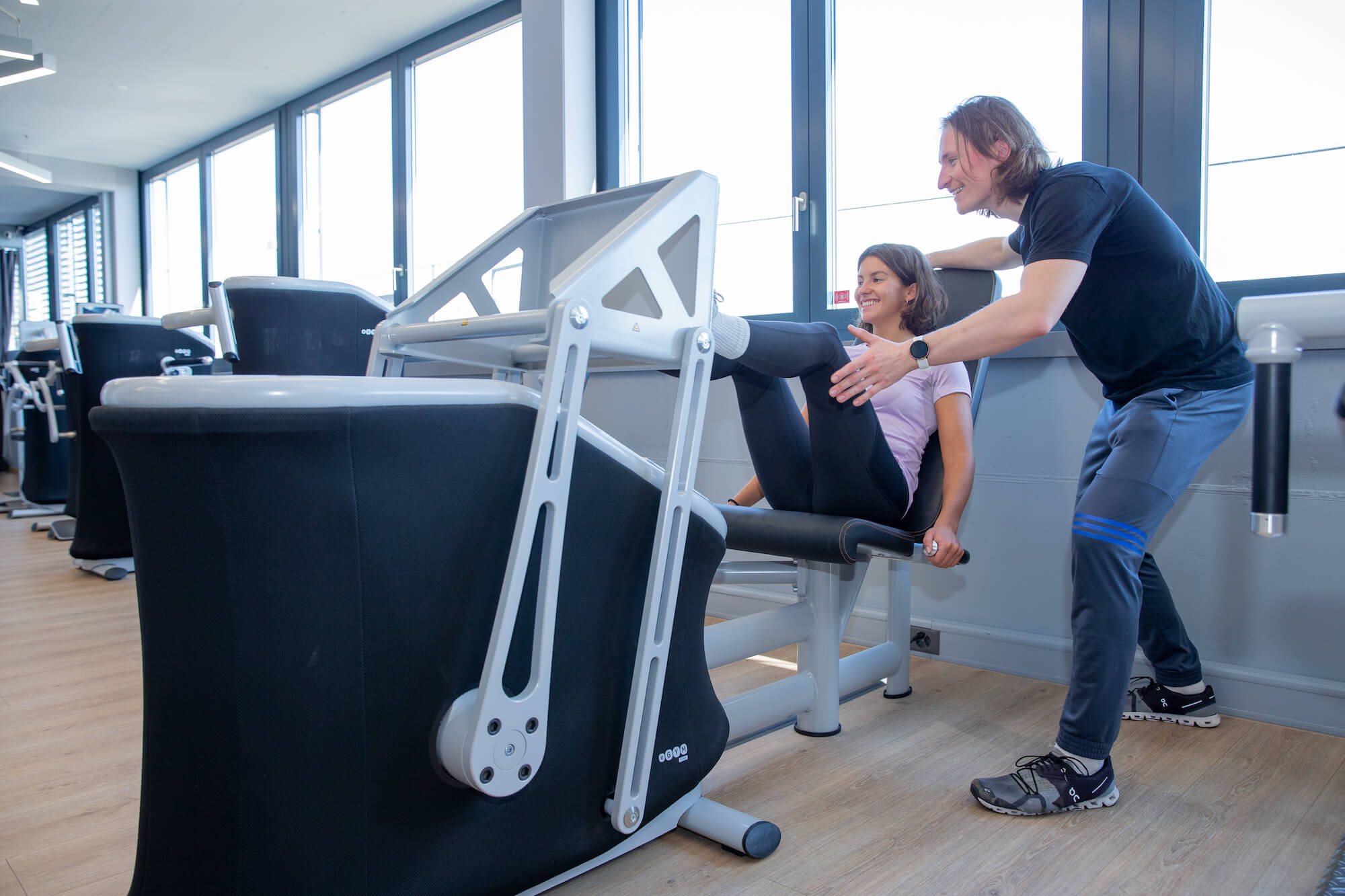
- Strength: Quadriceps and hip abductors measured with a dynamometer and compared side to side, plus single-leg calf raises to fatigue
- Mobility and stability: Knee-to-wall test for the ankle and Y-Balance Test for single-leg control
2. Treatment in phases
- Phase 1, weeks 1–2: calm the irritation. Pause jumping, hold exercises for the quadriceps, 4–5 x 30–45 seconds, plus calf and hip strength.
- Phase 2, weeks 2–6: build strength. Split squat, squat, leg press and step-downs, slow and heavy, 3–4 x 6–10, two to three times a week.
- Phase 3, from weeks 4–6: learn to land. Snap-downs, box jumps with step-down, then landings from small heights, 3–4 x 5. First with both feet, then on one leg.
- Phase 4: distance and repetitions. Broad jumps in series, then burpee broad jumps after running intervals.
- Criteria for full load: Strength almost equal side to side, clean landing even when fatigued, no reaction the next day.
3. Kineo services we use
- Sports physiotherapy: assessment, landing analysis and load plan
- Medical training therapy to build strength in the quadriceps, hips and calves
- Power training for jumping and landing technique
- Shockwave therapy for stubborn patellar tendon complaints, as a complement to training
- Cold therapy with Game Ready after intense sessions, when the knee is irritated
Landing training in four stages
- Snap-down: From standing on your toes with your arms overhead, drop quickly into the landing position, hips back, knees over your feet. 3 x 6.
- Box jump with step-down: Jump onto a low box, land quietly, step down. 3 x 5.
- Broad jump with hold: Jump for distance, hold the landing for two seconds and check your position. 3 x 5.
- Broad jumps in series: Several jumps in a row with a smooth landing, 3 x 4–6. Then work in burpees between them.
One to two times a week, when rested and at the start of the session.
From our practice
With knee pain after burpee broad jumps, we often see in the video analysis that the first jumps are clean and the landing gets stiffer as fatigue builds: knees almost straight, weight on the heels. Often the calves and glutes, which take the strain off the knee on landing, then lack strength. With targeted strength training and a little landing training, this often changes faster than many people expect.
Landing training on site: Kineo Escher Wyss
At Kineo Escher Wyss on Hardturmstrasse 18, right at Escher-Wyss-Platz, sports physiotherapy is combined with a supervised training floor. You do your strength building and landing training there under guidance. Shockwave and Game Ready are on site, and Kineo HYROX is in the same building. You can find out more about the location on the Kineo Escher Wyss page.
Frequently asked questions
Do I have to give up burpee broad jumps?
Usually only temporarily and in part. We reduce the jumps, build strength and then reintroduce them step by step.
Do knee supports or tape help?
They can feel pleasant and ease symptoms in the short term. They don't replace building strength.
How long does an appointment last?
An appointment lasts 30 minutes. In the first session we clarify the cause and start straight away with treatment and exercises.
Does health insurance cover physiotherapy?
Yes. With a doctor's prescription, your basic health insurance covers the cost. Kineo is recognised by all Swiss health insurers.
You might also like
- Patellar tendinopathy (jumper's knee)
- Runner's knee (patellofemoral pain syndrome)
- Squats and knee pain: myths and facts
Book an appointment
Does your knee protest at every landing? Book your appointment at Kineo Escher Wyss.