By Martino Crivelli, physiotherapist and co-founder of Kineo, Kineo Escher Wyss
Is the squat bad for your knees?
Hardly any exercise is surrounded by as many myths as the squat. "Your knees must never go past your toes", "Deep squats ruin your knees", "If it clicks, something is broken". If you hear that often enough, you eventually only do half squats or drop them altogether. Yet for most knees, it is one of the best exercises there is.
In this article we separate myths from facts. And we show you how you can keep squatting even with knee pain, adapted and targeted.
Myth 1: Your knees must not go past your toes
When you squat deep, in most people the knees naturally travel past the tips of the toes. That is normal and no problem for healthy knees. If you artificially hold your knees back, your upper body has to lean further forward. The load then shifts to the hip and lower back.
With an irritated kneecap, it can be sensible for a while to bring the knees forward a little less, for example with a box squat. That is a temporary adjustment, not a rule for ever.
Myth 2: Deep squats harm the knees
For healthy knees there is no good basis for the claim that deep squats do harm. What matters is that the depth suits your mobility and that you control the position. With certain complaints, for example after a meniscus operation or with an irritated kneecap, we temporarily adjust the depth.
Myth 3: If the knee clicks, something is broken
Clicking or grinding in the knee (crepitus) is very common, even in people without symptoms. Without pain, swelling or locking, it is usually harmless. You should have clicking checked if it is new and occurs together with pain, swelling or a catching sensation.
Myth 4: No squats with knee pain
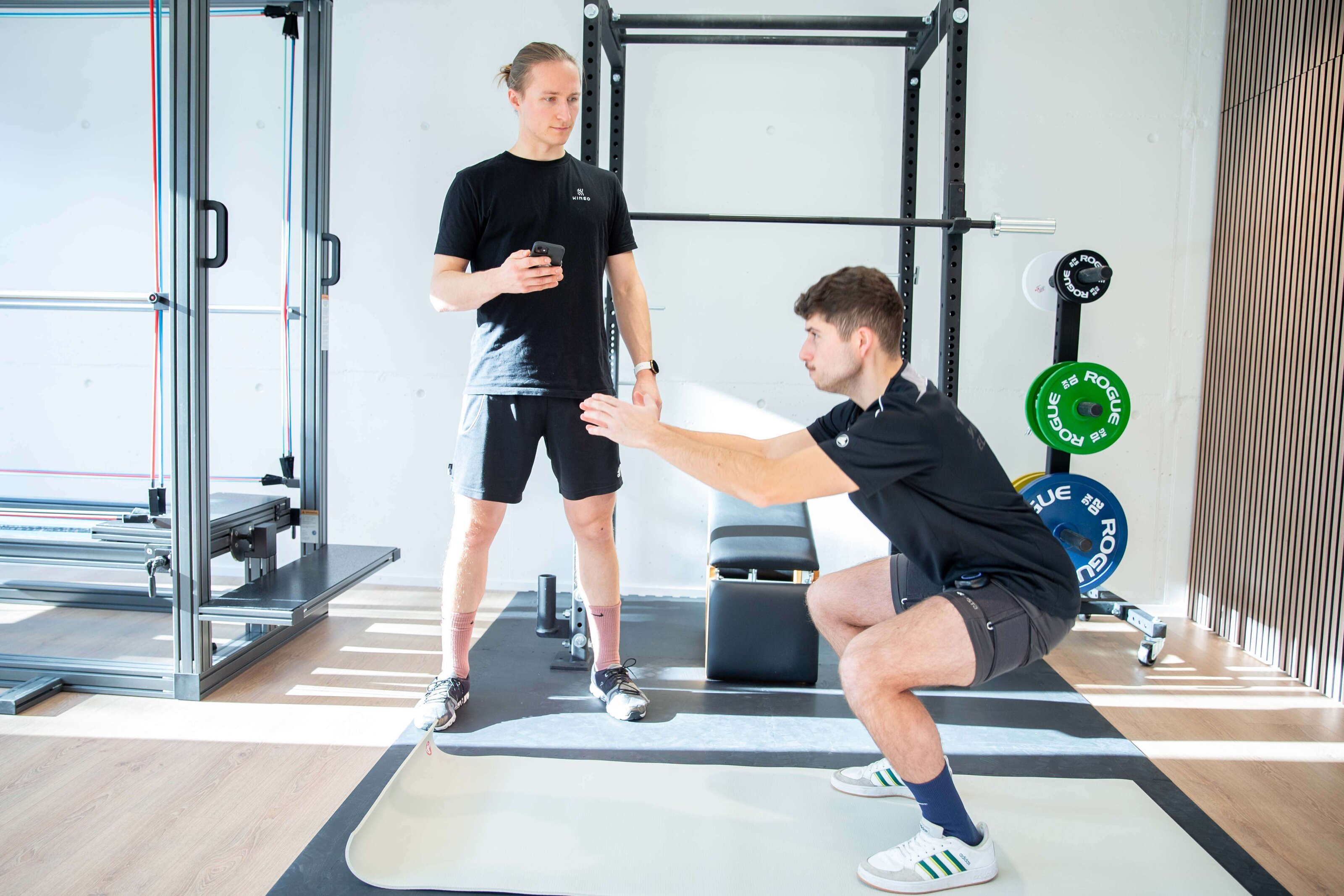
With many kinds of knee pain, for example patellofemoral pain syndrome, tendon problems or knee osteoarthritis, strength training is a central part of treatment. The squat is adapted, not scrapped: less deep, slower, with less weight or onto a box.
Myth 5: Your knees must never go inwards
A slight inward drift of the knees when coming up from heavy repetitions also occurs in well-trained athletes. It becomes unfavourable when the knees fall inwards in an uncontrolled and marked way, especially in jumps and landings, or when pain occurs. Then we train the hip and control in a targeted way.
Facts: what really counts
- Dosage: Whether a squat helps or irritates is usually decided by the amount: weight, repetitions, frequency and how fast you progress.
- Pain as a guardrail: Mild discomfort up to about 3 out of 10 during the exercise is usually fine if it settles by the next morning.
- Ankle: If you lack mobility when bending the foot towards the shin, you tip backwards or lift your heels. Slightly raised heels can then help.
- The right variation: Goblet squat, box squat, front squat and back squat distribute the load differently across knee, hip and back.
You should get checked by a doctor if you have: marked swelling after a twist, a knee that locks or gives way, redness and warmth, fever, or pain at rest and at night.
How we treat knee pain during squats at Kineo
We clarify which structure hurts and why. Then we make the squat part of the therapy instead of banning it.
1. Assessment: what we examine in your first session
- Palpation and functional tests: Kneecap, patellar tendon and joint line, and, with a fitting history, meniscus tests such as the Thessaly test
- Ligaments: Lachman test and stability on the inner and outer side, if an injury came first
- Squat analysis: two-legged and single-legged, depth, knee movement and trunk, filmed
- Strength: Quadriceps and hip abductors with the dynamometer, compared side to side
- Mobility: Knee-to-wall test, hip flexion and rotation, knee flexion compared side to side
- Pain threshold: down to what depth and with what load the squat is low in pain
2. Treatment in phases
- Phase 1, weeks 1–2: Find a low-pain squat. Box squat at a suitable height, wall sits 4–5 x 30–45 seconds, hip exercises.
- Phase 2, weeks 2–6: Build strength. Goblet squat, split squat and leg press at a slow tempo, 3–4 x 8–12, two to three times a week. Increase the depth step by step.
- Phase 3, from week 6: Increase the load. Barbell squat 3–5 x 4–8, plus single-leg exercises such as step-downs.
- Phase 4: Back to sport. Jumps, landings and sport-specific movements, as soon as strength is right in the side-to-side comparison.
3. Kineo services we use
- Sports physiotherapy: assessment, squat analysis and load plan
- Medical training therapy for structured strength building of the thigh and hip
- Manual therapy when the knee or ankle is restricted in mobility
- Shockwave therapy for stubborn tendon problems, alongside training
- Digital home programme with your squat progression for at home
The squat ladder in five steps
- Box squat: sit down onto a box or bench and stand up again, choosing the height so that it is low in pain. 3 x 10.
- Goblet squat: kettlebell or dumbbell in front of your chest, your upper body stays more upright. 3 x 8–12.
- Split squat: stationary lunge, good for side-to-side differences. 3 x 8–10 per side.
- Front squat: barbell in front on your shoulders. 3–4 x 5–8.
- Back squat: barbell on your upper back. 3–5 x 4–8.
Only move to the next step when you can do the current one cleanly and without more pain the following day.
From our practice
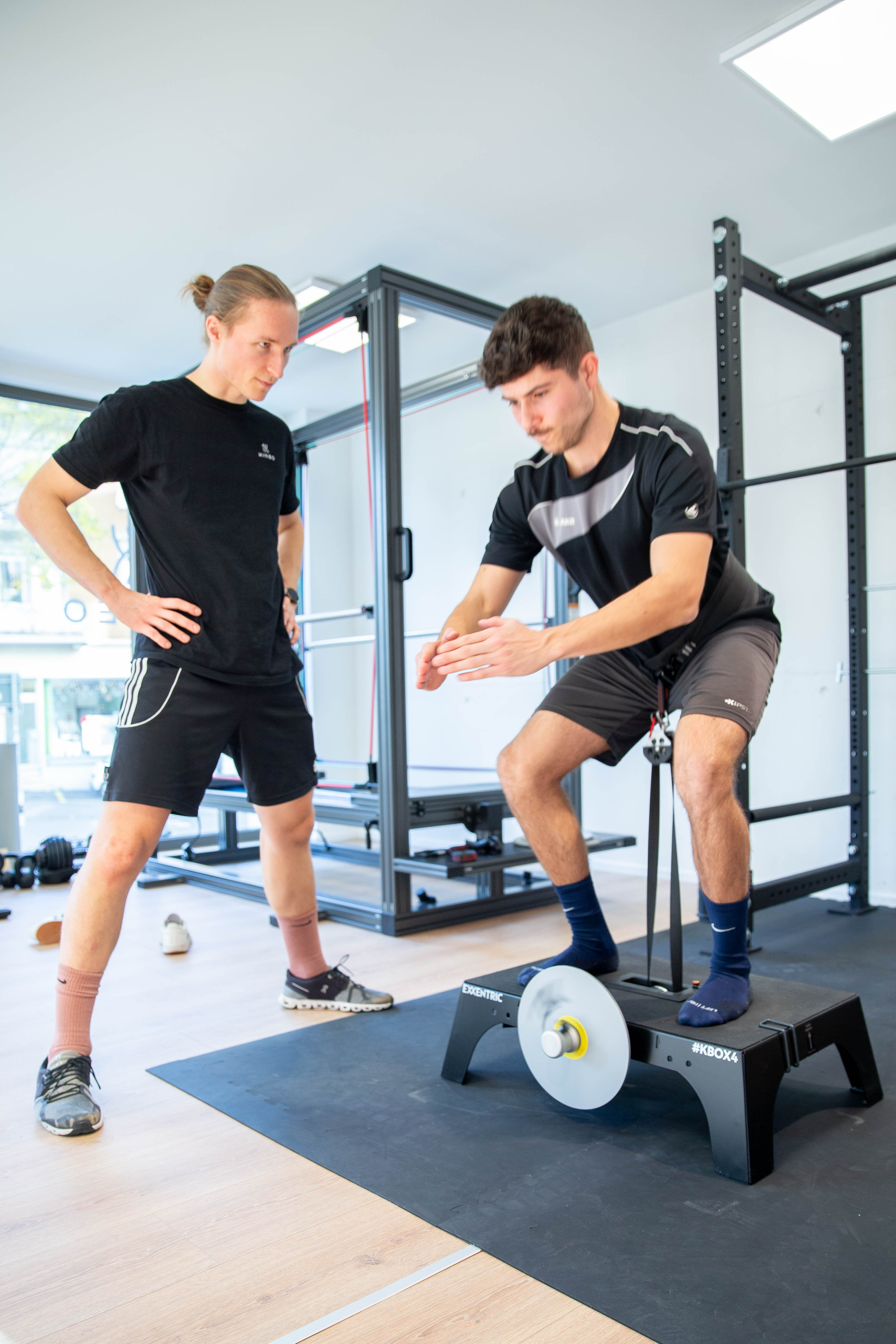
Many people who come to us with knee pain have left out the squat for months. The symptoms have rarely gone away as a result, but afterwards strength in the thigh is often missing. An adapted squat, for example slowly onto a box, is often tolerated well in the first few weeks. That builds confidence, and you can build on it.
Squats under guidance: Kineo Escher Wyss
At Kineo Escher Wyss at Hardturmstrasse 18, right at Escher-Wyss-Platz, we combine sports physiotherapy and a supervised training floor on two levels. You do your squat progression there under guidance, instead of just taking it home on a sheet of paper. Kineo HYROX is in the same building. You can find out more about the location on the Kineo Escher Wyss page.
Frequently asked questions
How deep should I squat?
As deep as you can control the position and keep it low in pain. With healthy knees, there is nothing against a deep squat.
Can I do squats with knee osteoarthritis?
Usually yes. Strength training is among the most important measures for knee osteoarthritis. We adapt depth and load to your symptoms.
How long does an appointment last?
An appointment lasts 30 minutes. In the first session we clarify the cause and start straight away with treatment and exercises.
Does health insurance cover physiotherapy?
Yes. With a doctor's prescription, your basic health insurance covers the cost. Kineo is recognised by all Swiss health insurers.
You might also like
Book an appointment
Does your knee play up when you squat? Book your appointment at Kineo Escher Wyss.