By Lucrecia Guerra, physiotherapist at Kineo Escher Wyss
When your shoulder twinges during wall balls
Wall balls are the last station at HYROX and a classic in many workouts: drop deep into a squat, throw the ball explosively at the target above you, catch it, and go down again. Many athletes notice their shoulder at some point. At first it is a pulling feeling at the front or side of the upper arm when catching, later also when putting on a jacket or sleeping on your side.
There is usually no injury behind it, but overload. Your shoulder can't cope with the repetitions at the moment because strength, mobility or technique don't match the demands. That is exactly what you can work on.
Why wall balls demand so much from the shoulder
Most of the force comes from the legs and hips. The shoulder has two jobs: guiding the ball upwards at the end and slowing it down when you catch it. Slowing it down overhead is the critical part.
- Many overhead repetitions: At HYROX there are 100 throws, and they come after seven stations and eight kilometres of running. Your shoulder is working in a very fatigued state.
- Arms instead of legs: As fatigue builds, the squat gets shallower and the throw comes more from the arms. The shoulder muscles then have to do much more.
- Stiff thoracic spine: If you sit a lot, you often have little extension in the thoracic spine. That leaves no room for your arms overhead, and the shoulder or lower back compensates.
- Catching with straight arms: If you catch the ball high up with almost straight elbows, the impact lands directly in the shoulder.
Typical complaints
- Subacromial pain syndrome: pain at the side of the shoulder, especially when lifting the arm between shoulder height and overhead (painful arc). This used to be called impingement.
- Overload of the rotator cuff: the small muscles that centre the head of the upper arm bone in the socket are irritated. Typical signs are pain when decelerating and during rotating movements.
- Acromioclavicular joint: pinpoint pain on top of the shoulder, especially at the very top overhead.
You should have these checked by a doctor: marked loss of strength after a fall or a jolt, a shoulder that feels dislocated, numbness or tingling down into the hand, severe night pain, fever, or pain in the shoulder and chest that comes on with exertion.
Technique: how to take load off the shoulder
- Ball close to the body: Hold the ball in front of your chest with your elbows under the ball. The further the ball is from your body, the greater the lever on the shoulder.
- Power from the hips: The throw starts at the bottom of the squat. Extend your legs and hips explosively, and let your arms simply guide the ball to the target.
- Catch softly: Catch the ball with slightly bent elbows and take it straight into the next squat. Your legs brake, not your shoulder.
- Plan your sets: Split the 100 repetitions up, for example 5 x 20 or 10 x 10 with short breaks. Planned breaks are better than a breakdown in technique.
What you can do yourself
- Adapt instead of stopping completely: Temporarily reduce wall balls and overhead exercises. Squats, running, rowing and pulling exercises can usually continue.
- Pain as a guardrail: Mild discomfort up to about 3 out of 10 during the exercise is fine if it settles by the next morning.
- Mobilise the thoracic spine: Every day for 1–2 minutes, extend backwards over a foam roller placed across your thoracic spine.
- Strengthen the rotator cuff: with the exercises below, two to three times a week.
How we treat shoulder pain from wall balls at Kineo
Shoulder pain when throwing rarely has just one cause. So we look at the shoulder itself, but also at your thoracic spine, shoulder blade and throwing technique.
1. Assessment: what we examine in your first session
- Mobility: raising the arm overhead compared side to side, internal and external rotation, plus extension and rotation of the thoracic spine
- Pain provocation: painful arc, Hawkins-Kennedy test and Jobe test (empty can test)
- Strength testing: external and internal rotation with a handheld dynamometer, compared side to side. Weak external rotators are a common finding with overhead loading.
- Shoulder blade: We watch how the shoulder blade moves as you raise and lower the arm (scapular dyskinesis).
- Movement analysis: You do a few wall balls, and we film them and assess depth, ball position and the catching phase.
2. Treatment in phases
- Phase 1, weeks 1–2: calm the irritation. Reduce overhead load, isometric external rotation against the wall, 5 x 30–45 seconds. Manual treatment of the thoracic spine and shoulder blade muscles.
- Phase 2, weeks 2–6: build strength. External rotation with a band or cable, Y-raises, rows and push-up plus, 3 x 10–15 with slow lowering. Two to three times a week.
- Phase 3, from weeks 4–6: bring overhead work back. Landmine press, overhead holds with a kettlebell, then wall balls with a lighter ball and few repetitions, for example 3 x 10.
- Phase 4: close to competition. Gradually increase ball weight and repetitions, and do wall balls after running or rowing too.
- Criteria for full loading: free overhead mobility, strength almost equal side to side, 100 wall balls without more pain the next day.
3. Kineo services we use
- Sports physiotherapy: assessment, technique analysis and a loading plan right up to competition
- Manual therapy for the thoracic spine, ribs and shoulder joint when mobility is lacking
- Trigger point treatment and dry needling for tense neck and shoulder blade muscles
- Medical training therapy for structured strength building of the shoulder
- Shockwave therapy for stubborn tendon problems, alongside training
Three exercises for a resilient throwing shoulder
- External rotation with a band: Elbow bent to 90 degrees at your side, a small towel between elbow and trunk. Rotate the forearm outwards against the resistance, and return over 3 seconds. 3 x 12–15.
- Y-raise on an incline bench: Lie face down on the bench and lift your arms into a Y shape, thumbs pointing up, shoulder blades back and down. Without weights or with light dumbbells. 3 x 10–12.
- Bottoms-up kettlebell carry: Hold a light kettlebell upside down, with the arm first at shoulder height and later overhead, and walk 20–30 metres. 3 rounds per side. This trains stability and control.

From our practice
With shoulder pain after wall balls, many people look at the shoulder first. In movement analysis, however, we often see that the squat gets shallower as fatigue builds and the arms take over the throw. When the legs do the work again and the ball is caught more softly, the load on the shoulder drops noticeably. Strengthening exercises for the rotator cuff back this up.
Physio and HYROX under one roof: Kineo Escher Wyss
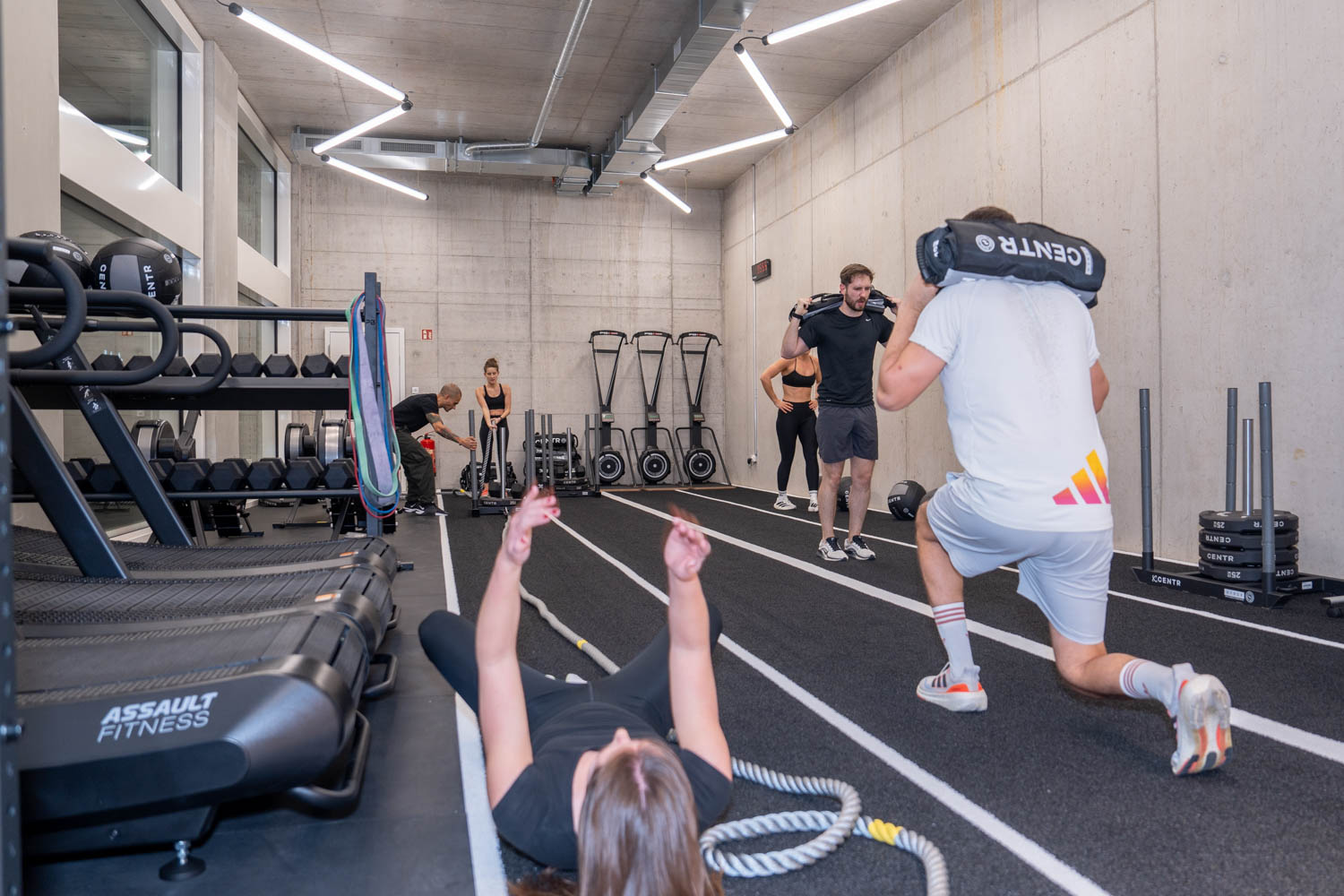
At Kineo Escher Wyss on Hardturmstrasse 18, right at Escher-Wyss-Platz, sports physiotherapy and Kineo HYROX are in the same building: HYROX downstairs, physiotherapy upstairs. You do your shoulder strengthening exercises on the supervised training floor. You can find out more about the location on the Kineo Escher Wyss page.
Frequently asked questions
Can I keep doing wall balls with shoulder pain?
Often yes, but adapted: a lighter ball, fewer repetitions, clean technique. If the pain gets worse during training and is still clearly there the next morning, the load was too high.
Is this impingement?
The term is used a lot, but it describes a pattern of symptoms rather than a cause. Usually the rotator cuff is overloaded. What matters is making the shoulder resilient again.
Does health insurance cover physiotherapy?
Yes. With a doctor's prescription, your basic health insurance covers the cost. Kineo is recognised by all Swiss health insurers.
You might also like
- HYROX: typical injuries and how to avoid them
- Rotator cuff syndrome
- Your first HYROX: the 12-week plan
Book an appointment
Is your shoulder holding you back during wall balls? Book your appointment at Kineo Escher Wyss.