By Barbara Victorio, physiotherapist at Kineo Wipkingen
When your shoulder keeps you awake at night
During the day you manage somehow, but at night it gets worse. You wake up as soon as you turn onto your side, can't find a comfortable position for your arm any more, and in the morning you're tired before the day has even begun. Shoulder pain at night is one of the most distressing complaints we see in practice, because it affects your sleep as well as your shoulder.
Night pain is an important clue. It occurs with a few typical shoulder problems that can mostly be treated well. But it can also be a sign that should be checked by a doctor.
Why shoulder pain gets worse at night
- Pressure on the shoulder: If you lie on the affected side, your body weight presses on irritated tendons and the bursa.
- Unfavourable arm position: If you lie on the other side, the upper arm falls forward across your body. This pulls on tendons and the joint capsule.
- Little movement: At rest, the movement that often gives relief during the day is missing. Irritated structures become stiffer and more sensitive as a result.
- Fewer distractions: At night you notice pain more consciously than in the bustle of the day.
Common causes of shoulder pain at night
- Rotator cuff tendinopathy: The tendons that centre the head of the upper arm in the socket are overloaded. Typical signs are pain when lifting the arm out to the side between roughly shoulder and head height, and when lying on your side.
- Calcific shoulder: Calcium deposits in a tendon. In the resorption phase they can cause very severe pain, including at night.
- Frozen shoulder: The joint capsule becomes inflamed and shrinks. At first, severe pain even at rest is in the foreground, later increasing stiffness, especially when turning the arm outwards.
- Rotator cuff tear: Often after a fall, or developing gradually in older people. Typical signs are loss of strength and pain when lying down.
- Shoulder osteoarthritis: Deep, dull pain, a grinding feeling and increasing restriction of movement.
- Referred pain from the neck: An irritated nerve root in the cervical spine can feel like shoulder pain.

Warning signs: when to get checked by a doctor
- Left shoulder or arm pain with pressure on the chest, shortness of breath, nausea or sweating: this can be a heart problem. Call the emergency number 144 straight away.
- The shoulder is red, warm and swollen, possibly with a fever
- After a fall you can no longer lift your arm actively
- Severe constant pain that doesn't change with any position or movement, or unintentional weight loss
- Numbness, tingling or weakness in the whole arm
What you can do yourself for better nights
- Lying on your back with pillows: Put a pillow under the elbow and forearm of the affected side, so that the arm rests slightly in front of the body.
- Lying on your healthy side: Hug a large pillow. That way the painful arm doesn't fall forward.
- Don't lie on the painful side while the symptoms are acute
- Move before sleep: Let your arm swing loosely while standing slightly bent forward, for 1 to 2 minutes. Many people find this relaxing.
- Isometric exercises during the day: Gently press your arm against a wall outwards or to the side, without moving. 5 x 30 seconds at medium effort. This can dampen tendon pain.
- Reduce overhead loading, but keep using the arm in the low-pain range in everyday life
How we treat shoulder pain at night at Kineo
Because night pain can have different causes, we start with a thorough examination. It determines whether we mainly calm, mobilise or strengthen.
1. Assessment: what we examine in your first session
- Active and passive mobility: If external rotation in particular is also limited passively, this points more towards a frozen shoulder.
- Painful arc: If lifting to the side hurts in a middle range, this suggests irritated tendons or the bursa.
- Rotator cuff strength: External rotation against resistance, the Jobe test and lag signs show whether a tendon might be weakened or torn.
- Provocation tests such as the Hawkins-Kennedy test
- Cervical spine: Movement testing and the Spurling test to rule out referred pain from the neck
- Shoulder blade: How it moves when you lift your arm
2. Treatment in phases
- Phase 1: Calm things down (usually 1 to 3 weeks). Sleeping positions, pain-relieving techniques, isometric exercises and adjusting the load in everyday life.
- Phase 2: Regain movement. Mobilisation of the shoulder and thoracic spine, active exercises in the low-pain range.
- Phase 3: Build strength (from about week 3 to 4). External rotation with a band, rowing and lateral raises, 3 x 10 to 15 repetitions each, two to three times a week.
- Phase 4: Everyday life and sport. Overhead movements, carrying, supporting your weight and sport-specific loads. For a frozen shoulder, we plan for several months.
3. Kineo services we use
- Manual therapy to mobilise the shoulder joint, shoulder blade and thoracic spine
- Trigger point treatment for the muscles around the shoulder blade, which often react along
- Dry needling for stubborn trigger points in the shoulder and neck
- Shockwave therapy for calcific shoulder or stubborn tendon problems
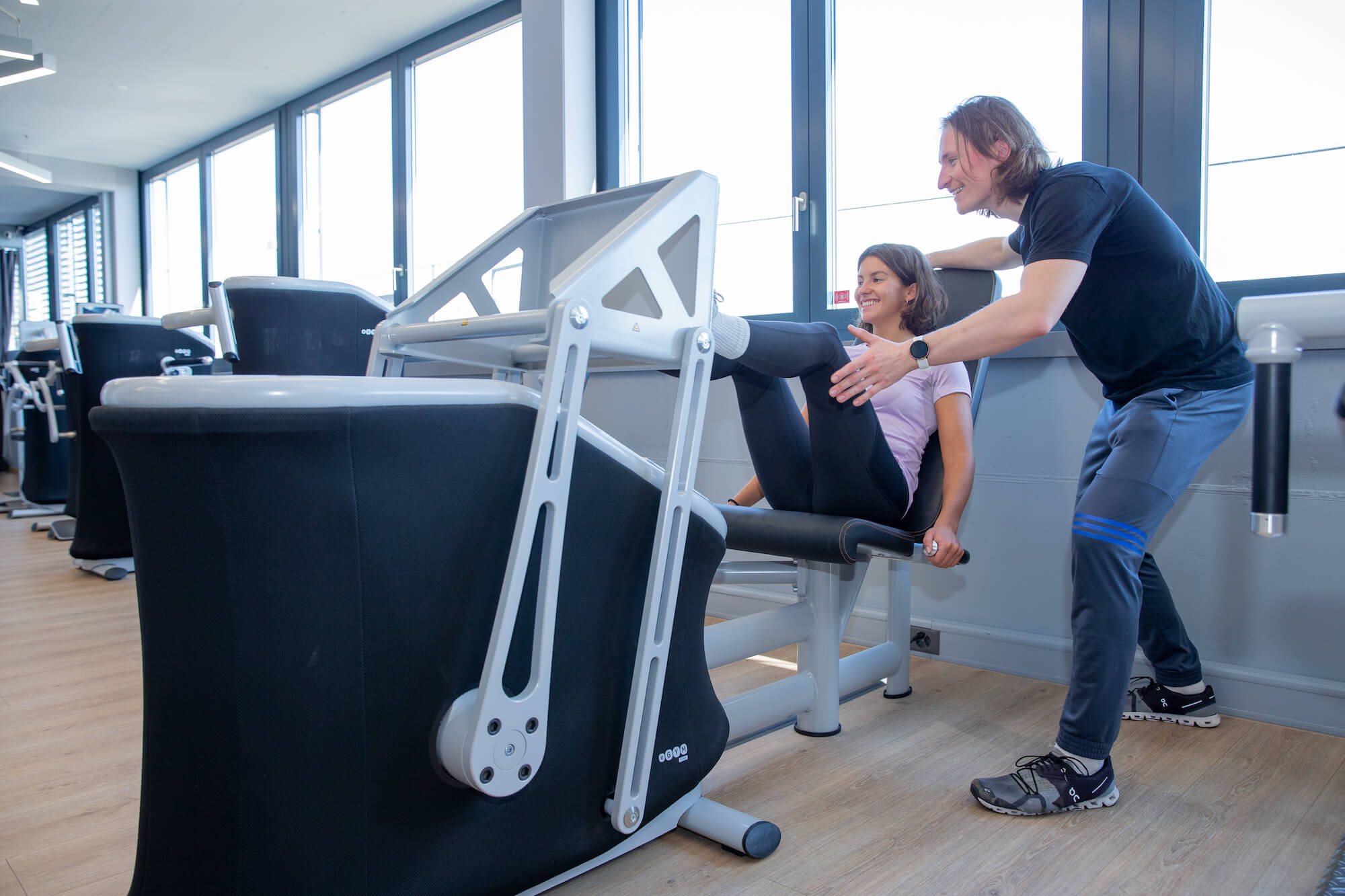
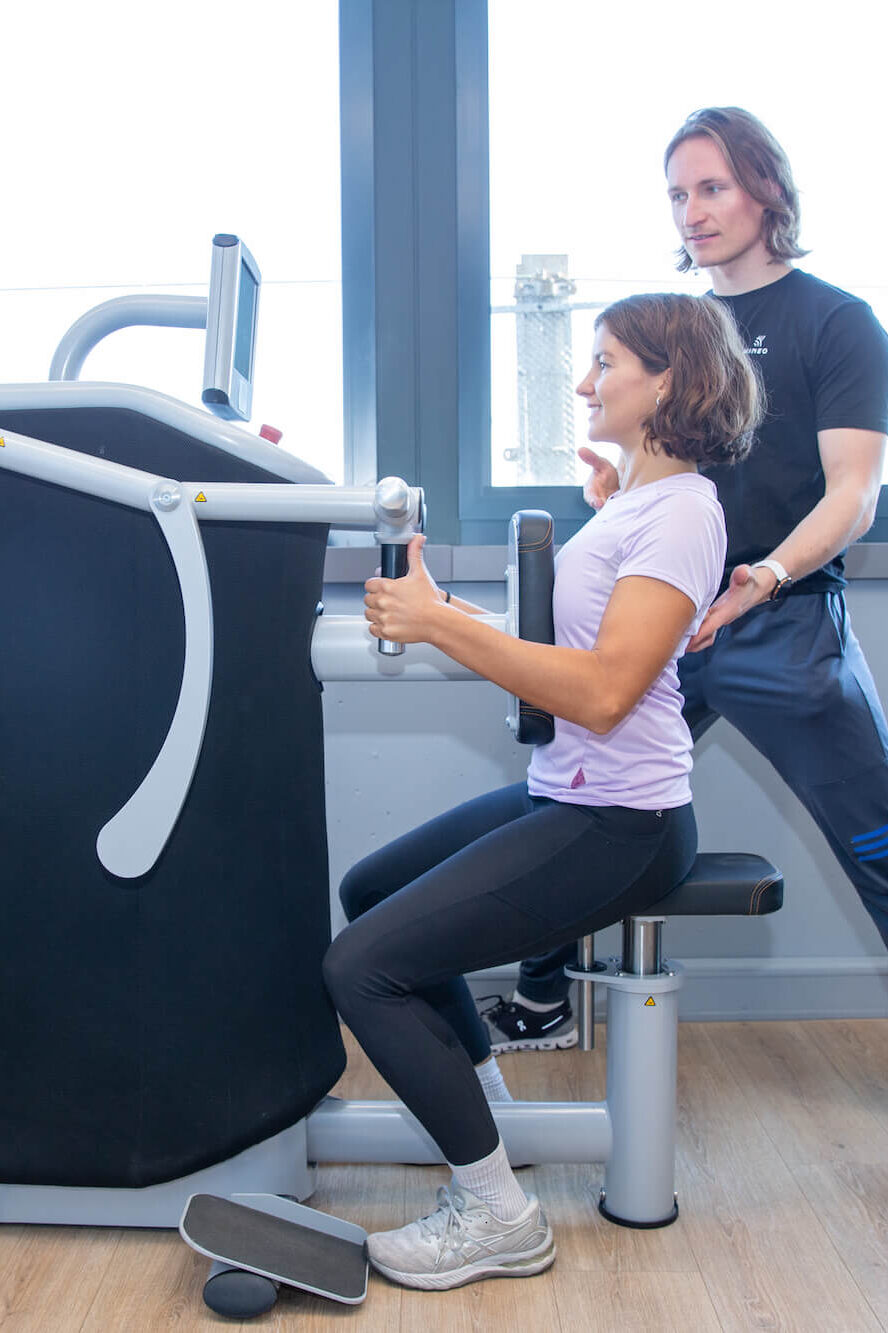
- Medical training therapy for targeted strength building of the rotator cuff
Three strength exercises for a more stable shoulder
- External rotation with a band: Elbow at your side, bent to 90 degrees. Turn your forearm outwards against the resistance. 3 x 12 to 15 repetitions.
- Rowing: Band at chest height, pull your elbows back, gently bring your shoulder blades together. 3 x 12 repetitions.
- Lateral raise in the scapular plane: Raise your arms slightly in front of your body up to shoulder height at most, with light dumbbells. 3 x 10 repetitions, in the low-pain range.
Mild discomfort during the exercises is fine, as long as it settles by the next morning and your night doesn't get worse.
From our practice
Many people only come to us after weeks of poor sleep, and until then have tried to keep the shoulder as still as possible. It often turns out that better positioning at night and simple isometric exercises already bring noticeable relief. Once you sleep through again, you also have more energy during the day for the training that keeps the shoulder stable in the long term.
Shoulder treatment in Wipkingen
Shoulder treatment is one of our focus areas at Kineo Wipkingen at Röschibachstrasse 79 on Röschibachplatz. On site we have shockwave therapy, dry needling and a training floor with strength machines and a rack, so that you are supported in the same place from pain relief through to strength building. You can find out more about the location on the Kineo Wipkingen page.
Frequently asked questions
Should I rest my shoulder when it hurts at night?
Immobilising it completely rarely makes sense, because the shoulder then gets stiffer. We temporarily reduce loads that hurt a lot. Movement in the low-pain range is usually helpful.
How long does it take until I sleep through again?
That depends on the cause. With irritated tendons, night pain often improves within a few weeks. A frozen shoulder takes much more patience.
How long does an appointment last?
An appointment lasts 30 minutes. In the first session we clarify the cause and start straight away with treatment and exercises.
Does health insurance cover physiotherapy?
Yes. With a doctor's prescription, your basic health insurance covers the cost. Kineo is recognised by all Swiss health insurers.
You might also like
Book an appointment
Is your shoulder robbing you of sleep? Book your appointment at Kineo Wipkingen and we'll find out what's behind it.