By Flin Jaggy, physiotherapist at Kineo Wipkingen
When the knee hurts during growth
Does your child play football, floorball or basketball and complain of pain below the kneecap after training? There may even be a bump there that hurts when pressed. Kneeling on the floor is uncomfortable, and so are climbing stairs and jumping. This is the typical picture of Osgood-Schlatter disease.
The good news: Osgood-Schlatter is common, benign and almost always fades once growth is finished. Even so, it can hold teenagers back in sport for months. With the right load management, most do not have to give up sport.
What happens in Osgood-Schlatter
The tendon of the kneecap (patellar tendon) attaches to a small bony prominence on the shinbone, the tibial tuberosity. In children and teenagers, there is a growth zone of cartilage there that is not yet as resilient as fully formed bone. The powerful thigh muscle (quadriceps) pulls on this spot through the tendon with every jump, sprint and sudden stop. If the load becomes too great, the growth zone reacts with irritation. The medical term is apophysitis.
Typically affected are teenagers during the phase of rapid growth, often between about 10 and 15 years of age. Girls are often a little earlier than boys, because their growth spurt starts earlier. One knee or both can be affected.
Typical signs
- Pain directly below the kneecap, at the bump on the shinbone
- Tender, sometimes visible swelling or thickening at this spot
- Pain when jumping, sprinting, climbing stairs, in a deep squat and when kneeling
- Pain mostly during and after sport, usually little at rest
- Often in phases with a lot of training, tournaments or a growth spurt
Similar symptoms right at the tip of the kneecap are more likely to point to Sinding-Larsen-Johansson syndrome, a related irritation at the upper end of the tendon. In adults with pain at this spot, we think more of patellar tendinopathy.

Warning signs: when to see a doctor
Osgood-Schlatter can usually be recognised well on examination. But have the symptoms checked by a doctor if any of the following signs appear:
- Pain at night or in complete rest
- Clear swelling, redness or warmth of the whole knee, fever
- Limping or pain after a fall or a blow
- Pain that starts more in the groin or hip and radiates into the knee. In teenagers, hip problems can show up as knee pain.
- The knee locks, gives way or can no longer be fully straightened
What you can do yourself
A complete break from sport is rarely necessary. It is more important to dose the load so that the knee settles down and still stays strong.
- Pain as a traffic light: Mild discomfort of up to about 3 out of 10 during sport is usually fine, as long as it has settled again by the next morning. If the pain is stronger or lasts, it was too much.
- Reduce peak loads: Fewer jump series, sprints and back-to-back matches. Technique and tactics are still possible.
- Isometric exercises: Wall sit (back against the wall, knees bent about 60 degrees), 4–5 x 30 seconds. Holding instead of moving is often well tolerated and can dampen the pain.
- Strengthen hip and calf: Side-stepping with a mini band, glute bridge and calf raises, 3 x 12–15 each.
- Stretch the thigh: Quadriceps stretch standing or lying on your front, 2–3 x 30 seconds per side. During growth in particular, the muscle often becomes relatively short.
- Cooling after sport can feel good in the short term. A knee pad protects when kneeling.
How we treat Osgood-Schlatter at Kineo
Our aim is for teenagers to stay as active as possible while the growth zone settles. Parents are welcome at the first session.
1. Assessment: what we examine in your first session
- Palpation of the tibial tuberosity, patellar tendon and tip of the kneecap to tell them apart
- Length of the thigh muscle with the Ely test (heel towards the buttock, lying on the front) and the hip flexors with the Thomas test
- Single-leg squat and landing from a small jump: we look at leg alignment and whether the knee drops inwards
- Strength compared between sides of the thigh, hip abductors and calf
- Training load: How many training sessions, games and sports per week? Has there been a growth spurt recently?
- Hip compared between both sides, to rule out a cause there
2. Treatment in phases
- Phase 1, about weeks 1–3: calm things down. Adjust load according to the pain traffic light, wall sit 4–5 x 30 seconds daily, hip and calf strength, gentle stretching.
- Phase 2, about weeks 3–8: build strength. Spanish squat with a band, step-ups and split squats, 3 x 8–12, two to three times a week. First controlled jumps with a soft landing.
- Phase 3: back to full training. Gradually increase jumping and sprinting volume, train changes of direction and stopping. We go by the reaction the next day.
- Alongside: weekly planning with parents and coach, so that peak weeks with tournaments do not also include jump training.
3. Kineo services we use
- Sports physiotherapy: assessment, load management and return to sport
- Medical training therapy for strength of the thigh, hip and calf
- Sensopro training for coordination, leg alignment and landing
- Sport-specific training with jumps, sprints and changes of direction
- Digital home programme, so the exercises are easy to do at home
The bump stays, the pain usually doesn't
Many parents ask whether the bony prominence goes away again. Often a visible thickening remains on the shinbone. This is usually harmless. What matters is that the symptoms ease once growth is complete, when the growth zone closes. Until then there can be phases when the pain gets worse again, for example with a new growth spurt or in a season with many games. If you then know how to adjust the load, you usually get through without a long break.
We generally do not recommend immobilisation or a complete ban on sport for months. It weakens the muscles, and the symptoms often come back when sport is resumed.

From our practice
Teenagers often come to us who play in several teams at the same time and also have school sport. The knee is then not weak, but simply overloaded. When we plan the week together with the family and build strength in a targeted way, most can keep playing in their team, just in a more measured way.
Physiotherapy at Kineo Wipkingen
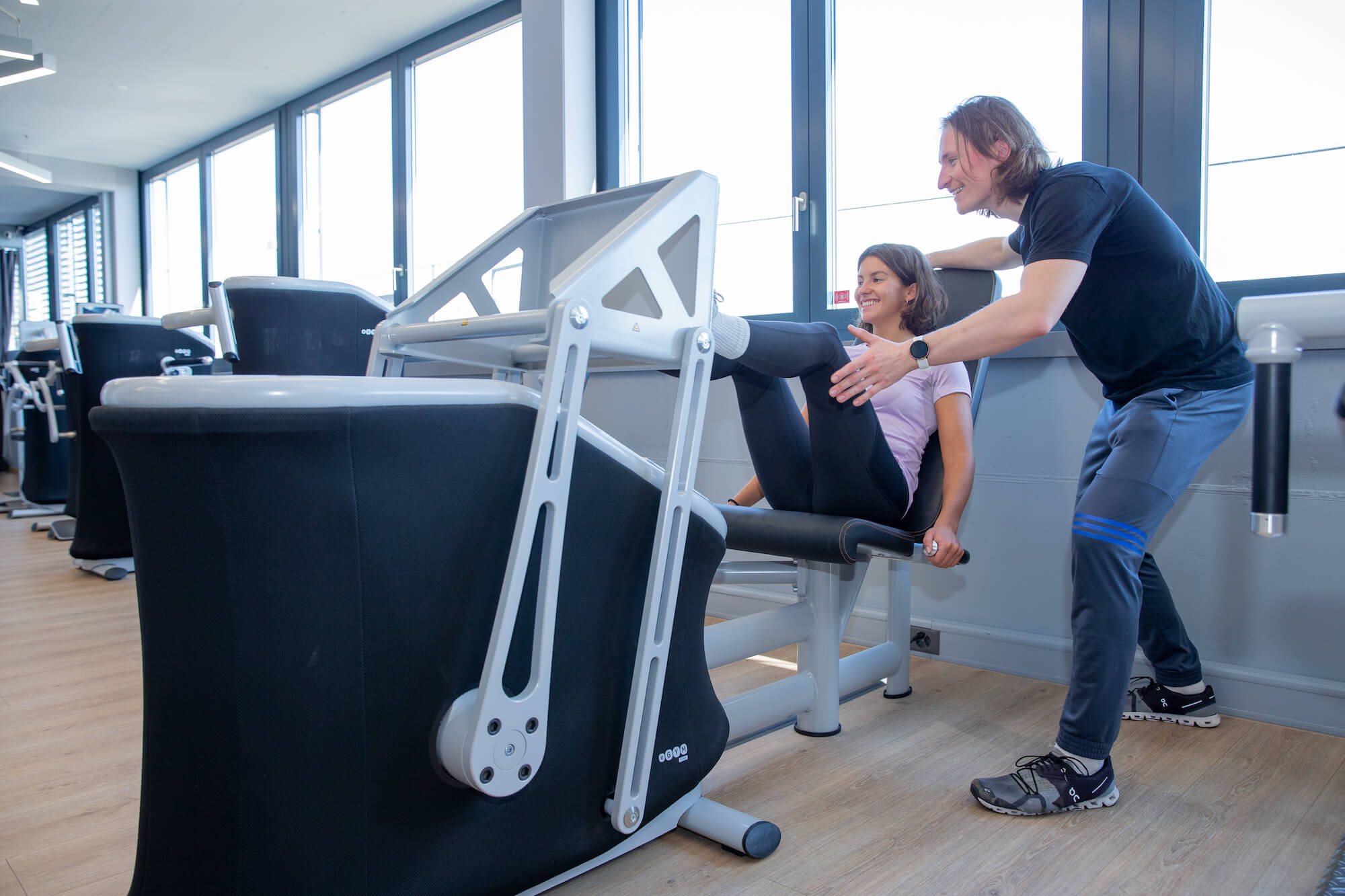
At Kineo Wipkingen at Röschibachstrasse 79, right at Röschibachplatz, we combine physiotherapy and training. On the training area with strength machines, a rack and the Sensopro coordination trainer, teenagers practise strength, landing and leg alignment under guidance. You can find out more about the location on the Kineo Wipkingen page.
Frequently asked questions
Does my child have to stop sport?
Usually not. We adjust volume and intensity, especially jumps and sprints. Many can keep training and playing.
How long does Osgood-Schlatter last?
That varies a lot. The symptoms can come and go over months and usually fade once growth is complete.
Does a knee brace help?
Some people find a patellar tendon strap or tape comfortable. But it does not replace adjusting the load and strength training.
Does health insurance cover physiotherapy?
Yes. With a doctor's prescription, your basic health insurance covers the cost. Kineo is recognised by all Swiss health insurers.
You might also like
- Patellar tendinopathy (jumper's knee)
- Injury prevention in football
- Runner's knee (patellofemoral pain syndrome)
Book an appointment
Does your child have knee pain during growth? Book an appointment at Kineo Wipkingen. We will clarify the cause and plan sport together.