
By Martino Crivelli, physiotherapist and co-founder of Kineo, Kineo Escher Wyss
Your knee has been operated on. What now?
The meniscus surgery is over, your knee is swollen, and you are wondering when you can jog, play football or train hard again. The honest answer: that depends above all on what was done during the operation.
In this article, we explain the difference between a partial meniscectomy and a meniscus repair, how rehab progresses in phases, which tests make sense before you return to sport and which warning signs you should know.
The meniscus and why it matters
The menisci are two crescent-shaped discs of cartilage between the thigh bone and the shin bone. They distribute pressure, stabilise the knee and protect the joint cartilage. Because they are so important for joint health, surgeons today try to preserve as much meniscus as possible.
Partial removal or repair: the decisive difference
- Partial meniscectomy (partial resection): The torn part is removed. Nothing has to heal. Usually you can put full weight on the leg quickly, and a return to sport is often possible after a few weeks to a few months.
- Meniscus repair (refixation): The tear is stitched and has to heal. That is why there are usually restrictions for a few weeks, for example on bending the knee under load or putting weight on the leg. Returning to sports with twisting movements usually takes several months.
Important: Your surgeon's instructions always take priority. They depend on the type and location of the tear, the technique and possible accompanying injuries, for example to the cruciate ligament.
Typical challenges after the operation
- Swelling: Fluid in the knee inhibits the thigh muscles. Controlling swelling is therefore one of the most important tasks at the start.
- Full extension: If the last bit of extension is missing, your gait changes and the knee is loaded more. Extension is the priority at the start.
- Quadriceps weakness: The front thigh muscle quickly loses strength and activation after operations.
- Too much too soon: Especially after a partial resection, the knee often feels good early. If you then progress too fast, it responds with renewed swelling.
What you can do yourself in the first weeks
- Tense the quadriceps: Lying down, press your knee into the surface and hold for 5 seconds. 3 x 10, several times a day.
- Heel slides: Lying down, pull your heel towards your buttocks, within the permitted range of movement. 2 x 15.
- Encourage extension: Rest your heel on a roll, let the knee hang relaxed, 3–5 minutes.
- Straight leg raise: Tense your thigh and lift the straight leg 20–30 cm. 3 x 10, as soon as you can do it without the knee sagging.
- Walking: With crutches for as long as prescribed, afterwards with a clean, even gait.
Important after a repair: Deep knee bends under load, squatting and twisting movements on the weight-bearing leg are usually not allowed in the first weeks. Follow the instructions from the hospital.
Warning signs after the operation
- Fever, increasing redness, warmth or discharge at the incisions: possible infection
- Swollen, painful, hard calf: possible sign of a thrombosis
- Sudden severe swelling or pain after a movement
- The knee locks and can no longer be straightened
In all of these cases, contact your surgeon straight away or go to the emergency department.
How we support you after meniscus surgery at Kineo
We plan your rehab based on the type of operation, the instructions from the hospital and your sporting goals. You move on not by the calendar, but when you meet the criteria.
1. Assessment: what we examine in your first session
- Operation report and instructions: partial resection or repair, permitted loading and bending
- Swelling: for example with the stroke test and circumference measurement compared side to side
- Mobility: extension and flexion measured in degrees
- Quadriceps activation: Can you lift the straight leg without an extension lag?
- Gait and balance: walking, single-leg stance and weight distribution
2. Treatment in phases
- Phase 1, usually weeks 0–2: Swelling and extension. Cold and compression, quadriceps activation, gait training. Goal: full extension and a calm knee.
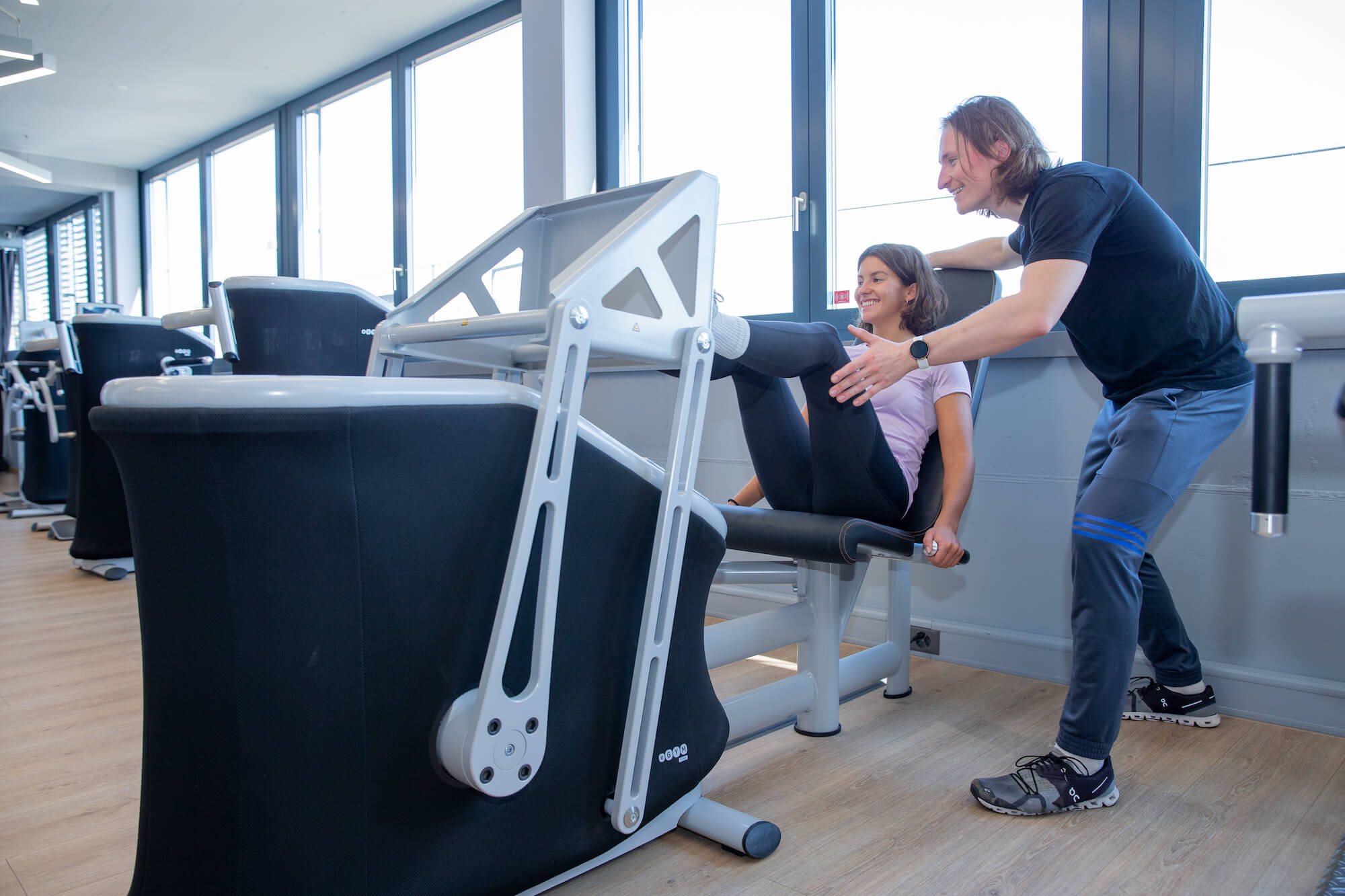
- Phase 2: Building strength. Leg press, step-ups, bridges and calf raises, 3 x 10–15, two to three times per week. After a repair, with limited bending.
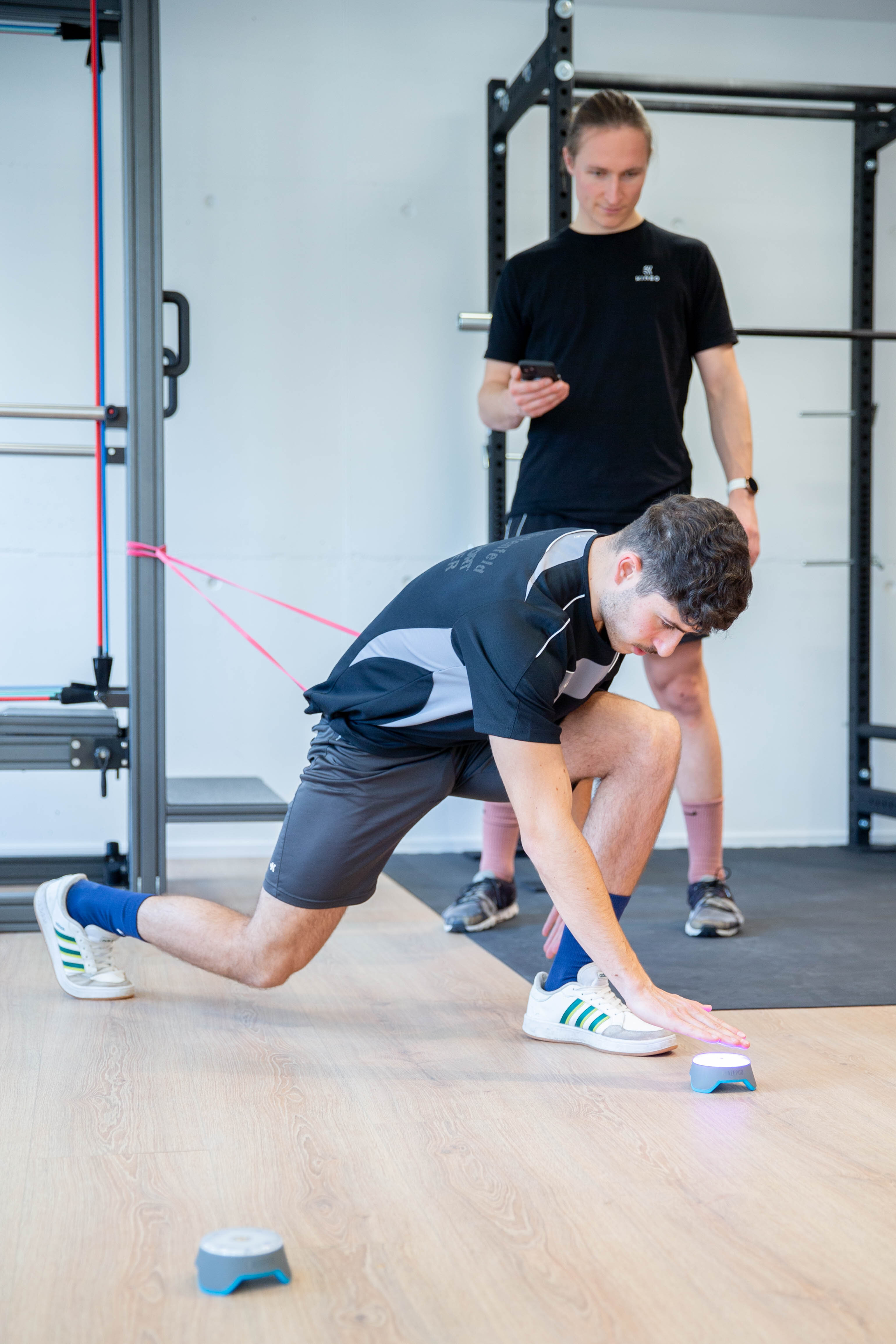
- Phase 3: Single-leg and dynamic. Single-leg squat, lunges, balance, first hopping and running exercises if the knee stays calm.
- Phase 4: Back to sport. Jumps, changes of direction, sprints and sport-specific loading.
- Clearance: No swelling after loading, full mobility, strength and hop tests at least 90 percent compared side to side, clearance from the operating team.
3. Kineo services we use
- Cold therapy with Game Ready: cold and compression against swelling in the first weeks
- Manual lymphatic drainage: if the knee stays swollen for a long time
- Medical training therapy: targeted strength building for quadriceps, hip and calf
- Sports physiotherapy: tests, load plan and return to sport
- Explosive strength training: jumps and sprints for the last phase before clearance
The tests before returning to sport
A knee can feel fine in everyday life and still not be ready for jumps and changes of direction. That is why we test objectively before giving clearance:
- Hop tests: single-leg hop for distance, triple hop and side hop, compared side to side
- Y-Balance Test: balance and control on one leg in three directions
- Strength compared side to side: front and back of the thigh
- Response the next day: If the knee does not swell after intense loading, that is a good sign
From our practice
After a partial meniscectomy, many people feel fit again after a short time and go straight back into their usual training. The knee then often responds with renewed swelling, and the build-up is delayed. If you build strength in a targeted way and increase the load in steps, you are usually more stable and back faster in the long run.
Rehab and training at Kineo Escher Wyss
At Kineo Escher Wyss at Hardturmstrasse 18 on Escher-Wyss-Platz, we combine sports physiotherapy, Game Ready and a supervised training area across two floors. If you want to return to functional training after clearance, you will find Kineo HYROX in the same building.
Frequently asked questions
When can I jog again after meniscus surgery?
After a partial removal, often after a few weeks, when the knee is calm and you are stable on one leg. After a repair, usually much later. The instructions from your operating team always come first.
Is swelling after training normal?
Slight swelling can occur. If it increases or is still clearly there the next day, the load was too high. Then we reduce it.
Does health insurance cover physiotherapy after the operation?
Yes. With a doctor's prescription, your basic health insurance covers the cost. Kineo is recognised by all Swiss health insurers.
How long does an appointment take?
An appointment lasts 30 minutes. In your first session, we check the state of your knee and start straight away with treatment and exercises.
You might also like
Book an appointment
Just had meniscus surgery and ready to rebuild? Book your appointment at Kineo Escher Wyss and we will bring you back to training step by step.