By Lucrecia Guerra, physiotherapist at Kineo Escher Wyss
Just put ice on it?
You roll your ankle playing football, knock your knee against the boards playing floorball, or feel a pull in your thigh during a sprint. The first reflex: put ice on it. That is not wrong. But cold is only a small part of what a fresh injury needs.
In recent years, the understanding of first aid has changed. Here you will find out what cold can do, where its limits lie, how to use it correctly and when it is better to go straight to a doctor.
What cold does in the tissue
- Pain relief: Cold slows the transmission of nerve signals. This noticeably eases pain. It is its clearest benefit.
- Narrower blood vessels: Blood flow near the surface decreases. This can limit bleeding in the tissue somewhat in the first minutes.
- Lower metabolism: The tissue needs less energy. This is meant to limit secondary damage around the injury.
Important: inflammation after an injury is not a mistake, but the start of healing. Whether cold speeds up healing has not been proven. Some specialists therefore recommend using cold in the first days mainly for pain relief, and rather sparingly.
From RICE to PEACE & LOVE
Many people still know the RICE rule: rest, ice, compression, elevation. Today many physiotherapists use the PEACE & LOVE concept. It stresses that it is not only the first hours that count, but also the weeks after.
PEACE for the first days:
- Protect: Protect the area and avoid movements that hurt a lot, for a few days
- Elevate: Raise the limb, if possible above heart level
- Avoid anti-inflammatories: Be critical of anti-inflammatory drugs and lots of ice, because they can affect natural healing. Discuss taking painkillers with your doctor.
- Compress: Compression with a bandage or tape against swelling
- Educate: Understand what has happened and avoid unnecessary passive treatments
LOVE for the time after:
- Load: Load the area early, guided by pain
- Optimism: A confident attitude can positively influence recovery
- Vascularisation: Pain-free endurance training to boost blood flow
- Exercise: Build mobility, strength and balance in a targeted way

How to use cold correctly
- Never directly on the skin: Always wrap ice or a cold pack in a thin, damp cloth
- Duration: 10–20 minutes, then a break of at least an hour. Shorter where there is little soft tissue over the bone, such as the ankle or elbow
- Frequency: Several times a day in the first 1–2 days, if it eases the pain
- Combine with compression: Cold and pressure together work better against swelling than cold alone
- Cold spray: Works only very superficially and briefly, good for the moment on the pitch, but no substitute
Take care, or avoid cold altogether, with circulation problems, Raynaud's syndrome, cold allergy, altered sensation at the site and open wounds. Also avoid cooling for too long over nerves that lie close to the surface, for example on the outside just below the knee.
When you should see a doctor
- You cannot walk four steps after the injury, or a bone is very tender to pressure. At the ankle, the Ottawa rules help to assess a possible fracture.
- Your knee swells up strongly within a few hours. This can point to bleeding in the joint, for example with a cruciate ligament tear.
- A visible deformity, a crack with immediate loss of function, or a dent in the muscle
- Numbness, tingling, or cold or bluish skin below the injury
- Severe, increasing pain and a very hard, tense muscle
How we treat acute injuries at Kineo
After an acute injury, we first clarify how serious it is and then plan your return to everyday life and sport.
1. Assessment: what we examine in your first session
- How the injury happened and its course: How did it happen, how quickly did the swelling appear, how much weight can you take?
- Ottawa rules at the ankle and knee, so that we don't miss a fracture
- Measuring swelling: for example with the figure-of-eight measurement at the ankle as a value to track progress
- Stability tests: for example the anterior drawer test at the ankle or the Lachman test at the knee
- Gait, mobility and strength compared with the other side
2. Treatment in phases
- Days 1–3: protect. Cold and compression against pain and swelling, elevation, pain-free movement. Tape or a brace if needed.
- Days 4–14: dosed loading. Walk guided by pain, regain mobility, first strength exercises, for example 3 x 15 double-leg calf raises.
- Weeks 3–6: strength and balance. Single-leg exercises, balance training, running in a straight line.
- From week 6: back to sport. Jumps, changes of direction and sport-specific load. The exact time frame depends heavily on the injury.
3. Kineo services we use
- Cold therapy with Game Ready: controlled cold combined with alternating compression, especially in the first days and after surgery
- Manual lymphatic drainage: when swelling stays stubborn
- Sports physiotherapy: assessing the injury, load plan and return to sport
- Medical training therapy: strength and stability for your return to everyday life
- Sport-specific training: jumps, changes of direction and game situations before you are cleared
Cold for overload and after training
Cooling is not only used for fresh injuries. For irritated tendons, cold after training can ease the pain, but it does not solve the problem: tendons need dosed loading to become more resilient. After operations, for example on the knee, cold with compression is a proven part of early aftercare to control swelling and pain. And after training? You can read more in our article on recovery.
From our practice
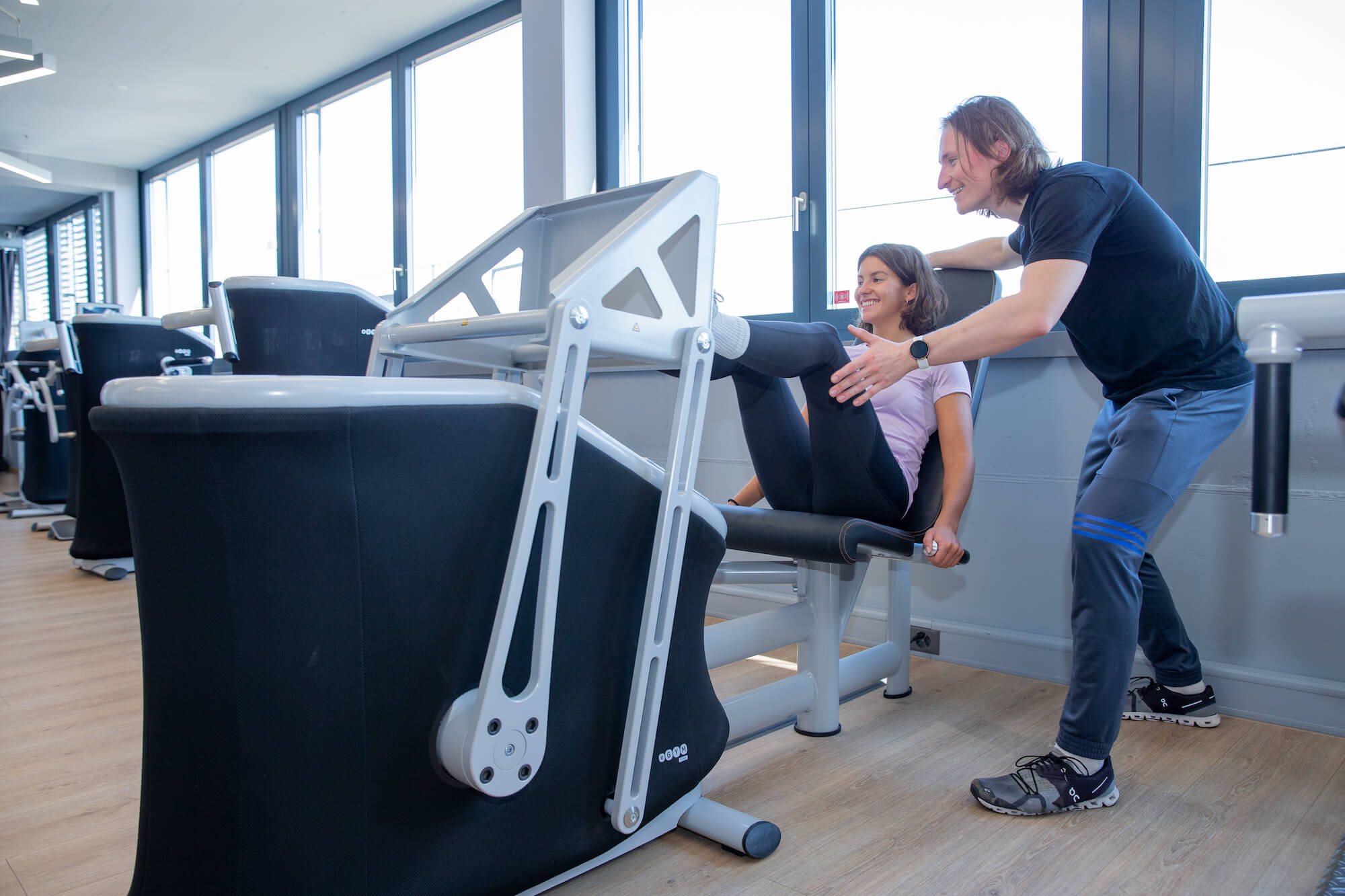
After ankle sprains, we often see that people rest, cool and elevate the ankle for days but hardly move it. The swelling does slowly go down, but the joint stays stiff and unstable. If you load it again early, guided by pain, and train balance in a targeted way, you are usually back faster and more stable.
At Kineo Escher Wyss after your injury
At Kineo Escher Wyss at Hardturmstrasse 18 at Escher-Wyss-Platz, Game Ready, sports physiotherapy and a supervised training floor are all part of the location. This way we link treatment in the first days directly with the build-up training afterwards.
Frequently asked questions
Heat or cold?
For fresh injuries with swelling, rather cold. For tension and stiffness without a fresh injury, many people find heat more pleasant.
How long should I cool after an injury?
In the first 1–2 days, 10–20 minutes several times a day, if it eases the pain. After that, movement is the priority.
What is Game Ready?
A device that combines cold with alternating compression through a cuff. It is often used after operations and acute injuries.
How long does an appointment last?
An appointment lasts 30 minutes. In your first session we assess your injury and start straight away with treatment and first exercises.
You might also like
- Ankle injury or instability
- Sore muscles, strain or torn fibres?
- Recovery after training: what really helps
Book an appointment
Freshly injured and unsure what happens next? Book your appointment at Kineo Escher Wyss and we will plan your way back.