By Asier Gochicoa, physiotherapist at Kineo Wipkingen
When every staircase becomes an obstacle
The stairs up to your flat, the steps to Wipkingen station or the descent after a hike: suddenly your knee stabs, often at the front around the kneecap. Many people notice it is worse going down than going up, and hold on to the handrail to spare the knee.
Knee pain when climbing stairs is very common, in young athletes just as in older people. The cause is usually not dramatic, but it should be tackled specifically so that an annoying ache does not become a permanent problem.
Why stairs demand so much from your knee
When you climb stairs, one leg carries your whole body weight while the knee is bent. Your thigh muscles (quadriceps) have to produce a lot of force, and the kneecap is pressed hard against the thigh bone. The deeper the bend, the greater this pressure.
Going down is often worse because the quadriceps works as a brake: it gives way in a controlled manner while you lower your weight. This eccentric work is particularly demanding for an irritated knee. In addition, your hip muscles have to stop the knee from collapsing inwards.
Common causes
- Patellofemoral pain syndrome: the most common reason in younger and active people. Pain at the front around or behind the kneecap, typically also after sitting for a long time with bent knees, at the cinema or in the car.
- Knee osteoarthritis: common in older people. Start-up pain in the morning, stiffness and pain under load, often going downstairs.
- Patellar tendon: pain directly below the kneecap, especially in jumping and running sports (jumper's knee).
- Meniscus: pain at the inner or outer joint line, possibly with catching or locking, pain when twisting or squatting deeply.
- Lack of strength and sudden jumps in load: suddenly hiking, running or climbing more stairs after a quiet phase often overloads the knee.
Warning signs: when to see a doctor
- Your knee swelled quickly and markedly after an accident or twisting injury
- Your knee keeps locking or suddenly gives way
- Redness, warmth and fever
- Severe pain at rest and at night that does not change
- You can no longer put weight on the leg
What you can do yourself
- Take the stairs cleverly: going up, lead with the healthy leg; going down, lead with the painful leg. Use the handrail to take load off your knee.
- Dose the load, don't avoid it: temporarily reduce long descents and deep squatting positions, but keep moving, for example on the bike.
- Break up long sitting: straighten your knee now and then or stand up briefly.
- Use pain as a gauge: mild discomfort up to about 3 out of 10 during an activity is usually fine if it settles by the next morning.
How we treat knee pain on stairs at Kineo
We first clarify which structure hurts and then build up exactly the strength your knee needs on the stairs.
1. Assessment: what we examine in your first session
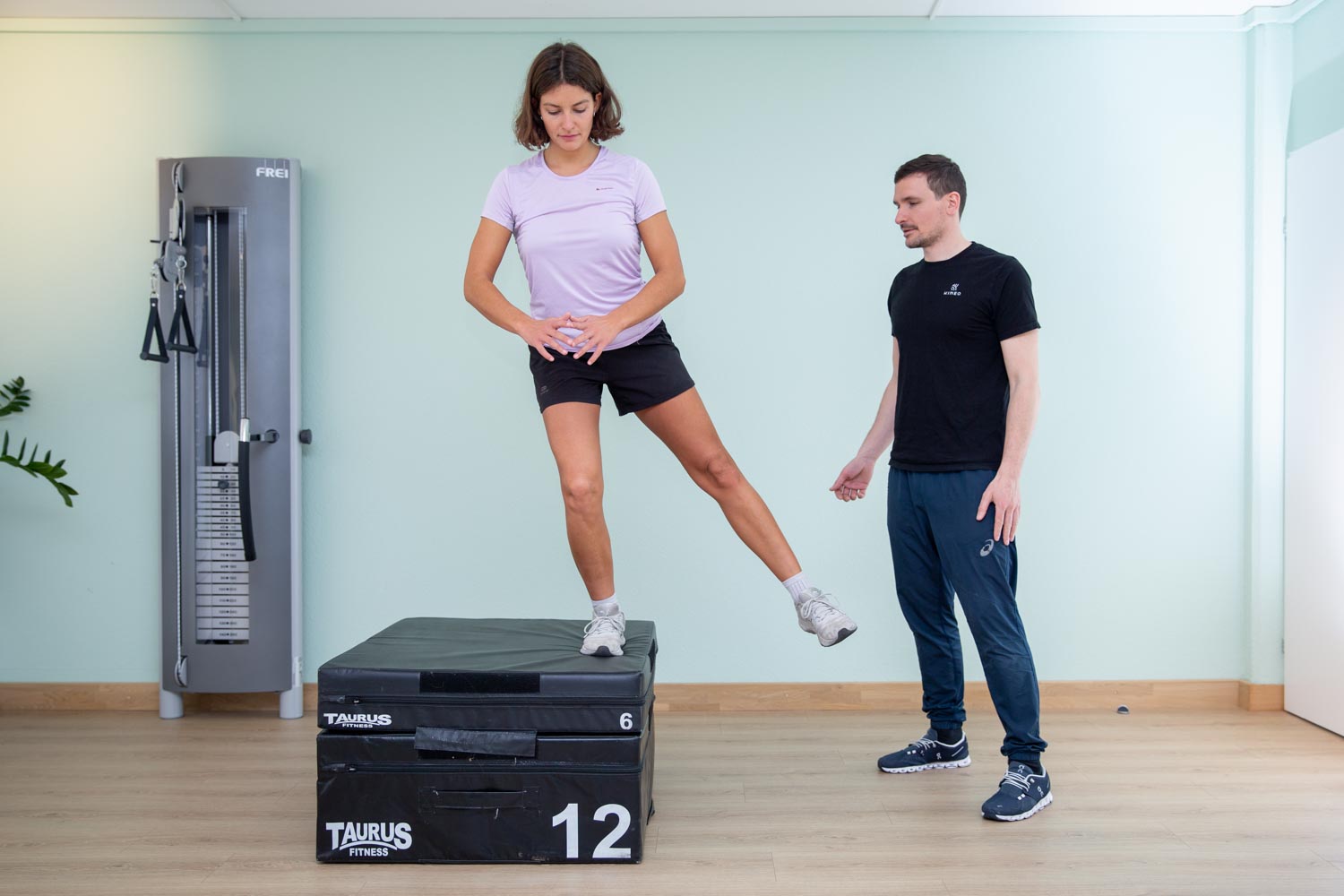
- Step-down test: you step down slowly from a step. We watch your leg alignment, pelvis and trunk and whether the pain appears.
- Single-leg squat: shows whether the knee collapses inwards and how well the hip stabilises
- Strength compared side to side: quadriceps, gluteal muscles and hip abductors
- Palpation and joint tests: kneecap, patellar tendon and joint line; if a meniscus problem is suspected, tests such as the Thessaly test and a check of the ligaments
- Hip and ankle mobility: for example with the knee-to-wall test. A stiff calf can put extra load on the knee.
2. Treatment in phases
- Weeks 1 to 2: calm things down. Adjust the load, isometric exercises for the quadriceps and hip strengthening, cycling with low resistance.
- Weeks 2 to 6: build strength. Leg press, leg extension in the low-pain range, box squats and hip exercises, 3 x 10 to 15 repetitions each, two to three times a week.
- From week 6: stairs and everyday life. Step-downs, lunges and single-leg exercises with increasing depth and load.
- Goal: going downstairs without pain and without a reaction the next day, plus the load your everyday life or sport demands.
3. Kineo services we use
- General physiotherapy for assessment, explanation and a load plan
- Medical training therapy on strength machines and in the rack for targeted strength building
- Manual therapy for the kneecap, knee joint and ankle when mobility is restricted
- Sports physiotherapy for runners and mountain sports enthusiasts who want to get back to their sport
- Digital home programme for the exercises between sessions
Four exercises for pain-free stair climbing
- Wall sit: with your back against the wall, bend your knees as far as is comfortable. Hold 5 x 30 to 45 seconds. Often eases pain.
- Side-lying leg raise: lift the straight top leg slightly backwards and upwards. 3 x 15 repetitions per side.
- Box squat: sit down slowly, touch the box briefly, stand up powerfully. 3 x 10 to 12 repetitions. Over time, lower the box or add weight.
- Step-down: stand on a low step and slowly tap the free leg down while the standing knee points over the middle of your foot. 3 x 8 to 10 repetitions per side. Slowly increase the step height.

From our practice
Many patients consistently avoid stairs and only take the lift. In the short term that brings relief, but in the long term the knee often becomes even more sensitive because strength keeps declining. Usually it is the route via dosed strength training that makes stairs a minor matter again. And this route is often shorter than people expect.
Knee treatment in Wipkingen
At Kineo Wipkingen, Röschibachstrasse 79 on Röschibachplatz, we combine treatment and training. On our training floor with strength machines, a rack and a bike ergometer, you build the strength for the stairs directly under guidance. The Sensopro coordination trainer can also help improve the stability of your leg. Find out more about the location on the Kineo Wipkingen page.
Frequently asked questions
Is climbing stairs bad for my knees?
No. Climbing stairs is good training for your legs and knees. If you have pain, the aim is to adjust the load temporarily and build strength, not to avoid stairs for ever.
Does a knee support help?
Some people find a support or tape comfortable. They can help in the short term, but they do not replace strength training.
How long does an appointment last?
An appointment lasts 30 minutes. In your first session we clarify the cause and start straight away with treatment and exercises.
Does health insurance cover physiotherapy?
Yes. With a doctor's prescription, your basic health insurance covers the cost. Kineo is recognised by all Swiss health insurers.
You might also like
Book an appointment
Are stairs giving your knee a hard time? Book your appointment at Kineo Wipkingen and we will get you up and down pain-free again.