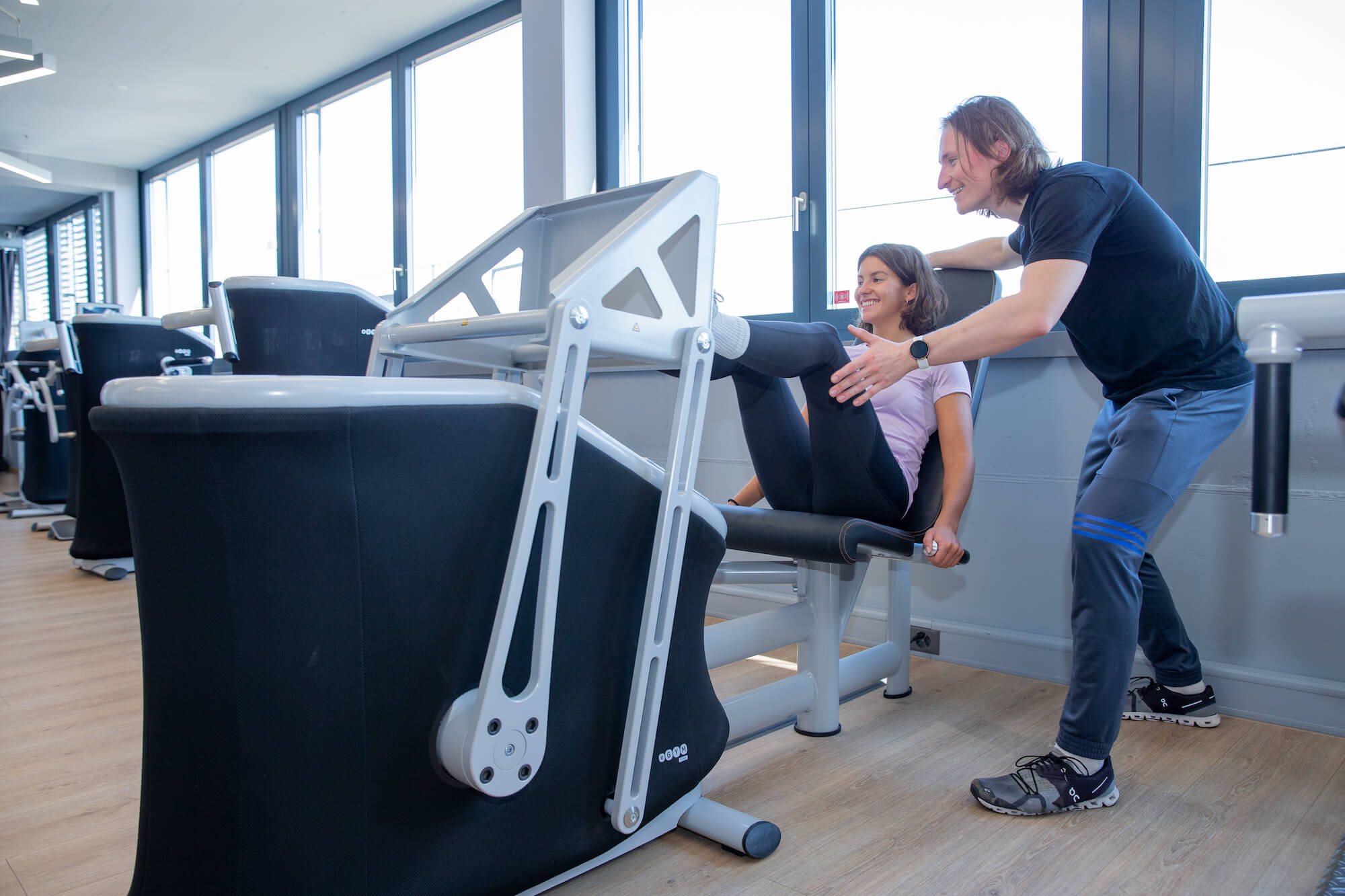

By Noah Stierli, physiotherapist at Kineo Seefeld
Suddenly your mouth won't open properly
Yesterday everything was fine, today you can hardly get a bite into your mouth. When you open, the jaw stops after a few centimetres, as if there were a barrier. Perhaps your jaw joint used to click and suddenly the clicking has gone. Or you have been clenching a lot lately, have been to the dentist or had a stressful phase.
Restricted mouth opening is worrying, because it immediately makes eating, speaking and brushing your teeth harder. In many cases, though, there is a cause behind it that is easy to treat. What matters is to classify it correctly and early.
Trismus or open lock? A quick check of the terms
In everyday language, many people say “locked jaw” when the mouth will not open. Medically, this is called trismus. The term open lock means the opposite, as dentists use it: the mouth stays open and can no longer be closed. This article is mainly about restricted opening. We describe the true open lock further down, because it must be treated by a doctor straight away.
Common causes when the mouth won't open
- Displaced joint disc without return: In the jaw joint there is a small cartilage disc (the disc). If it slips forward and no longer jumps back when you open, it blocks the joint. Specialists speak of disc displacement without reduction or a “closed lock”. Typical: the earlier clicking suddenly stops and from that moment your opening is restricted.
- Muscle-related clamp: Overloaded or irritated chewing muscles tighten protectively, for example from heavy clenching, grinding, stress or after a long dental treatment.
- After an anaesthetic injection: A nerve block in the lower jaw can irritate the medial pterygoid muscle. Your opening is then restricted for a few days.
- Inflammation or infection: For example an inflamed wisdom tooth or joint inflammation. Here swelling, fever or severe pain are often in the foreground.
- Accident: A blow to the chin or a fall can injure the joint and muscles or break the jaw.

The true open lock: when the mouth stays open
If the head of the joint jumps forwards over a bony prominence when you open wide, for example when yawning, and gets stuck there, this is called a dislocation of the jaw joint. The mouth then can no longer be closed. This is an emergency: go to an emergency department or a dental emergency clinic. Do not try to push the jaw back yourself by force.
Warning signs that must be checked by a doctor
- The mouth can no longer be closed
- Swelling in the face or neck, fever, pus or a bad taste
- Difficulty swallowing or breathing
- Restriction after an accident or a blow to the chin
- Numbness in the face or lip
- A restriction of opening that slowly gets worse over weeks, for no obvious reason
- Your bite suddenly no longer fits together
What you can do yourself
- Don't open by force: Pulling hard or levering with your fingers irritates the joint and muscles even more.
- Resting position: Lips closed, teeth apart, tongue resting on the roof of the mouth. This takes load off the chewing muscles.
- Heat: 10–15 minutes of heat on the cheek and temple, several times a day, as long as there is no inflammation or swelling.
- Soft food: Small bites, nothing tough, no chewing gum. Cut apples into wedges.
- Small movements: Slowly open and close your mouth in the pain-free range, 10 repetitions, several times a day. Movement helps the joint more than complete rest.
- Get help early: If the joint disc suddenly blocks your jaw, it is worth not waiting for weeks.
How we treat restricted mouth opening at Kineo
First we clarify whether the restriction comes from the joint or from the muscles. This determines which techniques and exercises make sense.
1. Assessment: what we examine in your first session
- Measuring mouth opening: active and passive opening in millimetres between the front teeth, and the three-finger test
- Watching the opening path: If the lower jaw clearly deviates to one side when opening, this often points to a blocked joint on that side.
- Sideways and forward movement: With a joint blockage, movement towards the healthy side is often restricted.
- End feel: We feel whether the movement ends hard, as at a barrier, or springy, as with tense muscles.
- Chewing muscles and neck: palpation of the masseter, temporalis and angle of the jaw, plus mobility of the upper cervical spine
- History: earlier clicking, dental treatments, accidents, clenching and grinding
2. Treatment in phases
- Phase 1, weeks 1–2: release mobility. Manual techniques at the jaw joint, for example gentle downward pull (traction) and gliding forwards, plus soft tissue techniques on the chewing muscles. At home, you open several times a day in the low-pain range.
- Phase 2, weeks 2–6: widen the opening. Held opening exercises with light finger pressure, 3–5 x 30 seconds, three to five times a day. In addition, sideways and forward movements.
- Phase 3, from week 6: function and control. Coordination exercises in front of a mirror for a straight opening, building up normal food, strategies against clenching.
- Coordination with others: If your opening stays clearly restricted despite therapy, we discuss further investigation with your dentist or with oral and maxillofacial surgery.
3. Kineo services we use
- CMD jaw therapy: telling a joint problem from a muscle problem, and your exercise plan
- Manual therapy with traction and gliding techniques for the jaw joint
- Trigger point treatment on the chewing muscles for a muscle-related clamp
- Dry needling for very tense chewing muscles, when manual techniques are not enough
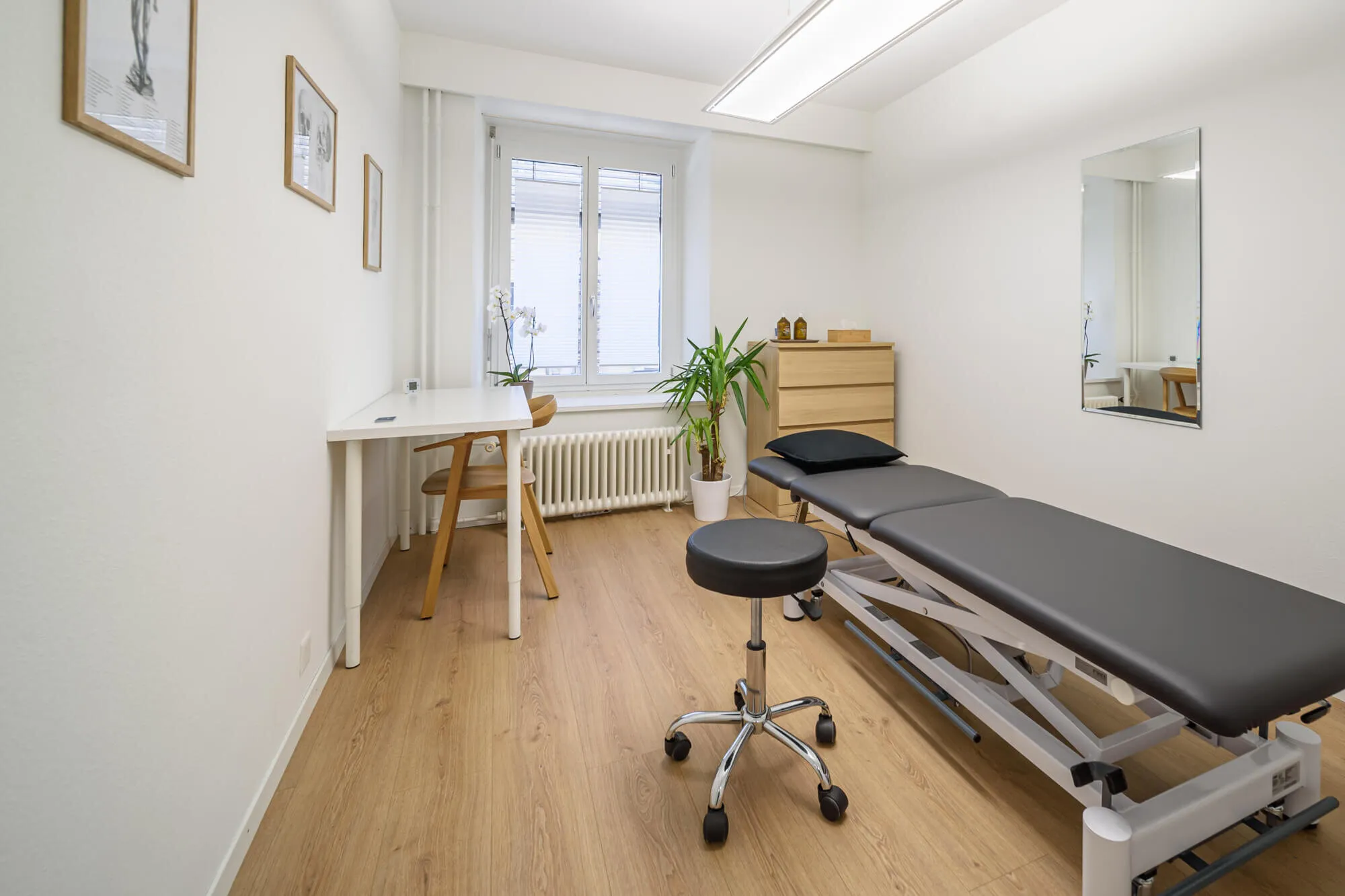
From our practice
Many people tell us that their jaw clicked for years and they had got used to it. When the clicking suddenly disappeared, they were relieved at first, until they noticed that their mouth no longer opened fully. This very moment is an important clue to the joint disc. If you come early, you usually regain your opening with patience and consistent exercises.
Jaw treatment at Kineo Seefeld
At Kineo Seefeld at Seefeldstrasse 83, near the Feldeggstrasse stop (trams 2 and 4), the jaw is one of our focus areas. We work according to the CRAFTA concept and look at the jaw joint, chewing muscles and neck together. You can read more about the location on the Kineo Seefeld page.
Frequently asked questions
Does a jaw clamp go away by itself?
A muscle-related clamp, for example after dental treatment, often improves within days to a few weeks. With a blocking joint disc, targeted therapy usually helps you regain your opening faster.
How far should the mouth open?
A simple test: three fingers stacked on top of each other should fit between the upper and lower front teeth. We also measure the opening in millimetres to follow your progress.
Do I need surgery?
Only rarely. Most jaw clamps can be treated well with physiotherapy and exercises. Surgery is only considered when conservative therapy is not enough.
Does health insurance cover physiotherapy?
With a doctor's prescription, your basic health insurance covers the cost. Kineo is recognised by all Swiss health insurers.
You might also like
- Clicking jaw joint: is it dangerous?
- Jaw pain after dental treatment
- Teeth grinding (bruxism): causes and physiotherapy
Book an appointment
Does your mouth no longer open properly? Book your appointment at Kineo Seefeld, so that we can start treatment early.