By Sereina Urech, physiotherapist and Head of Operations, Kineo Seefeld
The tooth is treated, but your jaw hurts
The root canal is done, the wisdom tooth is out or the new crown is in place. But instead of relief, you feel pain in your jaw, in your cheek or in front of your ear. Chewing is tiring, your mouth no longer opens fully, and sometimes the joint suddenly clicks.
This is more common than many people think. Usually there is no complication with the tooth behind it, but an overload of the chewing muscles and the temporomandibular joint (TMJ). The good news: complaints like this often fade by themselves. If they stay, physiotherapy can help in a targeted way.
Why your jaw hurts after dental treatment
- Long mouth opening: In longer treatments your mouth often stays wide open for an hour or more. For the TMJ and chewing muscles this is an unaccustomed sustained load, similar to holding a stretch position for a long time.
- Local anaesthetic injection: For treatment in the lower jaw, a nerve block is often given. The needle passes close to the medial pterygoid muscle. Irritation of this muscle can limit mouth opening for a few days.
- Wisdom tooth surgery: Swelling, pull on the jaw during the procedure and the protective posture afterwards put strain on muscles and joint.
- Changed bite: A new filling, crown or bridge that is minimally too high changes how your teeth meet. The chewing muscles try to compensate and tire.
- Pre-existing strain: If you already clench, grind your teeth or have a clicking TMJ, you react more sensitively to dental treatment.
What is normal and what is not?
A feeling in the jaw like sore muscles and slightly limited mouth opening in the first few days are not unusual after longer treatments. Usually it gets clearly better within one to two weeks.
Contact your dentist if:
- your bite feels "high" or uneven after a filling or crown. This can usually be corrected quickly.
- the pain increases after a few days instead of decreasing
- swelling, redness, pus or a bad taste appear
- you develop a fever or feel unwell
- your mouth opening gets worse again after a few days
- numbness in the lip, chin or tongue lasts longer
You need medical help immediately if you have difficulty swallowing or breathing, or a rapidly increasing swelling in the neck or floor of the mouth.
What you can do yourself
- Cool or warm: After an operation with swelling, cool in the first one to two days, as your dental practice recommends. For pure muscle pain without swelling, warmth usually feels good: 10–15 minutes on the cheek and temple.
- Soft food: For a few days, soup, pasta, yoghurt, scrambled eggs. Small bites, chew on both sides, no chewing gum.
- Let the jaw rest: Lips lightly closed, teeth apart, tongue on the roof of your mouth. This resting position takes load off the chewing muscles.
- Hold back big yawns: When you yawn, keep your tongue on the roof of your mouth or place a hand under your chin so that your mouth doesn't open to the maximum.
- Gentle opening exercise: Tongue tip on the roof of your mouth, slowly open and close your mouth, 10 repetitions, three to four times a day. It may pull, but it must not sting.
- Loosen the chewing muscles: With two fingers, massage the cheek over the masseter in gentle circles, 1–2 minutes per side.
How we treat jaw pain after dental treatment at Kineo
If the pain lasts longer than two weeks or your mouth opening stays limited, a physiotherapy assessment is worthwhile. It is important that dental causes such as an infection or a bite that is too high have been ruled out beforehand.
1. Assessment: what we examine in your first session
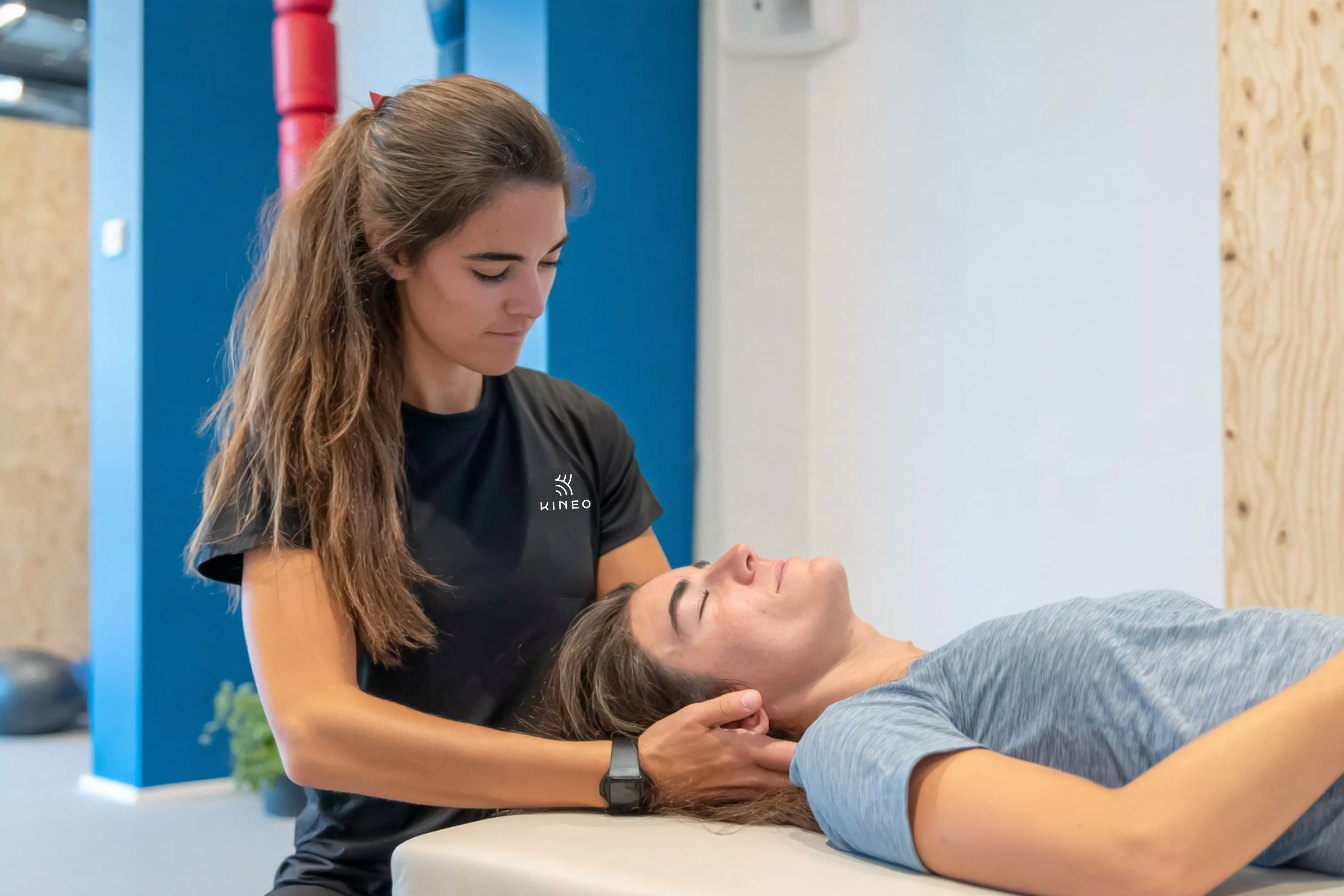
- Measuring mouth opening: We measure in millimetres how far you can open actively and with slight assistance. We also do the three-finger test: do three fingers fit on top of each other between your front teeth?
- Opening path: Does the lower jaw open straight or does it deviate to one side? This shows whether the muscles or the joint are more likely to be affected.
- Temporomandibular joint: Noises, tenderness in front of the ear and the movement when pushing the jaw forward and sideways
- Chewing muscles: Palpation of the masseter, temporalis and, as far as possible, the area of the medial pterygoid muscle at the angle of the jaw
- Neck: After lying for a long time in the dental chair, the upper cervical spine is often tense too. We check mobility and muscle tension.
2. Treatment in phases
- Phase 1, the first 1–2 weeks: Calm things down. Gentle soft tissue techniques on the chewing and neck muscles, small pain-free movements of the TMJ, resting position and everyday tips.
- Phase 2, weeks 2–4: Regain opening. Mobilisation of the TMJ, active opening exercises and held stretches, for example 3 x 30 seconds with light finger pressure, two to three times a day.
- Phase 3, from week 4: Chew normally. Coordination exercises for a straight opening, gradually harder food and strategies against clenching in everyday life.
After recent operations, we follow the instructions of the oral surgery team and only start when wound healing allows it.
3. Kineo services we use
- CMD jaw therapy for assessment, joint mobilisation and an exercise programme
- Trigger point treatment on the masseter and temporalis when the muscles are overloaded after treatment
- Manual therapy for the TMJ and upper neck
- Manual lymphatic drainage if swelling lasts a long time after wisdom tooth surgery
Tips for your next dental treatment
If you know that your jaw reacts sensitively, you can discuss a few things with your dental practice beforehand:
- Breaks: For longer treatments, ask for short breaks in which you can close your mouth and move your jaw loosely.
- Bite block: Ask whether a small support between the teeth is possible. Then your muscles don't have to hold your mouth open actively.
- Split appointments: Long treatments can sometimes be spread over two shorter appointments.
- Tell them beforehand: Let them know if you have CMD, a clicking jaw or limited mouth opening.
- Move afterwards: On the evening of the treatment, do a few gentle opening movements and warm your cheek, provided no operation took place.
From our practice
Patients often only come to us weeks after the dental treatment, because they thought it would go away by itself. In that time a protective pattern has often crept in: they only chew on one side and hardly open their mouth properly any more. With targeted treatment and a few simple exercises, most people regain their normal mouth opening.
Jaw therapy at Kineo Seefeld
At Kineo Seefeld on Seefeldstrasse 83, Feldeggstrasse stop with trams 2 and 4, the jaw is a focus. Our physiotherapists work according to the CRAFTA concept and see jaw, head and neck as one unit. You can find all the information about the practice on the Seefeld location page.
Frequently asked questions
How long is jaw pain after dental treatment normal?
Mild complaints usually improve within one to two weeks. If they last longer or get stronger, have them checked by your dentist and by a physiotherapist.
Can a new crown cause jaw pain?
Yes, if it changes your bite. If the way your teeth meet feels unfamiliar, your dentist should check the crown first.
Can I do jaw exercises after wisdom tooth surgery?
Only once the wound allows it and the oral surgery team agrees. After that, gentle opening exercises help you regain your mouth opening.
Does health insurance cover physiotherapy?
With a doctor's prescription, your basic health insurance covers the cost. Kineo is recognised by all Swiss health insurers.
You might also like
- Lockjaw: when your mouth won't open
- Clicking jaw joint: is it dangerous?
- CMD (cranio-mandibular dysfunction)
Book an appointment
Has your jaw hurt since your dental treatment? Book your appointment at Kineo Seefeld and we will find out what is behind it.