By Flin Jaggy, physiotherapist at Kineo Wipkingen
When it stabs low down in your back
The pain is on one side, right at the bottom of your back, just next to the sacrum. You can point to it almost exactly with one finger. It shows up when you get out of the car, climb stairs, turn over in bed or stand on one leg for a while. Sometimes it pulls into your buttock or the back of your thigh.
Often you then hear: «Your SI joint is blocked.» In this article we explain what is really behind it and why strengthening usually helps more than having it «put back».
What is the SI joint?
The sacroiliac joint, or SI joint for short, connects the sacrum with the two iliac bones of the pelvis. There is one on each side. It is a very stable joint with irregular joint surfaces and strong ligaments. Its job is to transfer forces between your spine and your legs, for example when you walk, run and lift. The movement in the joint is very small.
Your gluteal, back, abdominal and pelvic floor muscles work closely with the SI joint. They brace the pelvis like a corset and keep it stable under load.
Myth: the SI joint is out of place
An SI joint does not «pop out», and you cannot simply push it back in. The movement in the joint is far too small for that, and the ligaments are too strong. If the pain eases after a manual treatment, this is mainly due to the effect on nerves, muscles and pain processing. That can be very helpful for getting moving again. But the idea of a dislocated joint often leads people to protect themselves unnecessarily or to become afraid of movement.
Typical causes and situations
- Pregnancy and the time after: hormones loosen the ligaments and the pelvis has to carry more weight. Pelvic girdle pain is common in this phase.
- One-sided loads such as running high mileage, jumping sports, golf or work with a lot of twisting and lifting
- Falls onto your buttocks or an unexpected step into nothing
- Low strength in your gluteal and trunk muscles, for example after a longer break
- Inflammatory conditions such as ankylosing spondylitis, which often affect the SI joint early on
Typical symptoms
- One-sided pain below the belt line, over the bony prominence next to the sacrum
- Pain spreading into the buttock, the groin or the back of the thigh, usually not below the knee
- Pain when standing on one leg, climbing stairs, turning over in bed or getting out of the car
- Sitting for a long time on the affected side is uncomfortable
Warning signs: when to see a doctor
Have back pain checked by a doctor if it wakes you in the second half of the night, comes with long morning stiffness that improves with movement, and you are younger than about 45. These are typical signs of an inflammatory cause. Also get these checked straight away: fever, unintended weight loss, pain after a heavy fall, paralysis, numbness in the genital area or problems passing urine.
How we treat SI joint pain at Kineo
Before we treat, we clarify whether the SI joint really is the source of the pain. The lumbar spine, the hip and the SI joint cause very similar symptoms.
1. Assessment: what we examine in your first session
- SI joint provocation tests after Laslett: distraction, compression, thigh thrust, sacral thrust and Gaenslen's test. The more of them reproduce your familiar pain, the more likely the SI joint is involved.
- Ruling out the lumbar spine: repeated movements, neurological tests and nerve tension tests
- Hip joint: FADIR and FABER tests and range of motion compared side to side
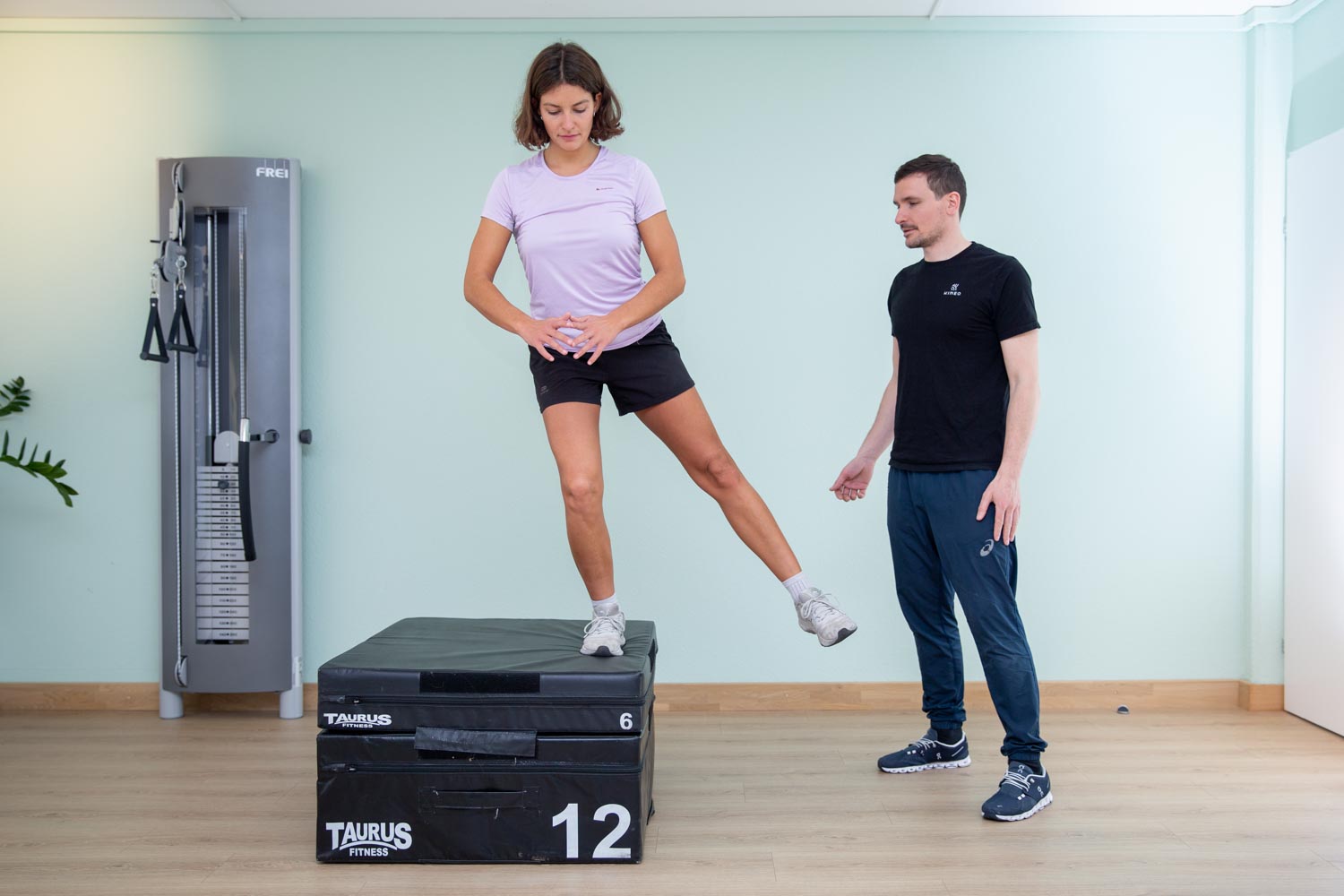
- Load tests: Active Straight Leg Raise (lifting the straight leg while lying on your back), single-leg stance and single-leg squat
- Strength and control: gluteal muscles, lateral trunk and, if needed, pelvic floor
2. Treatment in phases
- Phase 1, weeks 1–2: reduce pain. Manual techniques and soft tissue treatment, low-pain movement, tips for sleeping and sitting. Activation of the gluteal and abdominal muscles, 3 x 10 slow repetitions.
- Phase 2, weeks 2–6: build stability. Bridge, side plank and single-leg exercises, 3 x 8–12 repetitions or 3 x 20–30 seconds, two to three times a week.
- Phase 3, from week 6: load capacity. Deadlifts, lunges, carries and sport-specific movements with increasing load.
- Return to sport: single-leg jumps, running and rotational movements with no pain reaction the next day.
3. Kineo services we use
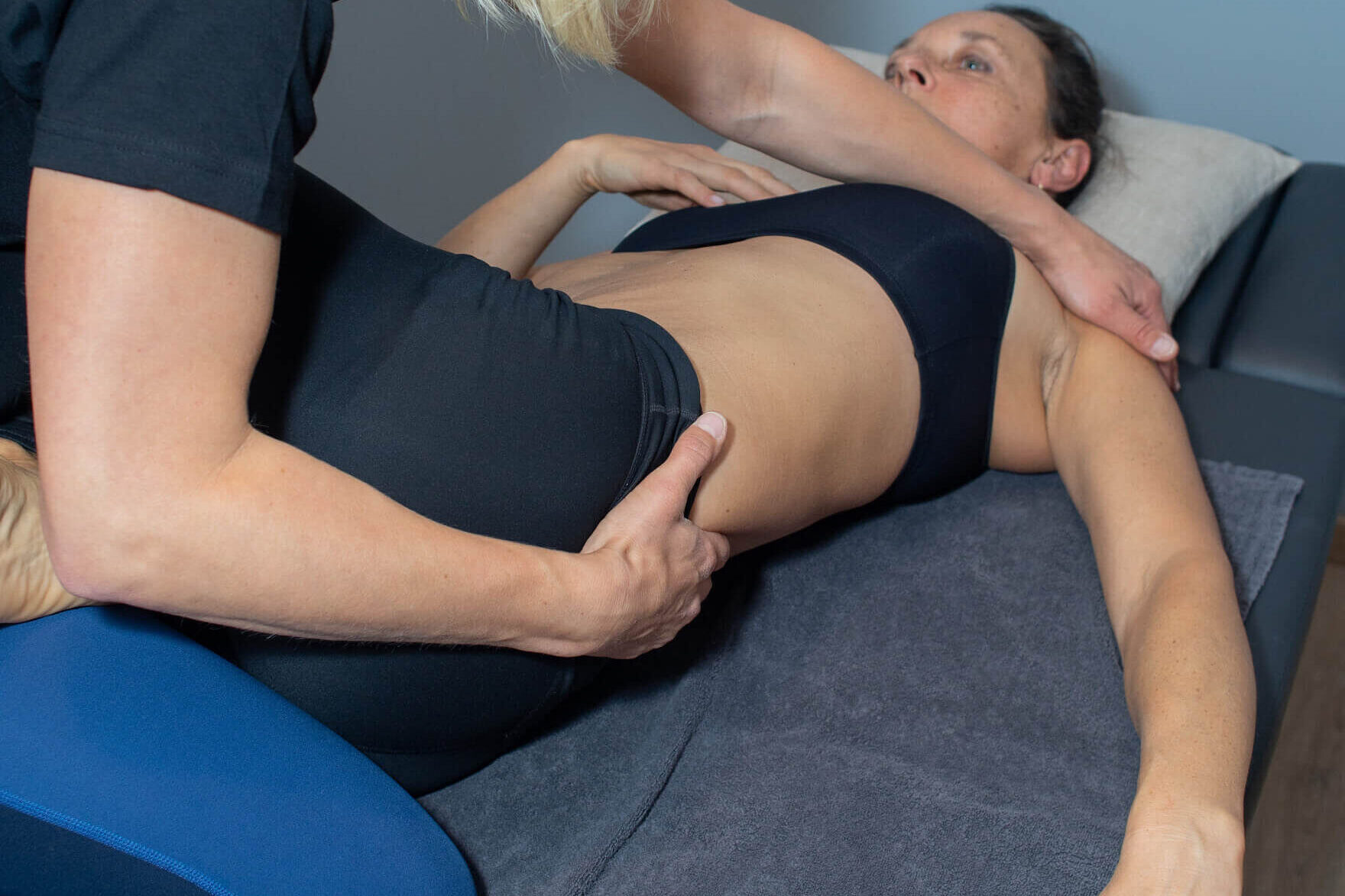
- Manual therapy for the SI joint, lumbar spine and hip, mainly to ease pain in the first phase
- Trigger point treatment for tight gluteal and back muscles
- Medical training therapy to make your glutes, trunk and legs stronger
- Sensopro training for balance and pelvic control in single-leg stance
- Physiotherapy during pregnancy when pelvic girdle pain occurs in pregnancy
Three exercises for a stable pelvis
- Bridge: lie on your back with your feet flat. Lift your pelvis until your upper body and thighs form a line, hold for 2 seconds, lower slowly. 3 x 12. Progression: on one leg.
- Side plank: on your forearm, knees bent. Lift your pelvis and hold without tipping forwards or backwards. 3 x 20–30 seconds per side. Progression: legs straight.
- Single-leg stance with hip hinge: stand on the painful leg and keep your pelvis level. Lean your upper body slightly forwards and straighten up again. 3 x 8 per side.
You may feel the exercises slightly. If the pain gets clearly worse over the following 24 hours, reduce the dose.
What about pelvic belts and insoles?
A pelvic belt can give short-term relief, especially in pregnancy, and make movement more comfortable. But it does not replace strengthening. Insoles and leg length correction only make sense if there is a clear, measured difference. Small differences in leg length are very common and usually not a reason for pain.
From our practice
Many of our patients have already had their joint «put back» several times and then had a few days of peace each time. Once they train their gluteal and trunk muscles regularly, the gaps between pain phases get longer, and often the symptoms disappear completely. Once you understand that the SI joint is not «out», you also move more freely again and with less fear.
Treatment and training in Wipkingen
At Kineo Wipkingen, Röschibachstrasse 79 on Röschibachplatz, back treatment is one of our focus areas. On the training floor with strength machines and a rack, you practise bridges, deadlifts and lunges under guidance. With the Sensopro coordination trainer, we train pelvic control on an unstable surface. You can find more about the location at Kineo Wipkingen.
Frequently asked questions
Can I put my SI joint back myself?
No, and there is no need to. The joint is not out of place. Movement and targeted exercises help far more lastingly.
Can I go jogging with SI joint pain?
Often yes, with adjusted duration and intensity. Downhill running and long strides usually put more load on the SI joint. We adjust the dose together with you.
How long does an appointment last?
An appointment lasts 30 minutes. In your first session we clarify the cause and start straight away with treatment and exercises.
Does health insurance cover physiotherapy?
Yes. With a doctor's prescription, your basic health insurance covers the cost. Kineo is recognised by all Swiss health insurers.
You might also like
Book an appointment
Your low back stabs with every step? Book your appointment at Kineo Wipkingen and we will find out whether the SI joint is behind it.