By Clara Benning, physiotherapist at Kineo Escher Wyss
When shoulder pressing suddenly twinges
You press the dumbbells overhead, and halfway up a stabbing pain appears at the front or side of your shoulder. At the top it feels better again, but on the way down it comes back.
In this situation many people are given the diagnosis "impingement" and the advice to drop overhead exercises altogether. That is rarely necessary. With the right variation, suitable dosing and targeted build-up, in most cases you can keep pressing and even make your shoulder more resilient in the process.
What lies behind the term "impingement"
It used to be thought that the tendons of the rotator cuff are mechanically pinched under the shoulder roof (acromion). Today we mostly speak of subacromial pain syndrome. This means pain in the tendons and the bursa under the shoulder roof, which occurs mainly under load in the middle range of movement. Pure narrowing is rarely the only cause. Usually the tendon is simply exposed to more load than it can currently tolerate.
Typical triggers in the gym:
- Increasing too quickly: more weight, more sets or new exercises in a short time, for example after a break from training.
- Lots of pressing, little pulling: bench press, shoulder press and dips dominate, while rowing and external rotation fall short.
- Restricted thoracic spine: If the thoracic spine cannot straighten up, the shoulder compensates at the end of the movement.
- Shoulder blade control: The shoulder blade does not rotate upwards enough when you raise your arm. This is called scapular dyskinesis, which is often more a result than a cause of the pain.
Typical symptoms
- Pain at the front or side of the shoulder, sometimes radiating into the upper arm
- Painful arc: symptoms between roughly 60 and 120 degrees of arm elevation, less above and below
- Pain when lying on the affected side
- Strength is there, but pressing feels "blocked" or unstable
Warning signs: If you suddenly cannot actively lift your arm after a fall or a jolt, have severe pain at rest at night, tingling or numbness down into the hand, a fever or a badly swollen shoulder, please have it checked by a doctor. A tendon tear, a nerve problem from the cervical spine or an inflammation could be behind it.
What you can do yourself
Complete rest usually does not help the tendon. It needs dosed load to adapt. These rules have proven their worth:
- Pain traffic light: During the exercise, pain up to about 3 out of 10 is fine, as long as it settles quickly after training and is not worse the next morning.
- Change the variation instead of dropping it: Landmine press, incline bench press or dumbbells with a neutral grip (palms facing each other) are often tolerated much better.
- Press in the plane of the shoulder blade: Arms slightly forward, about 30 degrees in front of the body line, rather than exactly out to the side.
- Adjust the range of movement: For the time being, work only in the low-pain range, for example from forehead height upwards.
- Lower the volume, keep the intensity: Better fewer sets with clean technique than many tired repetitions.
Exercises for a resilient shoulder
- Isometric external rotation: Elbow at your side, press the back of your hand against a wall. 5 x 30 to 45 seconds at moderate effort.
- External rotation with a band: Elbow at your side, slowly turn your forearm outwards. 3 x 12 to 15; the last repetitions should be hard work.
- Serratus wall slide: Forearms on the wall, glide upwards with a foam roller while pushing your shoulder blades forward. 3 x 10.
- Prone Y-raise: Lying face down on an incline bench, raise your arms in a Y shape with your thumbs pointing up. 3 x 10 to 12 with light weights.
- One-arm row: 3 x 10 to 12 per side. As a rule of thumb, do at least as many pulling sets as pressing sets per week.
Two to three sessions a week are enough. After about six to twelve weeks it usually becomes clear whether the shoulder can tolerate more load again.
How we treat shoulder pain when pressing at Kineo
Our goal is not to keep you away from overhead training, but to bring you back to it safely with a clear plan.
1. Assessment: what we examine in your first session
- Training history: Which exercises, how many sets, what progression in recent weeks
- Painful arc and Hawkins-Kennedy test: Do they provoke the symptoms under the shoulder roof
- Rotator cuff strength: External rotation and abduction against resistance compared with the other side, so that we don't miss a relevant tendon weakness or tear
- Shoulder blade movement: We watch the shoulder blade as you raise your arm and test whether manual support (scapula assistance test) reduces the pain
- Thoracic and cervical spine: Straightening up, rotation and ruling out a radiating neck problem
- Exercise analysis: We watch you press and immediately test which variation works with little pain
2. Treatment in phases
- Phase 1, weeks 1–2: calm the irritation. Isometric exercises, continue training with adjusted variations, temporarily replace painful exercises.
- Phase 2, weeks 2–6: build capacity. External rotation, shoulder blade muscles and rowing with 3 x 8 to 15, two to three times a week, plus landmine press or incline bench press.
- Phase 3, from week 6: back overhead. Seated dumbbell shoulder press, then standing.
- Phase 4: full load. Barbell, push press or wall balls depending on your sport, progressing according to the pain traffic light.
3. Kineo services we use
- Sports physiotherapy: assessment, training adjustments and clear criteria for returning to heavy pressing exercises
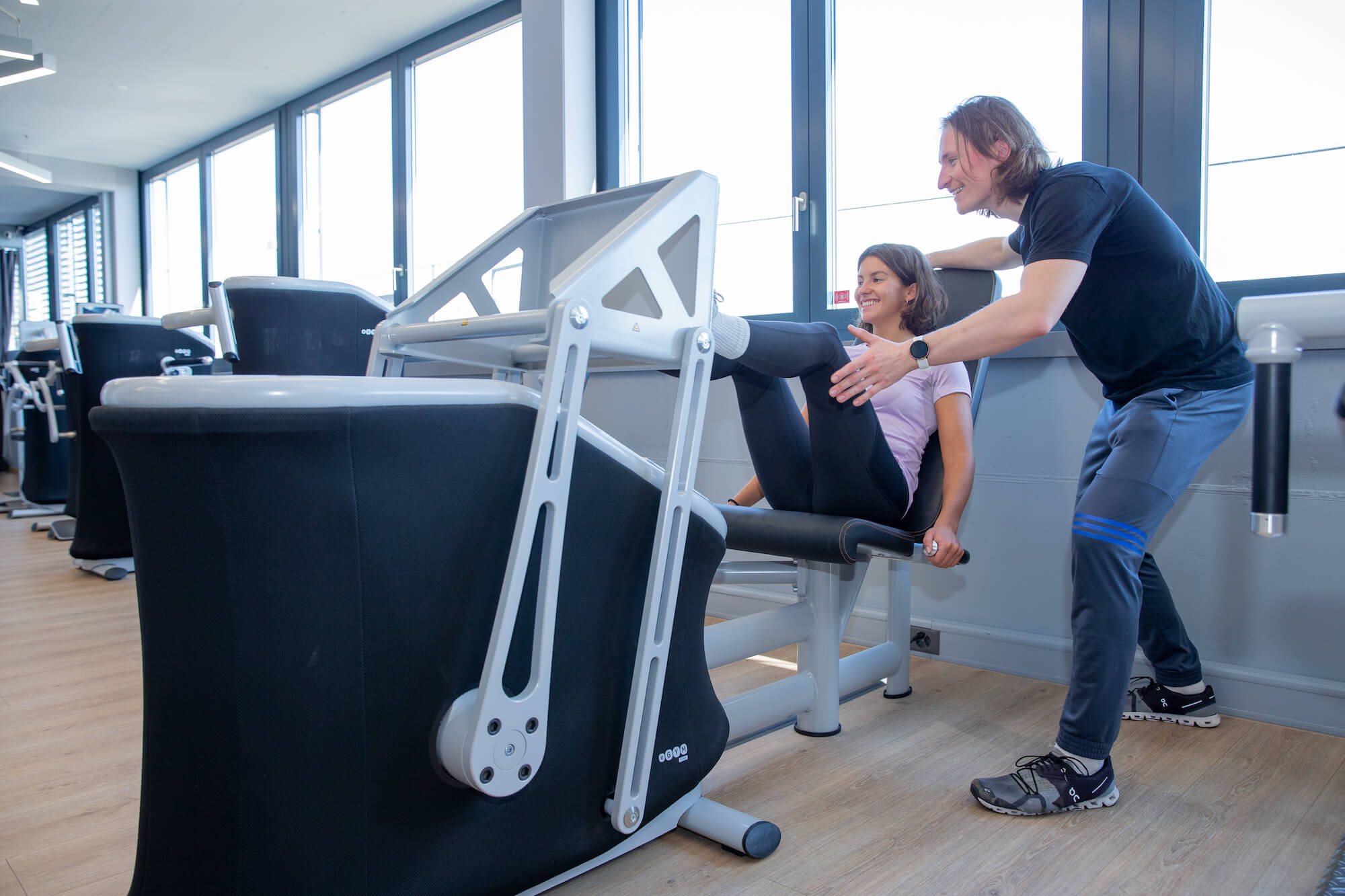
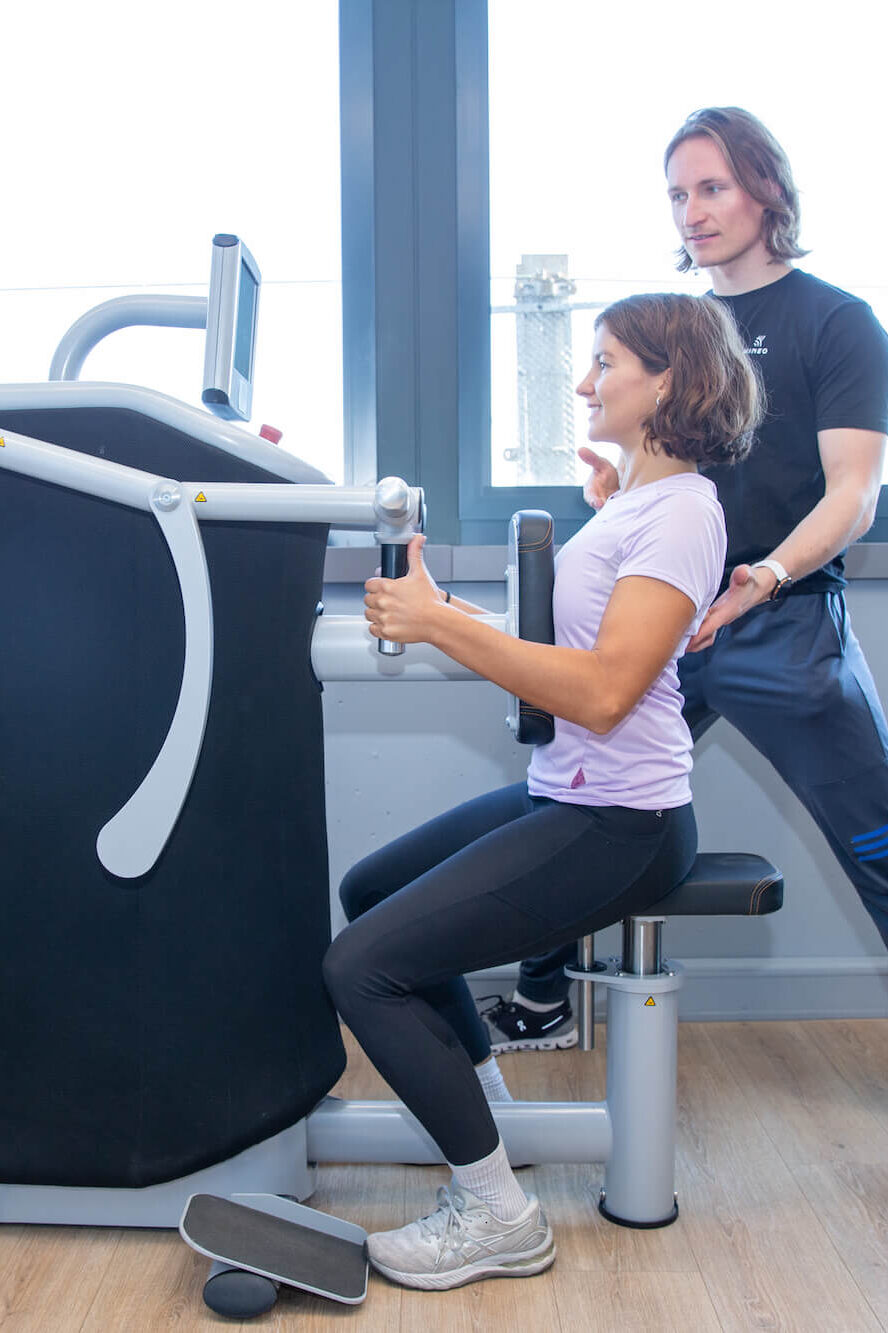
- Medical training therapy to build up the rotator cuff and shoulder blade muscles under guidance
- Manual therapy for the thoracic spine and shoulder joint when mobility is restricted
- Trigger point treatment and dry needling for painful tension around the shoulder blade and neck, as a complement to training

From our practice
Strength athletes often come to us who have been leaving out shoulder pressing for months and still feel no improvement. The shoulder is spared, but loses resilience as a result. As soon as they press again with a suitable variation and clear rules, many feel more secure after a short time.
Shoulder training at Kineo Escher Wyss
At Kineo Escher Wyss at Hardturmstrasse 18, right at Escher-Wyss-Platz, we combine sports physiotherapy and a supervised training floor across two levels. You do your shoulder exercises on site under guidance, and we adjust variations and weights directly. Kineo HYROX trains in the same building. If you are returning to wall balls and push-ups there, we can coordinate the transition closely with you.
Frequently asked questions
Can I keep bench pressing with shoulder pain?
Often yes, with an adjusted grip, a slightly smaller range of movement and less volume. As long as the pain traffic light is right, this does not harm the tendon.
How long does it take until I can press normally again?
That depends on how long the symptoms have lasted. With a recent overload it often takes a few weeks. With longer-standing pain, the tendon usually needs two to three months of build-up.
Do I need an MRI?
Not necessarily. With a typical finding and no loss of strength, we start with therapy. If there are warning signs, clear weakness or no improvement, we recommend a medical check-up with imaging.
Does health insurance cover physiotherapy?
Yes. With a doctor's prescription, your basic health insurance covers the cost. Kineo is recognised by all Swiss health insurers.
You might also like
Book an appointment
Is your shoulder holding back your training? Book your appointment at Kineo Escher Wyss and together we will find the right pressing variation.