By Clara Benning, physiotherapist at Kineo Escher Wyss
Stretching, mobilising or just training?
You feel stiff in your hips, or you can't get deep enough in a squat. So you stretch. Or you do mobility flows because everyone else is. And at some point you wonder whether any of it actually helps.
The short answer: both can make sense. It depends on what you want to achieve. Here you will find out how stretching and mobility differ and how to train sensibly.
Flexibility is not the same as mobility
- Flexibility: How far a joint can be moved passively, that is, when someone else or gravity puts you in the position.
- Mobility: How far you can move a joint actively and under control, using your own muscle strength. Mobility is flexibility plus control.
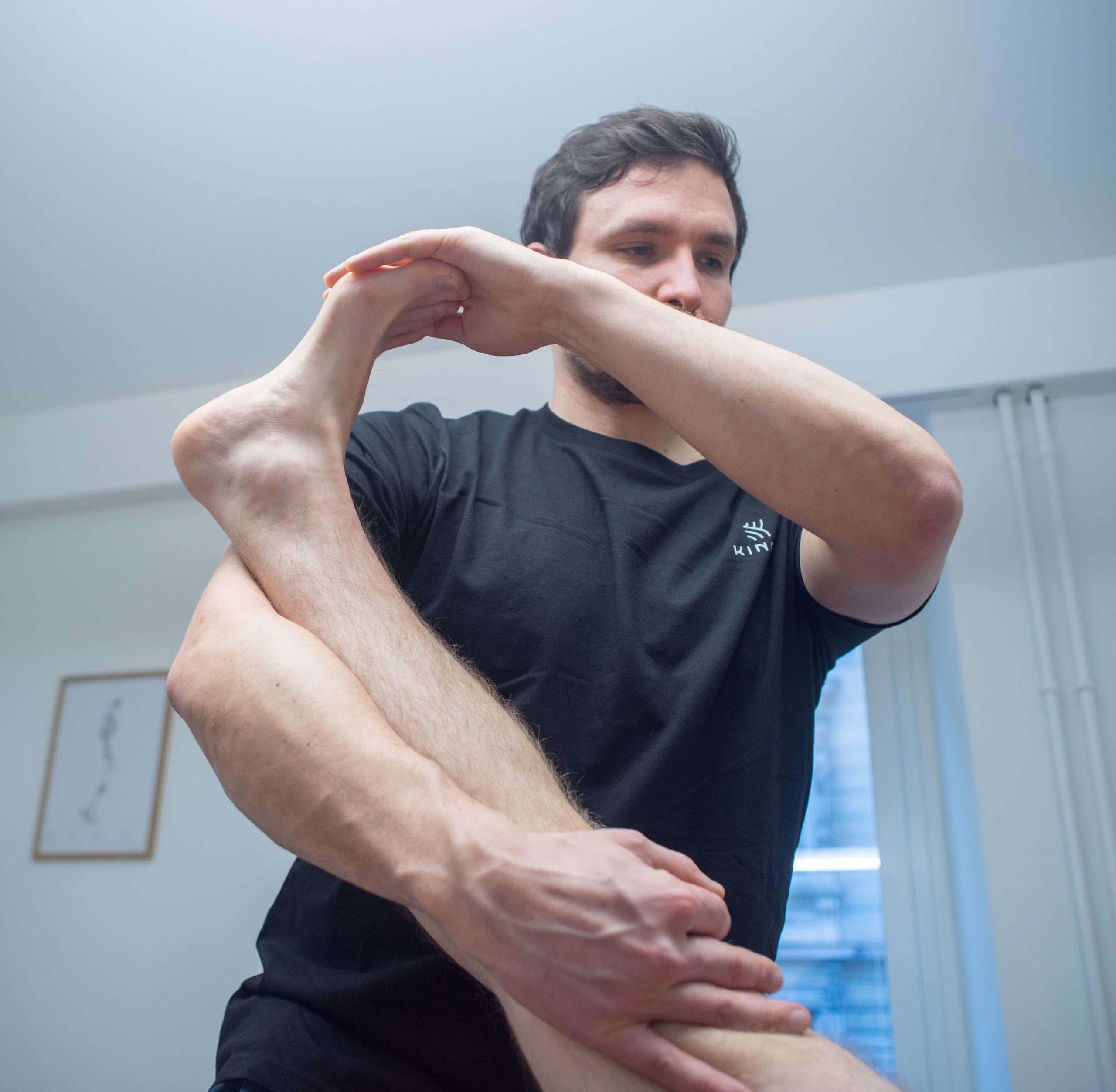
- Stretching: A method for improving passive flexibility. It can be static, dynamic or PNF stretching, which alternates tensing and relaxing.
- Mobility training: An umbrella term for active exercises that train range of motion and control at the same time, for example controlled joint circles, active end positions and strength exercises through the full range of motion.
The difference is easy to see in the leg: many people can have their straight leg lifted a long way while lying down, but can actively lift it much less high. This gap between passive and active is often the real bottleneck in sport.
What stretching really does
Regular stretching reliably improves flexibility. What's interesting is how: in the short term, it mainly raises your stretch tolerance. Your nervous system accepts more tension before it says "stop". Only over weeks and months do your muscles and tendons adapt a little as well.
What stretching, according to current knowledge, can't really do:
- Prevent muscle soreness: Stretching after training barely reduces muscle soreness.
- Prevent injuries in general: For most sports, a protective effect from static stretching alone is not clearly proven. Strength and coordination programmes do better here.
And before sport? Long-held static stretches directly before sprinting, jumping or maximal strength efforts can slightly lower performance in the short term. Short stretches as part of a dynamic warm-up, on the other hand, are not a problem.
When stretching makes sense
- When your sport demands a lot of passive flexibility, such as gymnastics, dance, martial arts or climbing
- When a certain range of motion is missing and limits you in daily life or training
- After an injury or surgery, when a joint has to regain movement
Dosage: For a measurable effect, 2–4 rounds of 20–30 seconds per muscle group are usually enough, around one minute in total, on at least two to three days a week. The stretch should be clearly noticeable, but not painful.
When mobility training is the better choice
In sport, you need flexibility that you can also control under load. A deep squat in a deadlift, a long lunge in HYROX or an overhead position in wall balls demand strength at the end of the range of motion. That is exactly where mobility comes in.
Good to know: strength training through the full range of motion often improves flexibility about as well as stretching. Eccentric exercises, where you give way under load in a controlled manner, are particularly suitable. If you train cleanly and deep, you are already doing a lot of mobility work.
What you can do yourself: a simple programme
These four exercises cover the most common bottlenecks. Two to three times a week, as part of your warm-up or as a short session of their own.
- Hip CARs (controlled articular rotations): On all fours, slowly move one knee in the biggest circle you can, without your trunk turning with it. 2 x 5 circles per direction and side.
- Active leg raise lying down: Raise one straight leg as high as possible, hold for 3 seconds, lower slowly. 2 x 8 per side. Trains the active flexibility of your hamstrings.
- Ankle at the wall: In a lunge, push the front knee towards the wall while your heel stays on the floor. 2 x 10 slow repetitions per side.
- Goblet squat with a pause: With a kettlebell at your chest, squat deep and hold at the bottom for 3 seconds. 3 x 6–8.
Over the weeks, increase the hold time, range of motion or weight.
When to look more closely
Stiffness is usually harmless. But get it checked by a doctor if a joint suddenly moves clearly less, if it is swollen, warm or red, if morning stiffness lasts clearly longer than half an hour over a longer period, or if tingling, numbness or loss of strength come with it.
The opposite exists too: some people are very flexible but unstable. For them, more stretching is rarely the answer. Strength and control are.
How we approach mobility problems at Kineo
Before we give you exercises, we find out where your bottleneck really lies: in passive flexibility, in control or in a combination.
1. Assessment: what we examine in your first session
- Knee-to-Wall Test: Measures how far your ankle can bend while standing, which matters for squatting and running
- Thomas Test: Shows whether the hip flexors or the front of the thigh limit your hip extension
- Active and passive Straight Leg Raise: The difference between the two shows whether you lack flexibility or control
- Overhead Squat: A movement test in which we see your ankle, hip, thoracic spine and shoulders working together
- Beighton Score: A short check for general hypermobility
2. Treatment in phases
- Weeks 1–2: Freeing up range of motion. Joint mobilisation and soft tissue techniques where a joint feels blocked. Plus 2–3 targeted exercises for home.
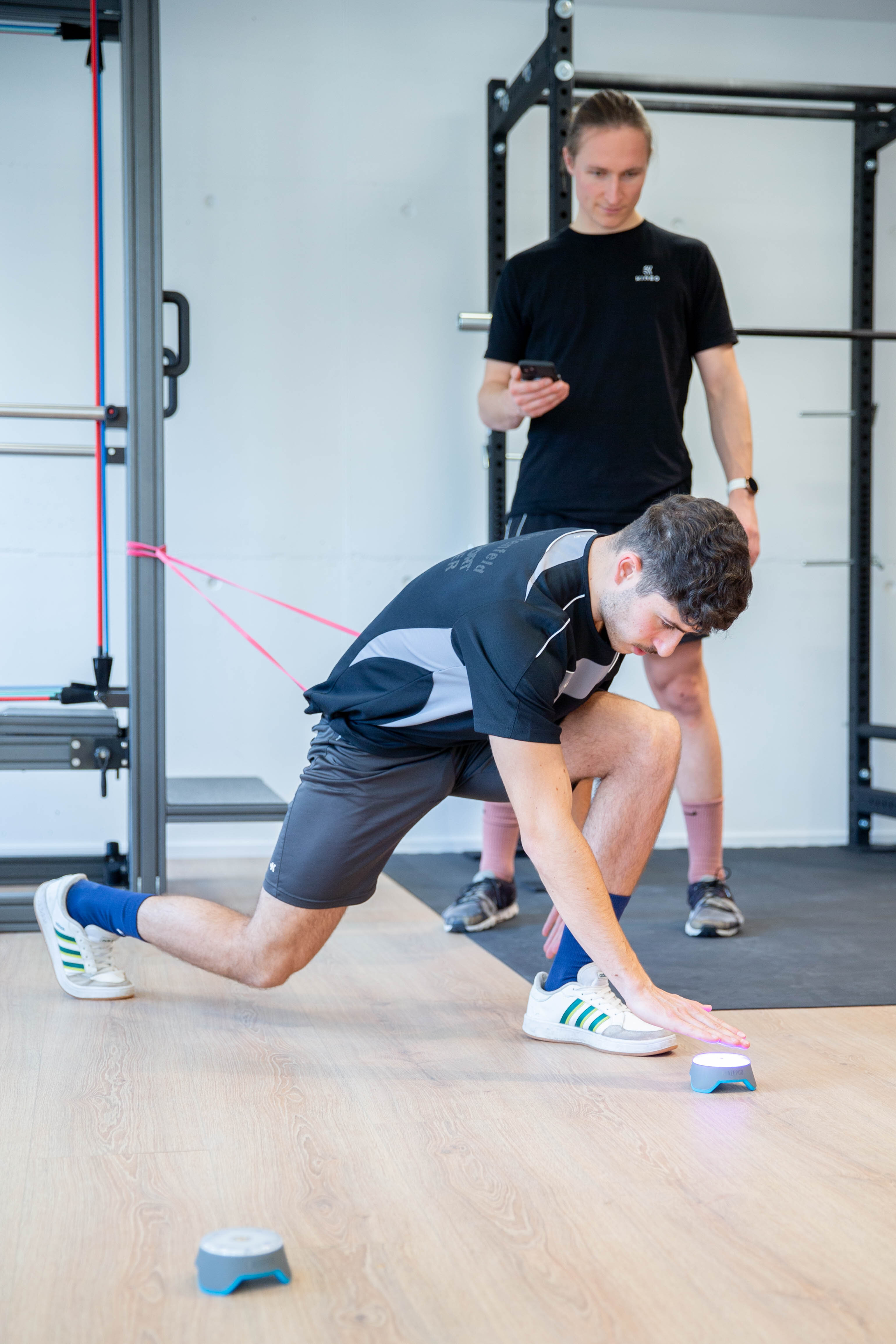
- Weeks 3–6: Active control. Holding end positions, controlled joint circles and slow eccentric exercises, two to three times a week.
- From week 6: Under load. The new range of motion is built into strength exercises such as squats, lunges or overhead presses.
3. Kineo services we use
- Manual therapy: when a joint such as the hip, ankle or thoracic spine is restricted
- Fascia therapy: to release tissue that feels stuck and make movement easier
- Proprioceptive neuromuscular facilitation: tensing and relaxing techniques that combine stretching and control
- Medical training therapy: to secure the range of motion you have gained under load
- Digital home programme: so you do your exercises correctly and regularly at home
From our practice
We often see athletes who have stretched every day for months and still can't get deeper into a squat. In the test, it often turns out that their passive flexibility is actually enough, but strength and control in the end position are missing. As soon as we replace the stretching programme with slow, deep strength exercises, the movement usually becomes freer after just a few weeks.
Training flexibility at Kineo Escher Wyss
At Kineo Escher Wyss on Hardturmstrasse 18, right at Escher-Wyss-Platz, we combine sports physiotherapy and a supervised training floor on two levels. This way you practise new ranges of motion directly under load rather than only on the mat. Kineo HYROX trains in the same building.
Frequently asked questions
Should I stretch before or after training?
Before training, keep it dynamic and short, as part of your warm-up. Longer static stretches suit better after training or in a session of their own.
How long does it take until I become more flexible?
You often feel first changes after a few sessions, because your stretch tolerance rises. For clear and lasting progress, you usually need several weeks of regular training.
How long does an appointment last?
An appointment lasts 30 minutes. In your first session, we clarify the cause of your restriction and start straight away with treatment and exercises.
You might also like
- Mobility and flexibility in elite sport
- Muscle soreness, strain or torn muscle fibres?
- Recovery after training: what really helps
Book an appointment
Do you want to know whether stretching or mobility will do more for you? Book your appointment at Kineo Escher Wyss and we will test your flexibility.