
By Asier Gochicoa, physiotherapist at Kineo Wipkingen
A pulling pain between the shoulder blades
You’re sitting at your laptop, and at some point a burning or pressing pain appears at the inner edge of your shoulder blade. You massage the spot with a ball against the wall, it eases for a while and comes back the next day. Sometimes it also pulls towards your neck or arm.
Shoulder blade pain is very common and usually muscular. But it can also come from the cervical spine, the thoracic spine or the rib joints. And in rare cases, internal organs are behind it. That’s why it pays to take a closer look.
Common causes
- Muscle overload: the muscles between the spine and shoulder blade (rhomboids, middle and lower trapezius) and the levator scapulae work constantly when you sit for long periods with your head pushed forward and your arms at the screen.
- Trigger points: tender spots in the muscle that cause a typical, often radiating pain.
- Cervical spine: an irritated nerve root in the lower neck can project pain to the inner edge of the shoulder blade, often together with neck pain or tingling in the arm.
- Thoracic spine and ribs: irritated small spinal or rib joints cause a localised pain that can get worse when you breathe in deeply or turn.
- Disturbed shoulder blade movement: if the shoulder blade doesn’t move smoothly as you lift your arm (scapular dyskinesis), the muscles and shoulder joint take more load.

Warning signs: not all shoulder blade pain comes from the back
Seek medical help if you notice these signs, and for the first two call the emergency number 144 immediately:
- Pain together with pressure or tightness in the chest, shortness of breath, nausea, sweating or pain spreading into the arm or jaw, especially on the left
- Sudden, very severe pain between the shoulder blades that feels like tearing
- Pain that depends on breathing and occurs with fever or a cough
- Pain under the right shoulder blade after a fatty meal, together with upper abdominal complaints
- Increasing numbness or loss of strength in the arm, pain at night with no relief, unintentional weight loss
What you can do yourself
Massage with a ball often brings short-term relief. In the longer term, what helps most is making the muscles around the shoulder blade more resilient and keeping the thoracic spine mobile.
- Band rows: fix the band at chest height, pull your elbows back, gently draw your shoulder blades together and down. 3 x 12–15.
- Prone Y raises: arms stretched forward in a Y shape, thumbs to the ceiling, lift your arms slightly. 3 x 10. Trains the lower trapezius.
- Wall slides: forearms on the wall, slowly slide upwards, taking your shoulder blades outwards and upwards with you. 2–3 x 10.
- Thoracic extension over the roller: foam roller across your upper thoracic spine, hands behind your head, gently extend backwards. 2 x 8 at different levels.
- Open book: lying on your side, open your upper arm in an arc backwards. 2 x 8 per side.
In addition: screen at eye level, forearms supported, and stand up briefly every 30–45 minutes to move your shoulders.
How we treat shoulder blade pain at Kineo
Because several regions could be involved, we examine the neck, thoracic spine, ribs and shoulder together.
1. Assessment: what we examine in your first session
- Cervical spine: mobility and the Spurling test, in which we tilt your head to the side and apply light pressure to detect irritation of the nerve root. Plus reflexes, strength and sensation in the arm.
- Thoracic spine and ribs: rotation while sitting and springing tests of individual segments and rib joints
- Shoulder blade movement when raising and lowering the arms, plus the scapular assistance test: we guide the shoulder blade as you lift your arm and check whether the pain eases
- Palpation of the rhomboids, trapezius and levator scapulae for trigger points
- Strength of the lower trapezius and the shoulder’s external rotators, compared side to side
- Workplace and daily life: sitting time, screen, sport, sleeping position
2. Treatment in phases
- Phase 1, around weeks 1–2: relieve pain. Soft tissue techniques, mobilisation of the thoracic spine and ribs, first light exercises such as open book and rows with a light band.
- Phase 2, around weeks 2–6: build strength. Rows, Y raises, face pulls on the cable machine and external rotation, 3 x 10–15, two to three times a week, with increasing resistance.
- Phase 3: become resilient. Overhead exercises, push-up variations and carrying weights, so that the shoulder blade and trunk also work together under load.
- Daily life: adjustments at your workplace and short movement breaks so the complaints don’t come back.
3. Kineo services we use
- Trigger point treatment of the rhomboids, trapezius and levator scapulae
- Dry needling when trigger points are stubborn
- Manual therapy for the thoracic spine, rib joints and cervical spine
- Neurodynamics when an irritated nerve root in the neck is involved
- Medical training therapy to build strength around the shoulder blade
Posture: less “sitting up straight”, more variety
Many people try to sit consciously upright with their shoulders pulled back all day. Hardly anyone can keep that up, and the constant tension can tire the muscles even more. There is no single perfect posture. What is mainly unfavourable for the muscles around the shoulder blade is long periods of monotony. So switch positions regularly, stand up in between, use a standing desk if possible and build short exercises into your day. The best posture is the next one.
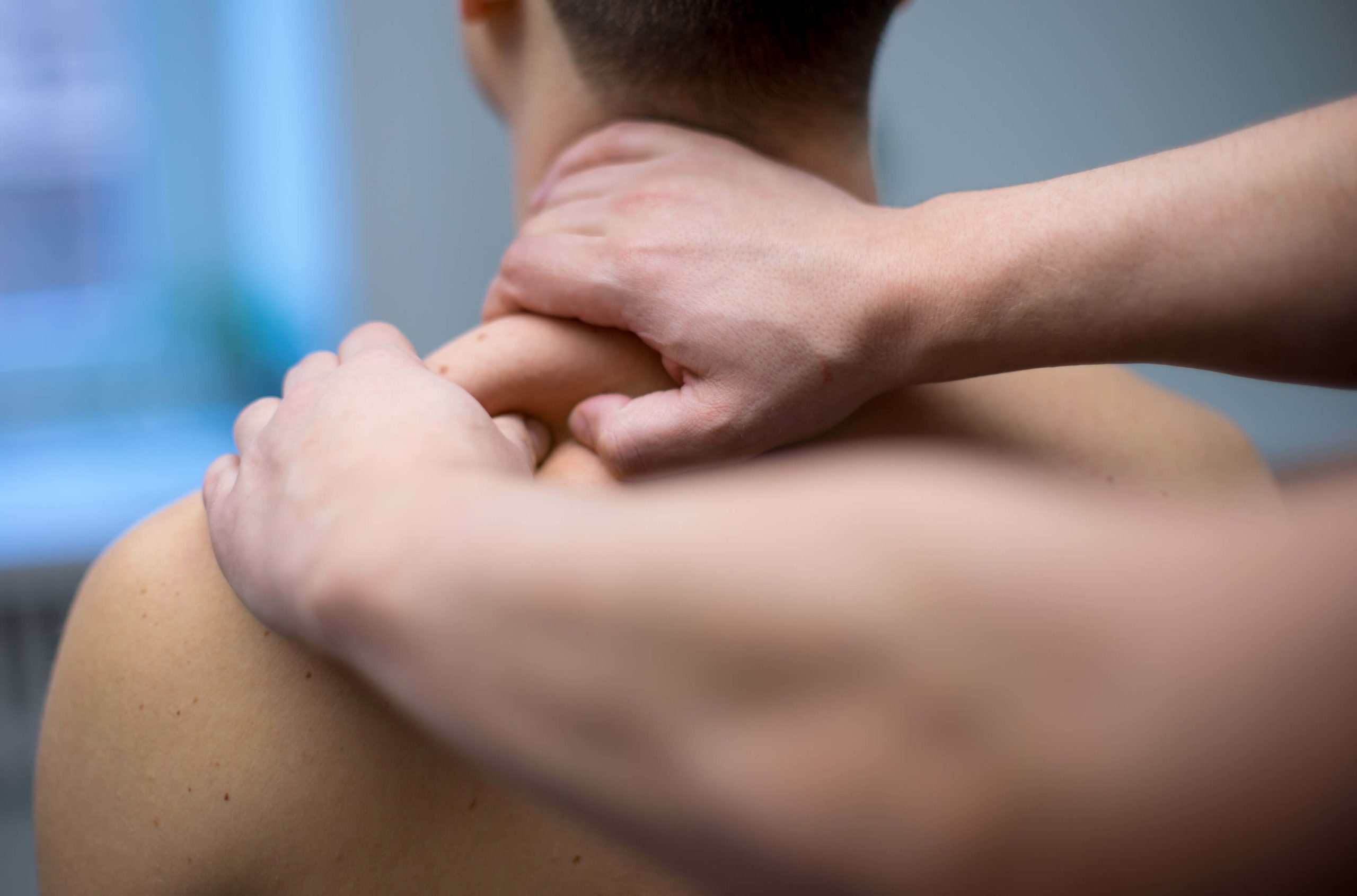
From our practice
A common pattern we see: people with office jobs who have had shoulder blade pain for months and massage and stretch a lot. The muscles feel tense, but are often overloaded rather than too short. As soon as we strengthen them specifically and mobilise the thoracic spine, the complaints usually settle down noticeably.
Shoulder and back treatment at Kineo Wipkingen
Shoulder and back treatment is one of our main focuses at Kineo Wipkingen at Röschibachstrasse 79 on Röschibachplatz. On the training floor with strength equipment and a rack, we build strength around the shoulder blade directly after treatment. Dry needling is also available on site. Find out more about the location on the Kineo Wipkingen page.
Frequently asked questions
Can shoulder blade pain come from the heart?
Rarely, but yes. If you have pressure in your chest, shortness of breath, nausea or pain spreading into your arm or jaw, call the emergency number 144 immediately.
Why does massage only help briefly?
Massage can ease tension but doesn’t change the cause. Usually the muscles lack strength and variety in everyday life.
Is a fascia ball useful?
It can be pleasant as an addition. Don’t press too hard or directly on the spine, and combine it with strengthening exercises.
Does health insurance cover physiotherapy?
Yes. With a doctor's prescription, your basic health insurance covers the cost. Kineo is recognised by all Swiss health insurers.
You might also like
Book an appointment
Has your shoulder blade been bothering you for a while? Book an appointment at Kineo Wipkingen and we’ll find out where the pain comes from.