By Barbara Victorio, physiotherapist at Kineo Wipkingen
After the operation: what happens next?
The operation is over, and the leg pain is often already much better. At the same time, new questions come up: how much can I move? When can I sit, work, ride a bike or jog again? And how do I stop it from happening again?
Physiotherapy supports you along the way. It helps you regain confidence in your back, build strength and find your way back into everyday life, work and sport step by step. This article is mainly about the most common operation, the microsurgical removal of a slipped disc.
What was done during the operation
In a slipped disc, tissue from the core of the disc presses on a nerve root. In a microdiscectomy, the surgeon removes the part of the disc that is pressing on the nerve through a small incision. Most of the disc itself is preserved. The spine is not fused.
It is different after a spinal fusion (spondylodesis) or a disc replacement. Different guidelines and time frames often apply there. Always follow the instructions of your surgical team. The information here is a general framework.
The first weeks: what’s normal
- Residual leg symptoms: tingling, numbness or mild pain can persist for weeks to months. A nerve recovers slowly.
- Wound pain and stiffness in the lower back in the first days and weeks
- Tiring quickly when sitting and standing, which decreases over time
- Uncertainty: many people are afraid of “breaking something”. That’s understandable, but movement is an important part of healing in this phase.
Warning signs: when to get in touch immediately
Contact your surgical team or the emergency department immediately if you notice numbness in the genital area or on the inside of your thighs, have problems passing urine or opening your bowels, or if one leg suddenly becomes much weaker. Also have these checked quickly: fever, a red, warm or weeping wound, and sudden, severe leg pain shooting back in like before the operation.
What you can do yourself
- Walk every day: walks are allowed and useful from the first days. Better several short walks a day than one long one. Increase duration and pace gradually.
- Change positions: at first, sitting for a long time is often uncomfortable. Alternate between sitting, standing, walking and lying down.
- Move normally: getting up, getting dressed and bending down for light objects are allowed, unless your surgical team says otherwise. Strict rest brings no benefit after a microdiscectomy.
- Sleep and recovery: lying on your side with a pillow between your knees, or on your back with your legs supported, is comfortable for many people.
- Be patient with the nerve: residual leg symptoms are not a sign that the operation has failed.
How we support you after disc surgery at Kineo
Your surgical team decides when physiotherapy starts. Targeted training often begins a few weeks after the operation. Before that, walking and light everyday movements are the most important “therapy”.
1. Assessment: what we examine in your first session
- Neurological status: strength of the leg muscles, sensation and reflexes compared with before the operation
- Nerve mobility: careful straight leg raise and slump test to see how freely the nerve glides again
- Capacity in everyday life: how long can you sit, stand and walk?
- Mobility: hips, thoracic spine and pain-free movements of the lumbar spine
- Scar and tissue: healing, mobility and sensitivity
- Fear of movement: with a short questionnaire, we assess how confident you feel when moving
2. Treatment in phases
- Phase 1, around weeks 0–4: move and heal. Daily walking, changes of position, gentle activation of the deep abdominal and back muscles and light nerve gliding exercises, once your team approves them.
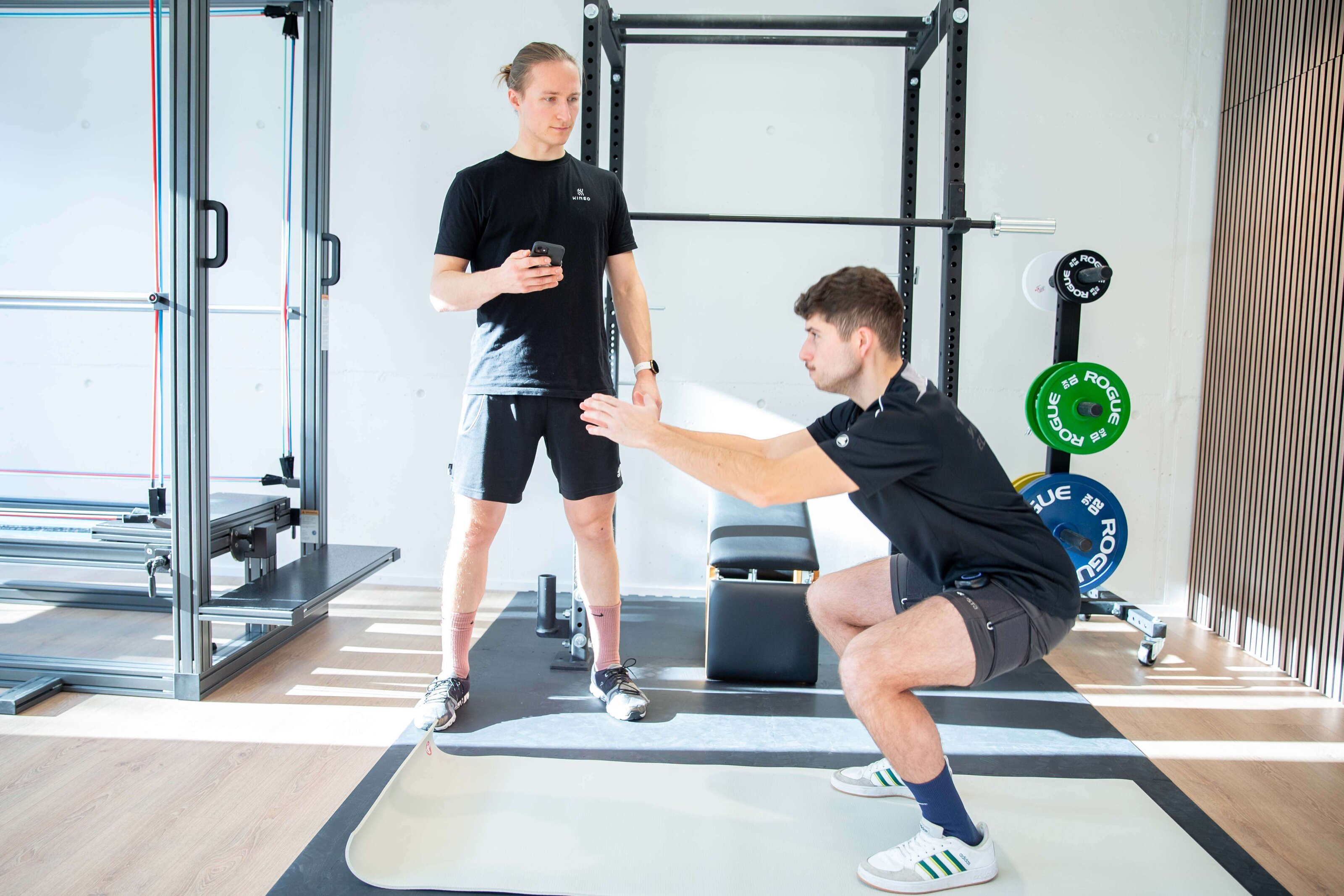
- Phase 2, around weeks 4–8: build basic strength. Bridge, four-point kneeling with arm and leg raises, side plank, squats to a bench. 2–3 sets of 10–12 repetitions, two to three times a week. Bike ergometer for endurance.
- Phase 3, around weeks 8–12: increase capacity. Weighted hip hinge, rows, carrying loads, lunges. Increase weights gradually.
- Phase 4, from around month 3: back to sport and work. Running, jumps, rotational movements and heavy lifting, adapted to your sport and your work.
3. Kineo services we use
- General physiotherapy: assessment, education and planning your return to everyday life
- Medical training therapy: the core element for making your trunk, glutes and legs strong again
- Neurodynamics if the nerve is still sensitive or glides poorly
- Manual therapy for the hips and thoracic spine to take the load off the lumbar spine
- Digital home programme so you keep going between appointments
Back to work and sport
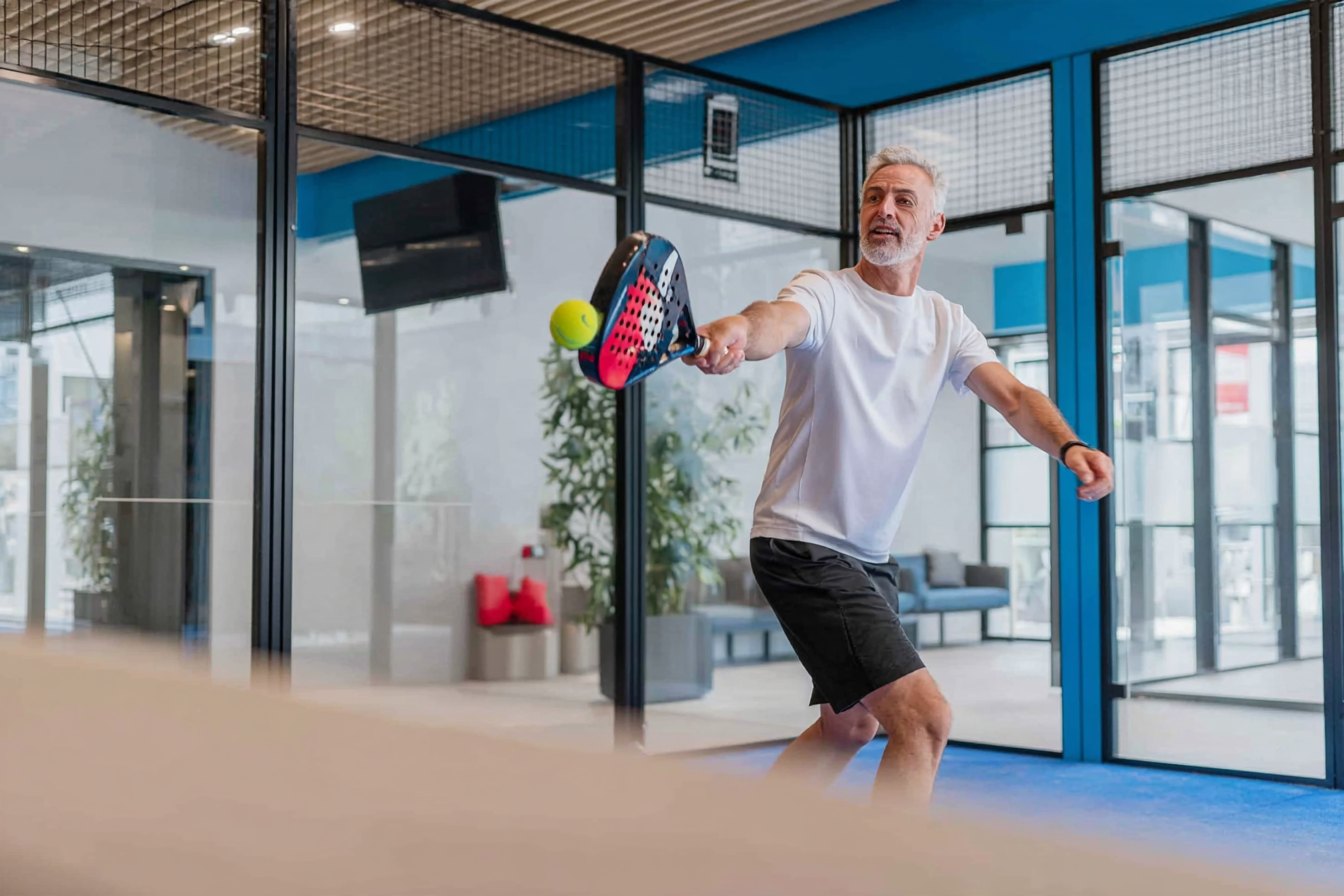
After a microdiscectomy, a return to an office job is often possible after a few weeks; physically demanding work usually takes longer. For sport: only when you no longer have a reaction the next day after training with weights, running and rotational movements do you gradually return to full training. We decide exactly when together with your surgical team.
As for how to prevent another herniation: a strong, resilient back and regular movement are the best foundation. There is no single “correct” lifting technique that prevents everything. What matters more is that your body is used to the loads you lift in everyday life.
From our practice
Many patients come to us after the operation with a long list of things they’re not allowed to do. They no longer bend, lift nothing and sit tensely. When we build up load together step by step, they notice that their back can handle more than they think. That takes away the fear and is often the turning point in rehabilitation.
Rehabilitation in Wipkingen
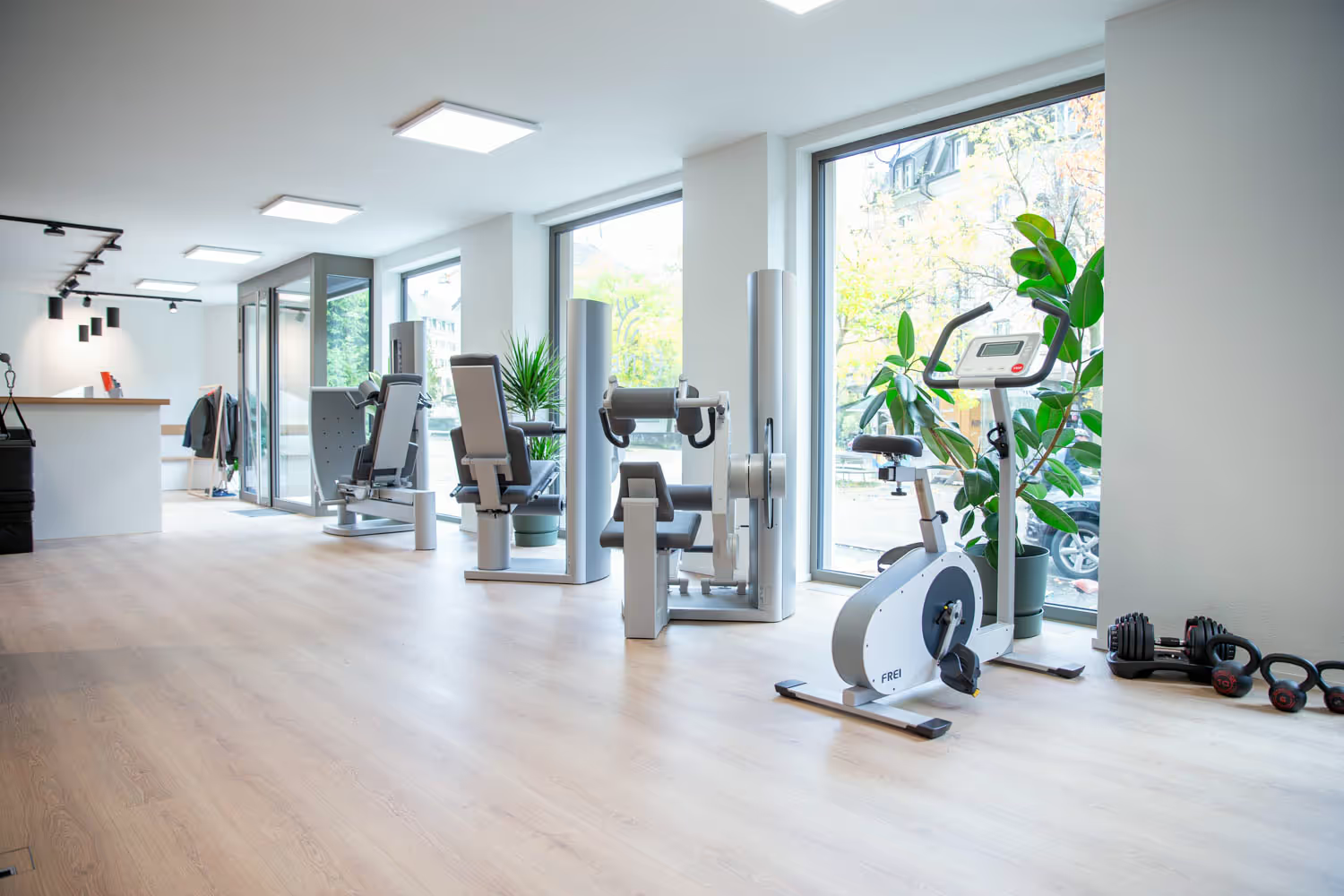
At Kineo Wipkingen at Röschibachstrasse 79 on Röschibachplatz, back treatment is one of our main focuses. On the training floor with strength equipment, a rack and a bike ergometer, you build your strength under guidance, from the first light exercises to training with the barbell. Find out more about the location at Kineo Wipkingen.
Frequently asked questions
When can I ride a bike again after disc surgery?
On the bike ergometer, often after just a few weeks. Outdoors on the road a little later, once you can get on and off safely and tolerate sitting well. Your surgical team decides the exact timing.
Is it normal that my leg still tingles?
Yes, residual symptoms are common and often improve over months. If the strength in your leg gets worse or the severe pain returns, contact your surgical team.
How long does an appointment last?
An appointment lasts 30 minutes. In the first session, we do the assessment and start straight away with treatment and exercises.
Does health insurance cover physiotherapy?
Yes. With a doctor's prescription, your basic health insurance covers the cost. Kineo is recognised by all Swiss health insurers.
You might also like
Book an appointment
Have you had disc surgery and want to become resilient again? Book your appointment at Kineo Wipkingen.