
Injury prevention in volleyball: jump higher, land safely and stay at your best for the long term
Volleyball is fast, explosive and physically demanding. Jumps, landings, changes of direction and powerful hitting movements challenge your body in every training session and every match.
The following are put under particular strain:
- knees,
- ankles,
- shoulders,
- back
- and fingers.
Many volleyball players know:
- knee pain after intense jumping sessions,
- recurring ankle sprains,
- shoulder problems when spiking
- or overuse problems during long seasons.
Studies show:
Up to 60% of all volleyball injuries affect the knees, ankles and shoulders.
The good news:
Targeted prevention can avoid many of these injuries.
Well-planned training improves not only:
- stability,
- movement quality
- and resilience,
but often also:
- jumping power,
- reaction speed
- and athletic performance.
At KINEO, we support volleyball players with:
- sport-specific physiotherapy,
- functional athletic training,
- movement analysis
- and individual prevention programmes.
Our aim:
To keep you healthy, high-performing and resilient in the long term.
COMMON INJURIES IN VOLLEYBALL
ANKLE INJURIES
Particularly common:
- sprained ankles,
- ligament injuries
- or chronic instability.
They often occur:
- when landing,
- during blocking
- or in fast changes of direction.
KNEE PROBLEMS
Above all, the so-called:
- patellar tendinopathy ("jumper's knee")
is common due to repeated jumping loads.
Also typical are:
- overload,
- irritation
- and pain around the kneecap.
SHOULDER PROBLEMS
Repeated overhead movements when:
- attacking,
- serving
- or blocking
put enormous strain on the shoulder.
This often results in:
- irritation,
- instability
- or overuse syndromes.
FINGER AND HAND INJURIES
Especially when:
- blocking,
- setting
- or making contact with the ball
the following can occur:
- sprains,
- capsule injuries
- or bruises.
EVERY POSITION PUTS DIFFERENT DEMANDS ON YOUR BODY
MIDDLE BLOCKERS AND ATTACKERS
They perform particularly many:
- jumps,
- landings
- and explosive movements.
This raises the risk of:
- knee
- and ankle problems.
SETTERS
Because of the many overhead movements, the following are put under heavy strain:
- shoulders,
- neck
- and upper back muscles.
LIBEROS
Fast changes of direction and deep defensive movements increase the risk of:
- acute injuries,
- overload
- and muscular problems.
WHY PREVENTION IS SO IMPORTANT IN VOLLEYBALL
An effective prevention programme improves:
- strength,
- stability,
- coordination,
- movement quality
- and body control.
Particularly important:
- clean landing technique,
- good core stability,
- stable shoulders
- and controlled leg alignment.
Studies show:
Targeted prevention programmes can reduce volleyball injuries by up to 50%.
WHAT CAN YOU DO YOURSELF?
FUNCTIONAL STRENGTH TRAINING
Good athletic training forms the basis for:
- stability,
- resilience
- and injury prevention.
FOR LEGS AND KNEE JOINTS
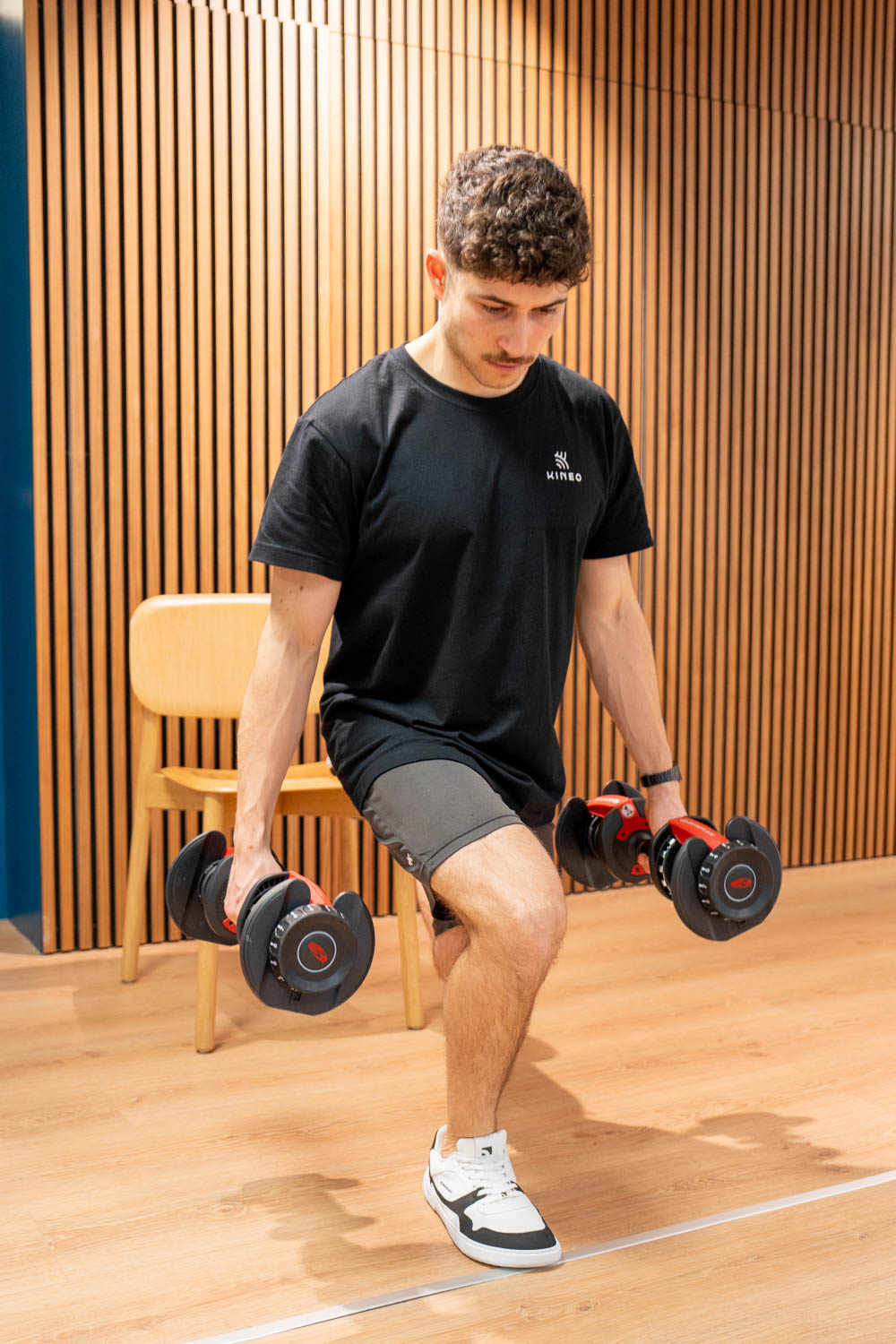
BULGARIAN SPLIT SQUATS
This exercise improves:
- leg alignment control,
- stability
- and strength.
Recommendation:
- 3 sets of 8–10 repetitions per side.
SINGLE-LEG SQUATS
This exercise strengthens:
- the stabilising muscles,
- coordination
- and balance.
Recommendation:
- 3 sets of 8 repetitions per leg.
FOR CORE STABILITY
A stable core improves:
- force transfer,
- jump control
- and shoulder stability.
SIDE PLANK WITH ROTATION
This exercise trains:
- the lateral trunk muscles,
- rotation control
- and stability.
Recommendation:
- 3 sets of 10 repetitions per side.
ANTI-ROTATION EXERCISES WITH A BAND
These exercises improve:
- body tension,
- stability
- and control against rotational forces.
Recommendation:
- 2–3 sets of 10 repetitions.
SHOULDER TRAINING FOR VOLLEYBALL PLAYERS
Healthy shoulders are essential for:
- spikes,
- serves
- and blocking movements.
Y-T-W EXERCISES
These exercises strengthen:
- the shoulder blade muscles,
- the rotator cuff
- and posture.
Recommendation:
- 2 sets of 10 repetitions per position.
EXTERNAL ROTATION WITH A THERABAND
This exercise specifically trains the often neglected:
- external rotators of the shoulder.
Recommendation:
- 3 sets of 12–15 repetitions.
JUMP TRAINING AND LANDING TECHNIQUE
The landing often decides whether your knee or ankle stays stable.
Important:
- bend your knees slightly,
- don't let your knees fall inwards,
- land softly,
- distribute your weight evenly.
BOX JUMPS WITH CONTROLLED LANDING
This exercise improves:
- explosiveness,
- landing control
- and stability.
Recommendation:
- 3 sets of 8 repetitions.
SINGLE-LEG STABILISATION JUMPS
These train:
- balance,
- ankle control
- and coordination.
BLOCK-JUMP COMBINATIONS
Ideal for simulating the loads specific to volleyball.
RECOVERY AND SELF-CARE
Recovery is often underestimated, but it is crucial for:
- performance,
- healing
- and injury prevention.
ACTIVE RECOVERY
Light:
- jogging,
- cycling
- or mobility training
promotes recovery.
FOAM ROLLING
Particularly useful for:
- legs,
- hips,
- back
- and shoulders.
EATING AND DRINKING ENOUGH
Important:
- enough fluids,
- protein,
- carbohydrates
- and enough sleep.
LISTEN TO YOUR BODY
Not every pain is "normal".
Taking early warning signs seriously helps you avoid bigger injuries.
HOW KINEO PHYSIOTHERAPY CAN SUPPORT YOU
At KINEO, we offer volleyball-specific prevention and rehabilitation programmes.
SCREENING AND RISK ANALYSIS
We analyse:
- movement quality,
- jumping technique,
- shoulder function,
- stability
- and movement patterns.
This lets us identify early:
- imbalances,
- risk factors
- and incorrect loading.
SPORT-SPECIFIC TRAINING
We develop individual programmes for:
- strength,
- stability,
- shoulder control,
- jumping technique
- and load management.
TECHNIQUE OPTIMISATION
We help you to:
- jump more efficiently,
- land more cleanly
- and optimise your shoulder movement.
TEAM WORKSHOPS AND PREVENTION PROGRAMMES
For teams, we offer:
- warm-up concepts,
- prevention programmes,
- workshops
- and coach training.
These can be integrated directly into everyday training.
OUR GOAL: STAYING HEALTHY AND HIGH-PERFORMING IN THE LONG TERM
Volleyball demands a lot of your body.
With:
- targeted athletic training,
- good technique,
- sufficient recovery
- and individual support
you can:
- avoid injuries,
- improve your performance
- and stay resilient in the long term.
The KINEO team supports you individually, evidence-based and sport-specifically.
FAQ: Injury prevention in volleyball
1. Which injuries are most common in volleyball?
Most often affected are:
- ankles,
- knees
- and shoulders.
2. Why is landing technique so important?
Poor landing control clearly increases the risk of:
- cruciate ligament injuries,
- sprained ankles
- and overload.
3. Does strength training help against injuries?
Yes. Functional strength training improves:
- stability,
- resilience
- and movement quality.
4. What can I do about shoulder problems in volleyball?
Targeted shoulder training, rotator cuff exercises and good technique help to reduce overload.
5. Is prevention also worthwhile for recreational players?
Absolutely. Recreational players in particular benefit from better stability, control and load management.