Injury prevention in equestrian sport: the basics
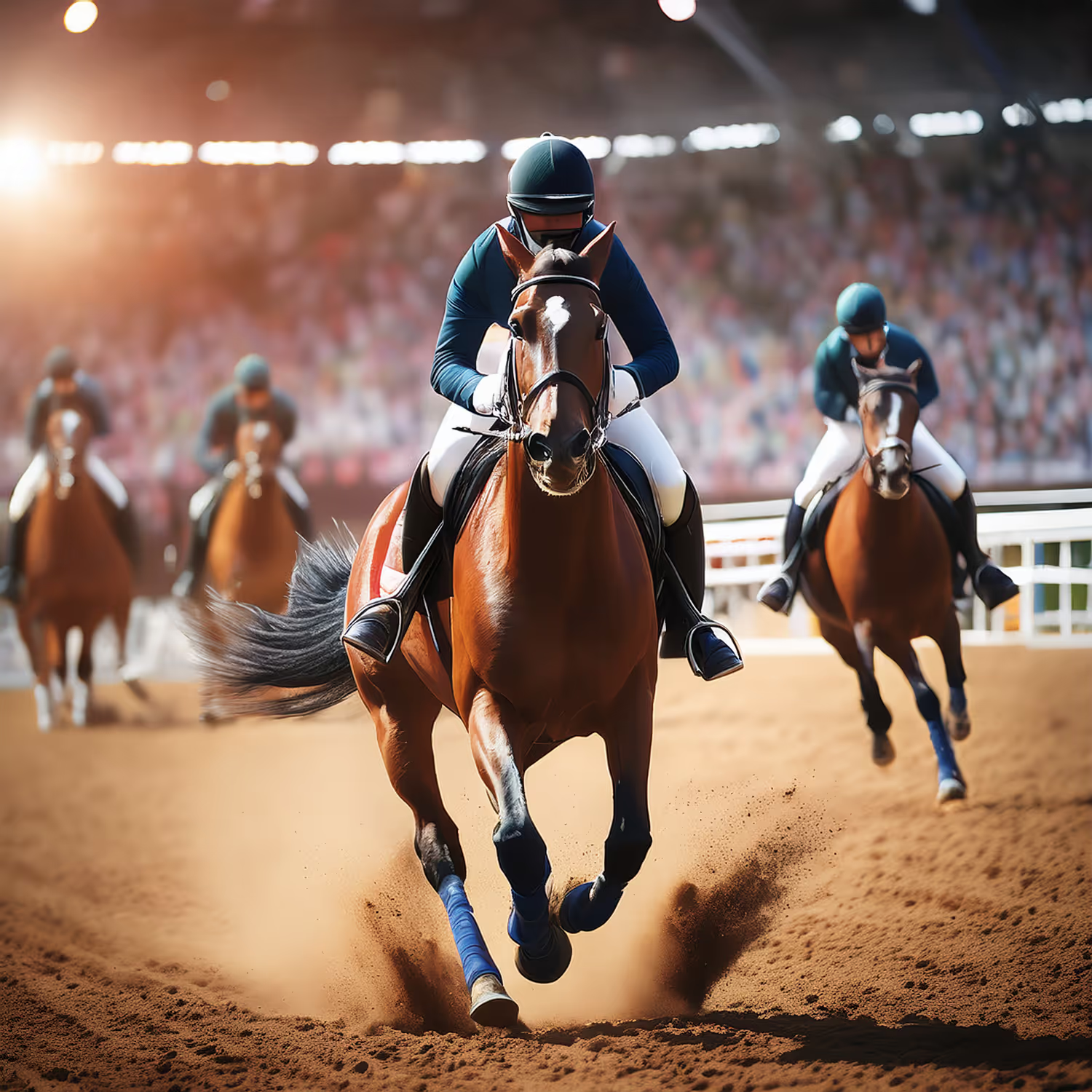
Competitive riding demands far more than talent and technique. Whether it is dressage, show jumping or eventing, riders have to meet the highest demands in:
- body tension,
- balance,
- mobility,
- strength,
- endurance
- and precision.
Only when rider and horse work together as a harmonious unit do fluid, controlled and powerful movements emerge.
The areas under constant load are mainly:
- the trunk,
- hips,
- shoulders,
- lower back
- and legs.
Many riders therefore struggle with:
- back pain,
- muscle tension,
- hip problems,
- instability,
- or overuse complaints.
Targeted functional training helps you to:
- improve your posture in the saddle,
- control your movements better,
- prevent injuries
- and raise your athletic performance in the long term.
At KINEO we support equestrian athletes with sport-specific physiotherapy, functional athletic training and individual prevention plans.

WHY INJURY PREVENTION MATTERS SO MUCH IN EQUESTRIAN SPORT
From the outside, riding often looks elegant and controlled. In reality, it puts enormous strain on the body.
The most demanding areas are:
- the deep trunk muscles,
- hip stability,
- the spine,
- the adductors,
- and the shoulder and neck region.
At the same time, movements have to be:
- finely dosed,
- controlled,
- symmetrical
- and precise.
Even small muscular imbalances or restrictions in movement can:
- worsen the quality of your seat,
- affect communication with the horse,
- cause pain
- or lead to overload in the long term.
Targeted prevention training improves:
- stability,
- mobility,
- balance,
- body control
- and load tolerance.
WHAT CAN YOU DO YOURSELF?
1. FUNCTIONAL STRENGTH TRAINING FOR RIDERS
DYNAMIC PLANK WITH WEIGHT
A stable core is the basis for a calm, controlled seat in the saddle.
This exercise improves:
- trunk stability,
- shoulder control,
- and body tension.
Recommendation:
- 3 sets of 10 repetitions per side.
SIDE PLANK WITH ROTATION AND WEIGHT
This exercise strengthens:
- the lateral trunk muscles,
- rotation control,
- and stability during dynamic movements.
In riding, controlled rotational movements are crucial.
Recommendation:
- 3 sets of 8 repetitions per side.
BULGARIAN SPLIT SQUATS WITH ROTATION
This exercise improves:
- single-leg stability,
- hip control,
- and balance.
It also trains the coordinative control of the leg axis.
Recommendation:
- 3 sets of 10 repetitions per leg.
PISTOL SQUATS ON A BALANCE PAD
A demanding exercise to improve:
- balance,
- leg strength,
- stability
- and control.
Particularly helpful for:
- coordination skills,
- and stable movements in the saddle.
Recommendation:
- 3 sets of 6 repetitions per leg.
SINGLE-ARM BENCH PRESS WITH ROTATION
This exercise strengthens:
- the chest muscles,
- shoulder stability,
- and rotation control.
Good upper-body stability improves:
- posture,
- rein control
- and movement precision.
Recommendation:
- 3 sets of 8 repetitions per side.
SINGLE-ARM ROW WITH RESISTANCE BAND
Strong back muscles support:
- an upright posture,
- stable shoulders
- and a better distribution of load.
Recommendation:
- 3 sets of 12 repetitions per side.
2. SPORT-SPECIFIC TRAINING FOR RIDERS
BALANCE EXERCISES ON THE GYM BALL
Balance and body tension are essential for a calm seat.
This exercise improves:
- balance,
- coordination,
- and stability.
Recommendation:
- 3 sets of 1 minute.
SINGLE-LEG STABILITY EXERCISES
These exercises promote:
- coordination,
- hip control,
- and balance.
Quick reactions and stability in particular benefit from them.
Recommendation:
- 3 sets of 30 seconds per leg.
ADDUCTOR AND SEAT MUSCLE TRAINING
Control in the saddle does not come from strength alone, but from precise muscle coordination.
This exercise improves:
- seat stability,
- adductor control,
- and fine movement control.
Recommendation:
- 3 sets of 30 seconds.

STEPPING MOVEMENT WITH RESISTANCE BAND
This exercise strengthens:
- hip control,
- the gluteal muscles,
- and leg-axis stability.
Particularly important for:
- precise giving of aids,
- and stable movements in the saddle.
Recommendation:
- 3 sets of 10 repetitions per leg.
3. FLEXIBILITY AND MOBILITY
Good flexibility improves:
- the quality of your seat,
- freedom of movement,
- and body awareness.
DYNAMIC HIP OPENERS
A mobile hip allows:
- a more relaxed seat,
- better adaptation to movement,
- and finer communication with the horse.
Recommendation:
- 3 sets of 8 repetitions per side.

SIDE SPINAL STRETCH
This exercise improves:
- spinal mobility,
- trunk rotation,
- and postural control.
Recommendation:
- 3 sets of 10 repetitions per side.
4. REGENERATION AND RECOVERY
Recovery is an important part of performance.
FOAM ROLLING FOR THE ADDUCTORS AND LOWER BACK
Foam rolling helps to:
- reduce muscle tension,
- promote blood circulation,
- and support recovery.
STRETCHING THE SHOULDER AND NECK MUSCLES
Tension in the shoulder and neck area is very common in equestrian sport.
Targeted mobilisation improves:
- posture,
- mobility,
- and wellbeing.
MASSAGE AND RELAXATION TECHNIQUES
Targeted recovery helps you to:
- prevent overload,
- reduce stress,
- and stay at your best in the long term.
HOW KINEO PHYSIOTHERAPY CAN SUPPORT YOU
At KINEO we offer specialised care for equestrian athletes.
MOVEMENT ANALYSIS FOR RIDERS
We analyse:
- posture,
- movement patterns,
- stability,
- and muscular imbalances.
This lets us identify:
- weak points,
- incorrect loading,
- and possible causes of your complaints.
INDIVIDUAL TRAINING PLAN
Based on your analysis, we develop:
- tailor-made strength training,
- mobility programmes,
- stability exercises
- and prevention strategies.
In doing so, we take into account:
- your discipline,
- your training level,
- your complaints
- and your personal goals.
MANUAL THERAPY AND RECOVERY
We treat:
- muscle tension,
- restrictions in movement,
- back complaints,
- shoulder problems
- and hip imbalances.
For this we use, among other things:
- manual therapy,
- trigger point treatment,
- fascial techniques,
- dry needling
- and active rehabilitation.

LONG-TERM PREVENTION
Our goal is not just short-term relief of symptoms.
We want to:
- improve your load tolerance,
- optimise your quality of movement,
- and prevent injuries in the long term.
Because:
A stable, mobile and resilient body improves not just your health, but also your performance in the saddle.
A STRONG BASE FOR MORE CONTROL AND PERFORMANCE
Riding demands:
- precision,
- stability,
- mobility,
- endurance
- and fine body control.
With targeted functional training you can:
- prevent complaints,
- improve your posture,
- ride more safely
- and raise your performance.
We support you individually, with an evidence-based and sport-specific approach.
FAQ: Injury prevention in equestrian sport
1. Which complaints are particularly common in equestrian sport?
Common ones are back pain, tension in the shoulder and neck area, hip problems and overuse of the adductors and trunk.
2. Why is trunk stability so important in riding?
A stable core improves seat control, balance and the transfer of movement to the horse.
3. Does strength training really help riders?
Yes. Targeted strength training improves stability, posture, load tolerance and precision in the saddle.
4. Why is flexibility so important in equestrian sport?
Good flexibility allows finer movements, a more relaxed seat and better adaptation to the horse's movements.
5. Can physiotherapy improve my performance in riding?
Yes. Movement analysis, individual training and targeted therapy can optimise technique, load tolerance and body control.